
For a thousand years, the oasis city of Dunhuang was one of the most important stopping points on the Silk Road. Merchants, diplomats, monks, and pilgrims from China, Central Asia, India, and the Mediterranean crossed paths here before and after the vast deserts to the west. They left behind an extraordinary legacy: 492 cave temples carved into a cliff face, containing 45,000 square metres of murals and more than 2,000 painted clay sculptures spanning 1,000 years of Buddhist art.
Today, Dunhuang is also surrounded by one of China’s most dramatic desert landscapes: 250-metre singing sand dunes, a natural freshwater lake that has persisted in the desert for millennia, and uninterrupted views of the Gobi sky.
Table of contents
Open Table of contents
The Mogao Caves (莫高窟): The World’s Greatest Buddhist Art Site
What You’re Visiting
The Mogao Caves were carved into the Daquan River cliff face between the 4th and 14th centuries, creating a multi-storey honeycomb of cave temples. Each cave contains one or more Buddhist sculptures in niches or on plinths, surrounded floor-to-ceiling and across the vaulted ceiling with painted murals.
The subject matter ranges from Buddhist cosmology and Jataka tales (stories of the Buddha’s previous lives) to donor portraits of Silk Road merchants and officials, scenes of daily life, and architectural perspectives of Tang Dynasty buildings. The murals represent the finest Buddhist art from the Wei, Tang, Song, and Yuan dynasties — an artistic heritage found nowhere else in such concentration.
In 1900, a wandering Daoist monk discovered a sealed cave (Cave 17) containing 50,000 manuscripts, silks, and paintings — the famous Dunhuang Manuscripts, which transformed scholars’ understanding of medieval Chinese, Tibetan, Sogdian, Sanskrit, and other languages and texts. Most of the manuscripts were acquired by European expeditions in the early 20th century and now reside in the British Museum, Bibliothèque nationale de France, and other international collections.
Visiting the Caves: The Process
Step 1: Book tickets in advance. The Mogao Caves have a daily visitor cap and online booking is mandatory. Book at mogaoku.net or through major travel platforms.
Step 2: Start at the Digital Exhibition Hall. All visitors begin at the digital centre 8 km from the actual caves. Here you:
- Watch a 20-minute panoramic film about the history of the caves
- Watch a 30-minute high-resolution film showing reconstructed cave interiors
This preparation significantly enhances the actual cave visit.
Step 3: Bus to the cave site. Shuttle buses depart from the digital centre to the cave complex.
Step 4: Guided cave tour. All visits are conducted with a mandatory guide. Standard tickets include 8 caves (selected to provide a representative chronological and thematic overview). Premium tickets (additional cost) include access to 2–4 extra caves including some not open to standard visitors.
Note on photography: Photography inside the caves is prohibited — the flash damages the fragile pigments. The exterior cliff face and valley setting are excellent photo subjects.
Tickets
- Standard ticket (8 caves + digital films + shuttle): ¥238
- VIP/Premium ticket (10+ caves, including special caves): ¥330–430
- Off-season discount: Available December–March
Book via mogaoku.net. During peak season (June–October), tickets sell out 3–10 days in advance.
What to Prioritise
Within the caves you’ll see, look specifically for:
Cave 16 & 17 (the Library Cave): Where the Dunhuang Manuscripts were discovered and sealed c. 1000 AD. Cave 17 is tiny but historically enormous.
Cave 96: The 9-storey pagoda structure houses a 35.5-metre tall Tang Dynasty Buddha — the third largest Buddha sculpture in the world.
Cave 17, Tang era caves: The combination of turquoise, vermillion, and ultramarine pigments in Tang Dynasty murals (7th–10th centuries) is at its most vibrant. The colours have barely faded in 1,300 years due to the desert’s extreme dryness.
Cave 285 (Northern Wei, 538 AD): One of the earliest dateable caves, with Western Zhou period Chinese mythological figures alongside Indian Buddhist imagery — showing Silk Road cultural synthesis at its most visible.
Cave 156 (Late Tang): Famous “Battle Murals” depicting actual military campaigns — one of the few examples of secular historical narrative in Mogao Cave art.
With 355 likes, the top-rated Chinese travel note says: “Mogao Caves — a comprehensive guide to everything. The most important thing: book tickets at least 3 days in advance even outside peak season. The caves with limited-access tickets (VIP caves) are extraordinary — if your budget allows, the premium ticket is worth it.”
Crescent Moon Lake (月牙泉) & Singing Sand Dunes (鸣沙山)
The Natural Wonder
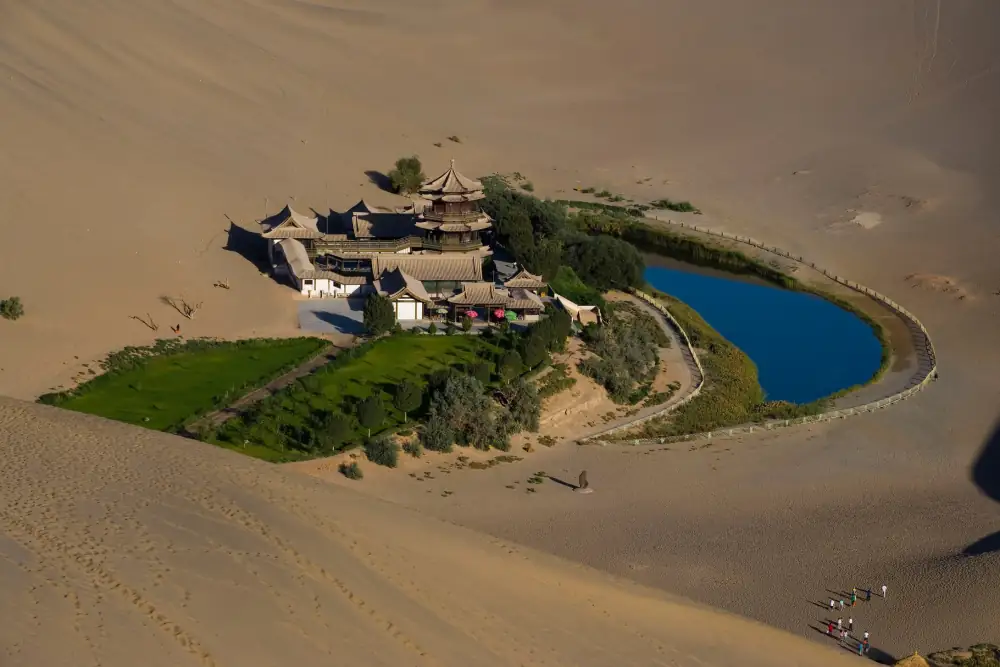
In the desert 6 km south of Dunhuang city, the Mingsha (Singing Sand) Dunes rise to 250 metres. At their base, sheltered by the crescent-shaped depression between dunes, sits a freshwater lake that has existed here for at least 2,000 years — fed by underground springs that persist despite the surrounding desert.
The lake’s persistence through millennia of desert conditions is considered miraculous. In Chinese culture, it is called a sacred spring.
Experiencing the Dunes
Sunrise: The most dramatic time. Arrive at the park entrance at 5:30 AM. The dunes glow gold and rose before the sun is fully up. The silence and the play of light on the sand ridges is extraordinary.
Sunset (more popular): The park is busiest from 4 PM onward. Sunset at around 7:30–8:30 PM (summer) over the dune crests creates iconic imagery.
Camel rides (骆驼骑行): The classic Dunhuang experience. Camel trains carry visitors to viewpoints across the dunes. Cost: ¥100 per person for the standard 45-minute circuit. Negotiate before mounting. The camels walk single-file along designated paths — not off-road desert riding, but the combination of camel, dunes, and Crescent Moon Lake is photogenic and memorable.
Sandboarding (滑沙): Renting a sled and sliding down the 250-metre dune face is undeniably fun. Cost: ¥30–50. Energy required: significant — climbing 250m of loose sand is one of the most exhausting activities available at Dunhuang.
Entrance ticket: ¥110. Open from dawn to past sunset during peak season.
The Crescent Moon Lake itself: A boat ride is available (¥20) but the most beautiful view is from the surrounding dune crests — looking down at the crescent-shaped oasis with its traditional pavilions reflected in the water, surrounded on all sides by desert.
Other Dunhuang Attractions
Western Thousand Buddha Caves (西千佛洞)
35 km west of Dunhuang, carved into a similar cliff face as Mogao but much less visited. 22 caves, most from the Tang Dynasty. ¥30 entry, no advance booking required. For visitors who want a more intimate cave experience without the crowds and tour groups of Mogao.
Yumen Pass (玉门关) & Han Dynasty Great Wall
75 km west of Dunhuang, the ruins of the Han Dynasty gate (120 BC) that marked the western boundary of China and the beginning of the Silk Road desert crossing. Little remains (two adobe forts and some wall sections) but the historical resonance and the vast desert landscape are extraordinary.
Dunhuang Silk Road Ruins Area ticket: ¥80 (includes Yumen Pass, Hecang Fort ruins, Han Dynasty wall section, and a Han-era agricultural ruin). Getting there requires a car (taxi: ¥150–200 round trip; tour: ¥100–150/person).
Dunhuang Night Market (沙洲夜市)
The most vibrant evening option in Dunhuang city. Dozens of stalls serve:
- Hand-pulled noodles (拉条子): Dunhuang’s signature noodle dish with spiced lamb sauce
- Roasted whole lamb (烤全羊): Best ordered for a group in advance
- Xinjiang-style skewers (新疆烧烤): Lamb, chicken, mushrooms on charcoal
- Dried fruit and nuts: Hami melon, raisins, walnuts from nearby Xinjiang
- Fresh-squeezed Hami melon juice: Perfect for desert heat
Getting to Dunhuang
By air: Dunhuang Mogao International Airport (DNH):
- From Lanzhou: 1.5 hours
- From Xi’an: 2 hours
- From Beijing: 3 hours (some direct, some via Lanzhou)
- From Urumqi: 1.5 hours
By high-speed train: Dunhuang is connected to the Lanzhou-Xinjiang high-speed rail at Liuyuan station, 130 km north of the city. Shuttle buses connect Liuyuan station to Dunhuang city (2 hours, ¥30).
- From Lanzhou to Liuyuan: 2 hours
- From Xi’an to Liuyuan: 5 hours
By overnight train: Several overnight trains connect Dunhuang directly. The sleeper train from Lanzhou takes 8 hours and is comfortable.
When to Visit
Best: May, September, October. Temperatures comfortable (18–28°C), clear skies, ideal for desert activities.
Summer (July–August): Peak season. Very hot (40°C+). All activities best done before 9 AM and after 5 PM.
Avoid: December–February. Bitterly cold and the Singing Sand Dunes activities are minimal.
How Long to Stay
- 2 days (minimum): Mogao Caves (full day with digital centre) + Crescent Moon Lake/Singing Dunes
- 3 days (recommended): Above + Western Thousand Buddha Caves + Yumen Pass/Han Wall
- 4 days (silk road complete): Add Yangguan Pass (阳关), another Han Dynasty gate 75 km southwest
Dunhuang sits at the intersection of Chinese civilisation, Central Asian trade, Indian Buddhism, and the vast void of the Gobi Desert. The Mogao Caves contain something irreplaceable: 1,000 years of humanity’s spiritual yearning, preserved in an unlikely desert cliff, surviving the centuries in extraordinary condition. Treat the visit as a pilgrimage, because that’s what it has always been.