
The Forbidden City is, by almost any measure, the most impressive historic building in Asia. 9,999 rooms across a 72-hectare walled compound; the home of 24 emperors spanning the Ming and Qing dynasties from 1420 to 1912; today the world’s most visited museum with over 17 million annual visitors.
First-time visitors often walk the main north-south axis and feel they’ve “done it.” They’ve experienced perhaps 20% of what the Forbidden City contains. This guide is designed to help you explore far more.
Table of contents
Open Table of contents
Before You Go: Booking Tickets (Essential)
The Forbidden City sells strictly limited tickets online only — no tickets are available at the gate. This is non-negotiable.
How to book:
- Visit dpm.org.cn (the official Palace Museum website) or use the WeChat/Alipay mini-programs
- Register with your passport number
- Select your visit date — book at least 2–3 weeks in advance during peak season (April–October)
- Pay online: ¥60 per adult (peak season), ¥40 (off-season November–March). Free for visitors under 18 and over 65.
- Show the QR code at the Meridian Gate entrance — no printing required
Daily capacity: 40,000 visitors. On popular days in high season, tickets sell out days ahead.
Tip: Weekday tickets are significantly easier to obtain and the visit is less crowded. If you have flexibility, avoid weekends.
Getting There
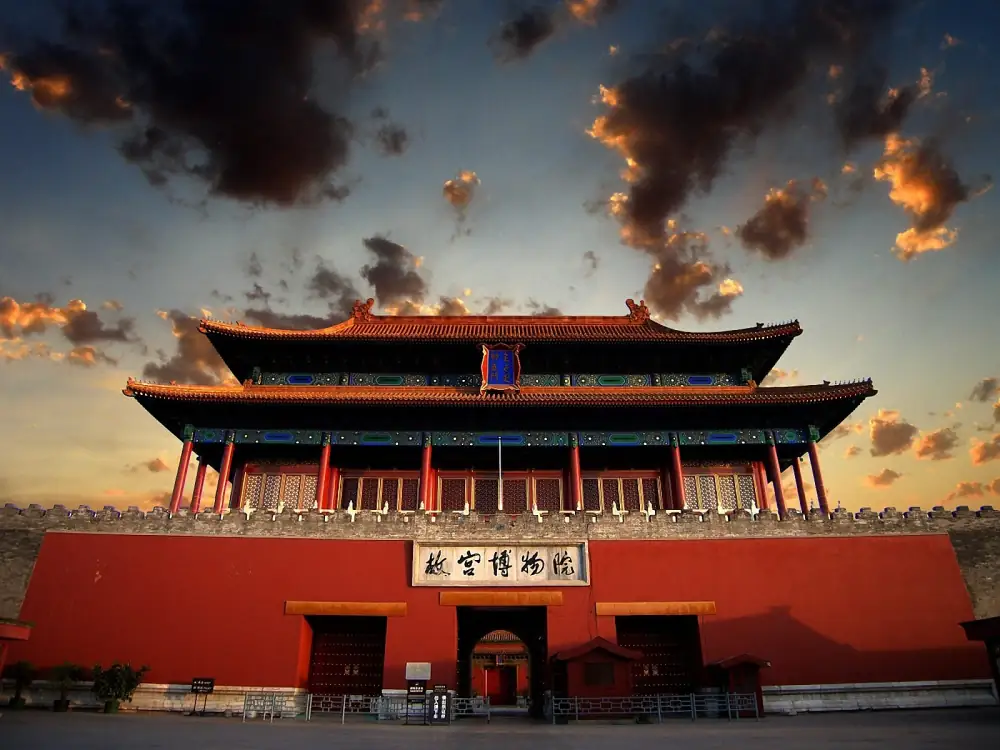
Metro: Take Line 1 to Tiananmen East or Tiananmen West stations. The main entrance (Meridian Gate / 午门) faces south onto Tiananmen Square — exit the metro and walk north.
Note: The Forbidden City opens at 8:30 AM. Arrive by 8:15 AM to queue at the ticket scanning gate and enter early.
Layout: Understanding What You’re Seeing
The Forbidden City is organised along a strict north-south central axis. The southern section (called the Outer Court) was for state business; the northern section (the Inner Court) was the imperial family’s private quarters.
Most visitors spend all their time on the central axis. The left (east) and right (west) wings contain some of the most extraordinary collections and far fewer people.
[North: Shenwu Gate Exit]
         ↑
[Imperial Garden]
         ↑
[Inner Court: Palace of Heavenly Purity + residential halls]
         ↑
[Gate of Heavenly Purity]
         ↑
[Hall of Preserving Harmony]
[Hall of Central Harmony]     ← OUTER COURT
[Hall of Supreme Harmony (太和殿)]
         ↑
[Gate of Supreme Harmony]
         ↑
[Meridian Gate (午门) ENTRANCE]
         ↑
[Tiananmen Square]
The Main Route: Central Axis
Allow 2–3 hours for the central axis alone.
The Three Great Halls (三大殿)
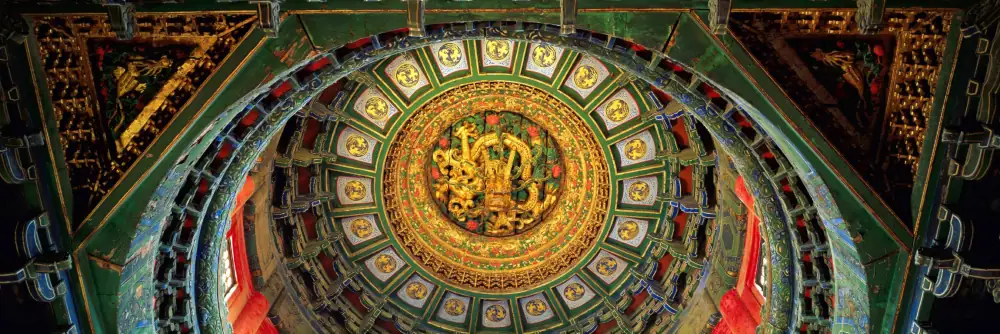
The Hall of Supreme Harmony (太和殿) is the largest and most important building — the throne hall where emperors held their most important ceremonies. The gilded throne, the enormous interior space, and the dragon-adorned ceiling create an overwhelming impression of imperial power.
The Hall of Central Harmony (中和殿) was where emperors rested and prepared before major ceremonies.
The Hall of Preserving Harmony (保和殿) hosted imperial banquets and, in the Qing Dynasty, the final stage of the imperial examination that determined government appointments.
The Gate of Heavenly Purity (乾清门)
This gate marks the transition from the public Outer Court to the private Inner Court. Note the enormous bronze lions flanking the gate — these were the symbolic guardians of the emperor’s private domain.
Palace of Heavenly Purity (乾清宫)
The primary bedroom palace of the Ming emperors, and in the Qing Dynasty, the main audience hall. The inscription above the throne — 正大光明 (Upright and Honorable) — concealed the imperial succession document during the Qing Dynasty: the name of the next emperor was written and sealed behind this plaque, preventing the power struggles that plagued the Ming succession.
Imperial Garden (御花园)
The Forbidden City’s surprisingly intimate garden occupies the northern section. Ancient cypress trees over 500 years old, ornamental rocks, pavilions, and seasonal flowers create a peaceful contrast to the vast ceremonial spaces. Visit early morning when it is quietest.
Hidden Gems: What Most Visitors Miss
Treasure Gallery (珍宝馆) — East of the Central Axis
Requires a separate ¥10 ticket purchased on-site. Contains the imperial family’s personal treasures: extraordinary jade carvings, gold and silver objects, cloisonné, and ceremonial regalia.
Do not skip this. The collection here — including a jade cabbage the size of an actual cabbage, a jade mountain carved with a panoramic landscape, and the emperor’s personal golden vessels — is extraordinary. Far fewer visitors pay the extra fee, so it is also significantly less crowded.
Clock Museum (钟表馆) — West of the Central Axis
Another separate ¥10 ticket. A remarkable collection of antique clocks and automata given as tribute gifts to the Qing emperors — predominantly from 18th-century Europe. Some pieces are extraordinarily intricate: a clock with a miniature waterfall, another with tiny performing musicians, a third that writes Chinese characters with a mechanical brush.
The collection was assembled over 200 years and represents the finest European and Chinese clockmaking of the era. A genuine highlight that most visitors entirely miss.
Western Six Palaces (西六宫)
The residential quarters of the imperial concubines, on the western side of the inner court. These palaces are beautifully preserved with original furniture, decorations, and room arrangements. Far fewer tourists explore here. The Palace of Eternal Spring (长春宫) contains detailed murals depicting scenes from the classic novel Dream of the Red Chamber.
Eastern Six Palaces (东六宫)
The Palace of Concentrated Beauty (储秀宫) was where Empress Dowager Cixi lived for much of her time in the Forbidden City — her personal quarters, bedroom, and sitting rooms are remarkably preserved with her actual furnishings.
The Meridian Gate’s Upper Level
During the imperial era, the emperor watched military ceremonies from the upper galleries of the Meridian Gate. Today, the upper level hosts temporary exhibitions (separate ticket, ¥20–30). The view down into the enormous outer courtyard and the procession of halls stretching north is exceptional — a perspective most visitors never see.
Recommended Routes by Time Available
2 Hours (Rush)
Central axis only: Meridian Gate → Three Great Halls → Gate of Heavenly Purity → Palace of Heavenly Purity → Imperial Garden → Exit via Shenwumen (North Gate)
4 Hours (Standard)
As above, plus: Clock Museum or Treasure Gallery (choose one), Western or Eastern Six Palaces
Full Day
Complete exploration: all halls on the central axis, both wing museums, all six palaces in both wings, Imperial Garden, and the temporary exhibition at the Meridian Gate upper level. Exit mid-afternoon and cross to Jingshan Park for the aerial view of the whole complex.
Practical Tips
Arrive Early
The Forbidden City opens at 8:30 AM. The main axis from the Gate of Supreme Harmony becomes extremely crowded after 10 AM. Arriving at 8:15–8:30 AM gives you 90 minutes of a significantly less crowded experience.
Exit Strategy
Most visitors funnel through the North Gate (Shenwumen) — the main exit after walking the central axis. This creates a bottleneck. If you are visiting the east or west wings, exit through the East Glorious Gate (东华门) or West Glorious Gate (西华门) instead.
Audio Guide
The official audio guide costs ¥40 deposit + ¥30 rental. The free Palace Museum app is excellent, with AR features that show historical paintings of halls in their original states. Highly recommended.
Prohibited Items
Large bags and luggage must be checked at the entrance. Selfie sticks are not permitted in many hall interiors.
Restaurants Inside
There are several cafeterias and one sit-down restaurant (the Forbidden City’s own brand “故宫餐厅”) inside the complex. Quality is decent but prices are elevated. A packed lunch from a nearby convenience store before entering is the more economical option.
After the Forbidden City
Jingshan Park (景山公园) — ¥2
Directly north of the Forbidden City, Jingshan Park’s central hill offers the best possible view of the entire palace complex. From the main pavilion at the hilltop, the Forbidden City spreads south in perfect symmetry — the central axis aligned precisely from the pavilion to the horizon. Go at golden hour if possible.
Tiananmen Square
The enormous public square immediately south of the Forbidden City. Free entry but requires scanning your ID/passport. The National Museum of China on the east side is excellent and free (requires advance appointment).
Beihai Park (北海公园) — ¥10
A short walk west, this former imperial garden built in 1179 AD features a large lake, the White Pagoda on the central island, and several historic temples. A peaceful contrast to the formality of the Forbidden City.
The Forbidden City rewards preparation. Those who book tickets in advance, arrive early, and explore beyond the central axis discover a place of extraordinary depth and beauty. Those who don’t often leave feeling vaguely disappointed by the crowds. The difference is entirely in the planning.