
“Once you’ve climbed the Five Sacred Mountains, other mountains are unremarkable. But once you’ve climbed Huangshan, even the Five Sacred Mountains pale.” Deng Xiaoping’s famous assessment remains accurate. Mount Huangshan is not the highest mountain in China, nor the most challenging to climb. It is simply, by widespread consensus, the most beautiful.
The sea of clouds that fills the valleys between the granite peaks — most dramatic in the days following rain — has inspired Chinese painters, poets, and photographers for 1,400 years. The uniquely shaped pine trees growing horizontally from cliff faces, the bizarre rock formations, and the views from above the cloud line create a landscape found nowhere else on earth.
Table of contents
Open Table of contents
Why Overnight is Worth It
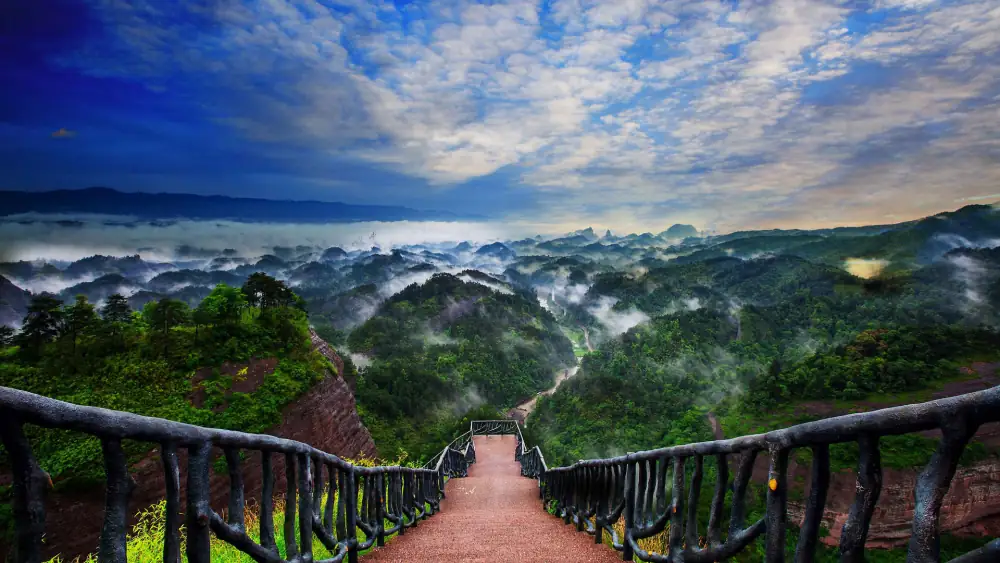
The single most consistent advice from experienced Huangshan visitors: stay overnight on the mountain.
Day-trippers see Mount Huangshan in afternoon sunlight, which is pleasant. Overnight guests see:
- Sunset: The granite peaks turn gold and pink as the sun descends
- Sea of clouds at dusk: Evening mist begins filling the valleys before sunset
- Stars: The mountain is high enough and far enough from city lights for extraordinary stargazing
- Sunrise: The most magical Huangshan experience — watching the sun emerge from the cloud sea, illuminating peak after peak
- Morning sea of clouds: The most dramatic cloud formations occur in the 2–3 hours after sunrise
With 1,516 likes, the most widely shared Huangshan travel note says: “Huangshan’s routes in one image. The mountain speaks to the sky in a language of rock and cloud — you need to stay overnight to hear the full conversation.”
Mountain hotels range from basic dorms (¥150–200/bed) to comfortable doubles (¥400–800/night). They fill weeks in advance during peak season. Book as early as possible.
Getting There
By High-Speed Train
Huangshan is extremely well-connected:
- From Hangzhou: 1.5 hours to Huangshan North (黄山北) station
- From Shanghai Hongqiao: 2.5 hours
- From Nanjing: 2 hours
- From Beijing: 4.5 hours (one change)
The station is called Huangshan North (黄山北). From there:
- Bus (Route 31): ¥18, takes 40 minutes to Tangkou (the mountain base town)
- Taxi: ¥80–100, takes 35 minutes
From Tangkou, cable car buses run to the three cable car base stations (¥10 per ride).
By Bus
Several long-distance buses connect Huangshan to Hangzhou (3 hrs), Nanjing (4 hrs), and Tunxi (the local city, 1 hr).
Ascending the Mountain: Options
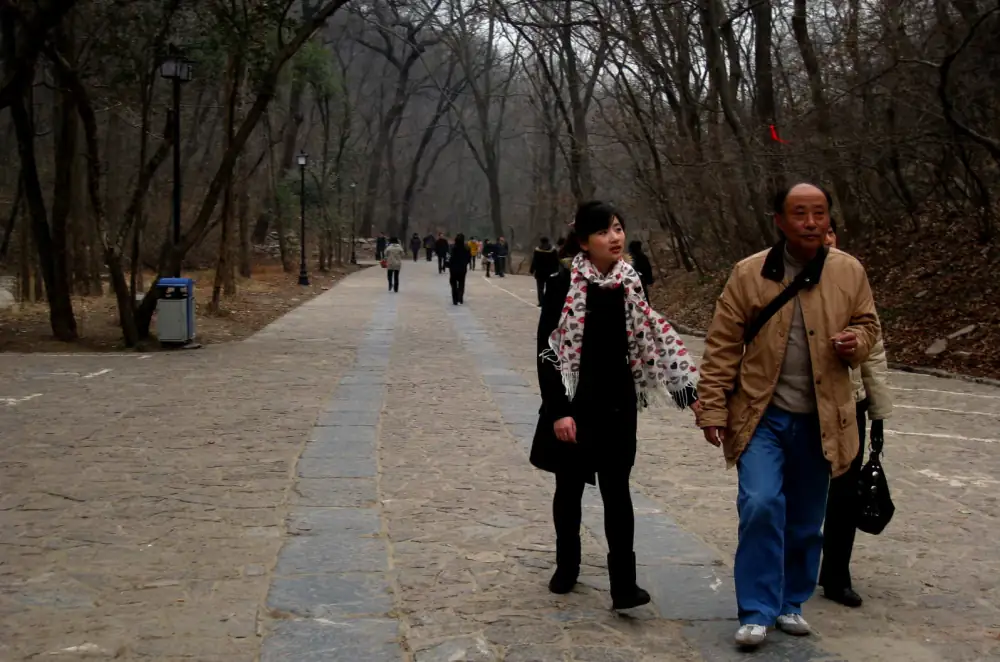
Cable Cars (Recommended for Most Visitors)
Three cable cars connect different parts of the mountain to the plateau above:
Yungu Cable Car (云谷索道): East side. Most scenic approach, takes you up past dramatic rock formations to White Goose Ridge. 8-minute ride, ¥90 one way.
Yuping Cable Car (玉屏索道): South side. Takes you to the area around the famous Greeting Pine and Jade Screen Pavilion. 8-minute ride, ¥80 one way.
Taiping Cable Car (太平索道): North side. Less scenic approach but access to the northern plateau and Beihai area. 20-minute ride, ¥85 one way.
Recommended combination: Ascend via Yungu (east), descend via Yuping (south) — gives you the most complete view of the mountain while minimising hiking time.
Hiking Up
For the fit and adventurous: the East Steps from Yungu base station to White Goose Ridge cover approximately 7,500 steps (5 km, 800m elevation gain). Allow 2.5–3.5 hours depending on fitness. The views throughout are excellent.
The West Steps (also called the Tiandu Peak route) are steeper and more dramatic but require significant fitness and should be undertaken only in dry conditions.
Combining: Many visitors take the cable car up and hike down — the descent takes 1.5–2 hours via the East or West Steps and is significantly less strenuous than the ascent.
Key Scenic Areas on the Mountain
Beihai Scenic Area (北海景区)
The “North Sea” — the plateau area most famous for sea-of-clouds views. The Beihai Hotel is the best base for sea-of-clouds photography.
Key viewpoints:
- Refreshing Terrace (清凉台): Classic sea-of-clouds and sunrise viewpoint
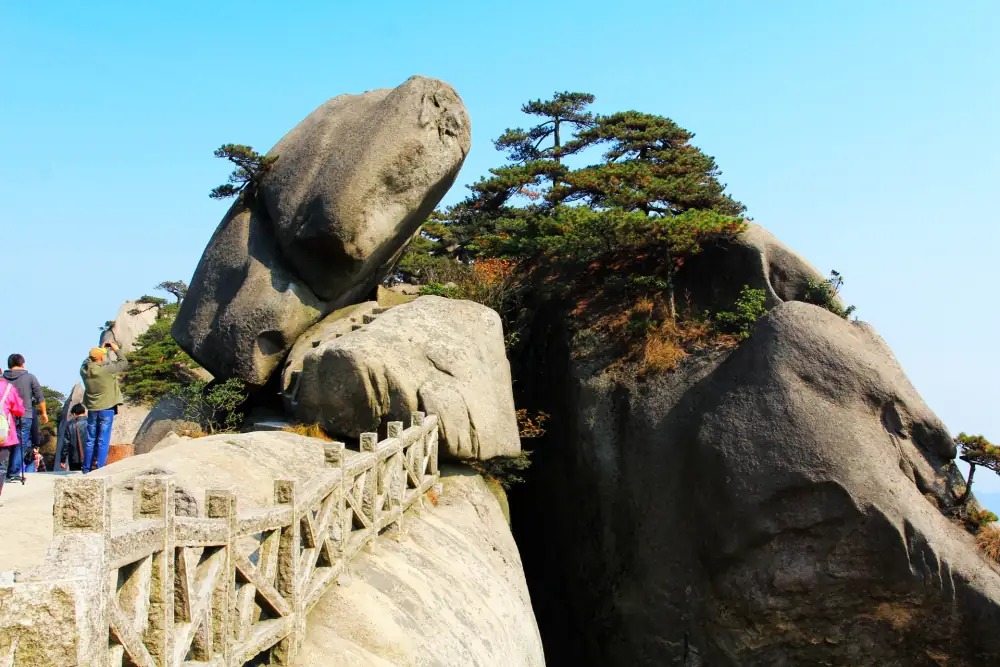
- Shi Lin Peak (狮子林): Lion-shaped rock formation in a sea of pines
- Dream Brush Peak (梦笔生花): A slim pillar with a pine growing from its top — the most poetic of Huangshan’s improbable pines
Yuping Scenic Area (玉屏景区)
The most famous section of the mountain, featuring:
The Greeting Pine (迎客松): The world’s most photographed tree, and arguably China’s most recognisable natural symbol. This 1,300+ year-old Huangshan pine grows horizontally from a cliff at 1,670m elevation, its spread branches appearing to welcome visitors. The tree appears on official Chinese government documents and countless artworks. It is genuinely as striking in person as in photographs.
Jade Screen Pavilion (玉屏楼): The historic resting point below the Greeting Pine, with sweeping views south toward Jiuhua Mountain and north toward the sea of clouds.
Sky Sea (天海): The dramatic area between the south and north sections, offering 360-degree views.
West Sea Grand Canyon (西海大峡谷)
A more recently opened section of Huangshan that descends into the dramatic canyon between the granite peaks. The canyon floor trail requires taking a spiral staircase (or elevator, ¥50) down 200m into the gorge.
The canyon’s lower section — narrow paths between vertical cliff walls, occasional cloud drifting through — is among Huangshan’s most dramatic environments. Allow 3–4 hours for the full canyon circuit.
Lotus Peak (莲花峰)
The highest point on Huangshan at 1,864m. A designated hiking route (open in alternating years to allow recovery) leads to the summit, where on clear days you can see the entirety of the Huangshan range stretching to the horizon.
The Sea of Clouds: When and Where
The sea of clouds (云海) is Huangshan’s most celebrated phenomenon. Understanding when and where it appears dramatically improves your chances of witnessing it.
Best conditions: The day after light rain. The valleys fill with cloud that hangs below the mountain peaks, creating the “ocean of clouds” effect.
Best viewpoints:
- North Sea (北海): The largest cloud sea, best seen from Refreshing Terrace at sunrise
- South Sea (南海): Visible from Tiandu Peak and Yuping areas
- West Sea (西海): The most dramatic views from the canyon rim
Timing: Sea of clouds typically forms overnight and is most dramatic in the 2 hours after sunrise. It often dissipates by 10–11 AM as temperatures rise.
The honest reality: You cannot guarantee seeing the sea of clouds. Many visitors go without seeing it; others see it multiple times in a single stay. If witnessing it is your primary goal, build flexibility into your itinerary.
Practical Tips
Tickets
- Entrance ticket: ¥190 (peak season), ¥150 (off-season)
- Peak season: March–November
- Off-season: December–February (significantly reduced crowds; cold but potentially snow)
Book tickets online at huangshan.com.cn or through travel platforms. The Yungu cable car has long queues — book a cable car time slot if the option is available.
What to Bring
The mountain weather changes rapidly. Even on a warm day in the valley below, temperatures at the summit plateau (1,600–1,800m) can be 10–15°C cooler.
Essential items:
- Warm jacket or fleece (even in summer for early morning)
- Rain jacket — cloud and light rain can appear suddenly
- Comfortable walking shoes with good grip — steps can be wet and slippery
- Camera battery packs — cold temperatures drain batteries faster than normal
- Cash — mountain restaurants and some facilities don’t accept mobile payments
Mountain Restaurants & Food
Food on the mountain is expensive (everything is carried up by porters) and quality is basic. Expect to pay ¥50–80 for simple noodle dishes.
Pack your own snacks for daytime hiking. The Tangkou town at the base has numerous excellent and affordable restaurants for dinner.
Best Time to Visit
Spring (March–May): Fresh greenery and occasional sea of clouds. Cherry blossoms in April on the lower slopes.
Autumn (October–November): Clear blue skies, temperature 8–18°C, dramatic sunrises. The peak photography season.
Winter (December–February): Snow on the peaks creates extraordinary ice-and-rock landscapes that very few people photograph. Extremely cold at night (-5 to -10°C at altitude). The most dramatic visual season for prepared visitors.
Huangshan asks patience of you. The sea of clouds comes when conditions align, not when scheduled. The granite peaks have been forming for 150 million years — they are in no hurry. Come for two nights minimum, go slowly, and let the mountain reveal itself on its own terms.