
Table of contents
Open Table of contents
Why Maoming Deserves Your Attention
Ask most Chinese travellers about Guangdong and they will name Guangzhou, Shenzhen, or maybe Foshan. Maoming (茂名) rarely comes up, and that is exactly its appeal. Sitting on Guangdong’s southwestern coast about 350 km from Guangzhou, this city of 6 million operates at a pace that feels closer to a county town than a major prefecture. The skyscraper density drops sharply. The streets are wider. People sit outside tea houses in plastic stools at 10 AM on a Tuesday, seemingly without a care in the world.
Maoming’s attractions are real but understated: 180 km of coastline with beaches that see a fraction of Sanya’s crowds, a dramatic mountain that plunges straight into the South China Sea, one of China’s oldest petroleum industries, and a seafood culture that makes the Pearl River Delta look overpriced. If you are road-tripping Guangdong or looking for a beach escape that does not involve fighting for towel space, Maoming is your answer.
Getting There
By High-Speed Rail
The Shenzhen–Zhanjiang high-speed railway connects Maoming to Guangzhou South Station in about 2.5 hours (¥180–220 second class) and Shenzhen North in about 3 hours (¥230–270). Trains run roughly every 30 minutes during peak times. Maoming Station is the main stop, about 8 km from the city centre.
By Bus
Long-distance buses run from Guangzhou (5–6 hours, ¥120–150) and Zhanjiang (2 hours, ¥60). The bus station is centrally located near the intersection of Guangming Road and Renmin Avenue.
By Car
The Guangzhou–Zhanjiang Expressway (G15 Shenhai) runs through Maoming. The drive from Guangzhou takes about 4 hours. From Zhanjiang, count on 1.5 hours. Car rental is available at Maoming Station and the downtown area (approximately ¥150–250/day for a compact car).
Guanyin Mountain: Where Rock Meets Sea
The Main Attraction
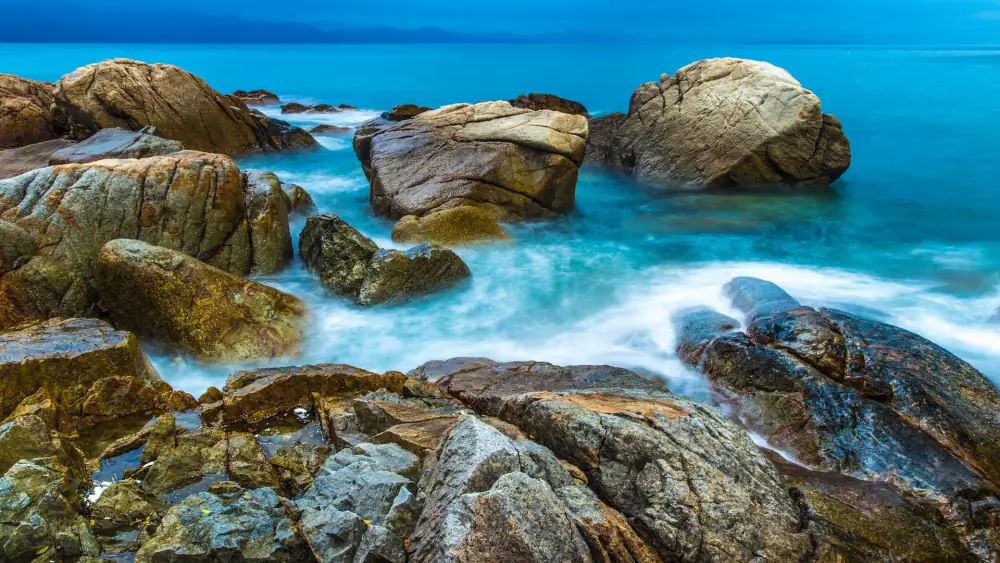
Guanyin Mountain (观音山) is Maoming’s single most impressive natural sight and worth the visit on its own. Located in the Dianbai District about 40 km southeast of the city centre, this granite massif rises abruptly from the coastal plain and drops in sheer cliffs into the churning waters of the South China Sea.
The mountain gets its name from a natural rock formation near the summit that resembles the Bodhisattva Guanyin gazing out to sea. Whether you see the resemblance depends on your imagination, but the geology is genuinely dramatic — massive boulders balanced on narrow pedestals, sea caves carved by millennia of waves, and headlands that jut into the ocean like ship prows.
Hiking Routes
Two main trails lead to the summit:
- Eastern Trail (2.5 km, 1.5–2 hours uphill): The more scenic route, passing through secondary forest, a small waterfall, and several viewpoints. Stone steps throughout; moderate difficulty.
- Western Trail (1.8 km, 1–1.5 hours uphill): Shorter and steeper. Less shade but better views of the sea cliffs. Best for sunrise hikes.
At the summit (elevation 648 m), you get a panoramic view stretching from the Dianbai coast to the Leizhou Peninsula on clear days. A small temple and refreshment stand mark the top. Entry to the scenic area costs ¥60.
Sea Cave Exploration
At the mountain’s base, a series of sea caves is accessible at low tide. The largest, called Dragon Palace Cave (龙宫洞), extends about 50 metres into the cliff. You will need a flashlight (phone torch works) and shoes with good grip — the rocks are slippery. Check tide tables at the entrance gate; the caves are dangerous at high tide. No additional fee beyond the mountain entry.
Maoming’s Beach Coast
China First Beach (Dianbai)
Despite the slightly awkward name, China First Beach (中国第一滩) is a genuinely nice stretch of sand about 25 km from downtown Maoming. The 5 km beach has fine golden sand, gentle surf, and enough space that it never feels truly crowded — even on summer weekends. Facilities include showers (¥10), umbrellas and chairs for rent (¥50–80/day), and jet ski rentals (¥150 for 15 minutes).
Entry to the beach is free. Parking costs ¥20. The best swimming months are May through October when water temperatures reach 25–28°C. Watch for the flag system — red flags mean dangerous rip currents.
Fangji Island
About 15 km offshore, Fangji Island (放鸡岛) is Maoming’s answer to a tropical island getaway. The 1.9 km² island features coral reefs, hiking trails through tropical vegetation, and a lighthouse with sweeping sea views. A high-speed catamaran runs from Dianbai Port (¥160 round trip, 25 minutes each way), and island entry costs ¥80.
Snorkelling gear rental is available on the island for ¥50/day. The coral is not world-class by any stretch — visibility averages 3–5 metres — but for a quick underwater fix in Guangdong, it beats the alternatives. The island has a small resort with rooms from ¥380–680/night if you want to stay overnight.
Romantic Coast (Langman Coast)
The Romantic Coast (浪漫海岸) in Bohe town, about 35 km from the city, is a privately developed resort area with a more upscale feel. The beach is well-maintained, and the complex includes beachfront restaurants, a spa, and wooden boardwalks. Entry is ¥50. It is popular with Chinese couples on weekend getaways — expect more photo shoots than surfboards.
Xiti Ancient Fishing Village
About 20 km from the city centre, Xiti Village (西堤古渔村) offers a glimpse of traditional Guangdong coastal life before the high-rises arrived. The village dates to the Song Dynasty, and its narrow stone lanes wind past ancestral halls, dried fish workshops, and weathered houses with oyster-shell walls — a traditional building technique unique to this part of the coast.
There is no entry fee and no formal tourist infrastructure, which is part of the charm. A few villagers sell dried shrimp, salted fish, and homemade fish sauce from their doorways. A bag of premium dried shrimp costs ¥40–60 and makes an excellent souvenir for anyone who cooks. Come in the late afternoon when fishing boats return and the harbour comes alive with sorting and trading.
Petroleum Heritage: The Oil City
Maoming’s modern identity is inseparable from oil. The city sits atop one of China’s largest oil shale deposits, and the Maoming Petrochemical Company has been the backbone of the local economy since the 1950s. While an oil refinery might not sound like a tourist attraction, the Maoming Petroleum Museum (茂名石油博物馆, open Tuesday–Sunday 9:00–17:00, free) does a surprisingly good job of telling the story.
Exhibits cover the history of oil shale mining in China, the technical processes of refining, and the social history of the workers who built Maoming from scratch. The most compelling section documents the 1950s and 60s, when thousands of engineers and labourers arrived in this remote coastal area to establish China’s independence from foreign oil. It is industrial heritage tourism at its most genuine.
Outside the museum, the towering distillation columns and flame stacks of the active refinery create an oddly compelling skyline, especially at dusk when the gas flares light up against the darkening sky.
The Seafood Scene
What to Eat
Maoming’s location between mountain and sea means an abundance of both freshwater and saltwater ingredients:
- Steamed grouper (清蒸石斑鱼): Fresh from the morning catch, steamed with ginger, spring onion, and soy sauce. ¥60–100 per jin at harbour restaurants.
- Oyster omelette (蚝烙): A Guangdong classic, made with local oysters that are among the plumpest in the province. ¥25–35.
- Salt-baked shrimp (盐焗虾): Whole prawns baked in coarse salt until the shells turn coral-red. ¥50–80 per jin.
- Fish ball soup (鱼丸汤): Bouncy, handmade fish balls in a clear broth with bok choy. ¥15–20 per bowl.
- Dianbai rice noodle roll (电白肠粉): Thinner and more delicate than the Guangzhou version, filled with shrimp or pork. ¥8–12.
- Sandworm porridge (沙虫粥): A local delicacy that sounds alarming but tastes surprisingly mild and nourishing. ¥20–30 per bowl.
Where to Eat
- Bohe Seafood Street (博贺海鲜街): A strip of open-air restaurants by the fishing harbour. You pick your seafood from tanks and they cook it to order. ¥80–150 per person for a feast.
- Dianbai Night Market: Along Haibin Road, operating from 6 PM onwards. Grilled oysters at ¥3 each, skewered squid at ¥2 per stick. Hard to spend more than ¥60.
- Maoming Restored Street (茂名老街): Several old-school Cantonese restaurants serving breakfast congee and rice noodle rolls from 6 AM. ¥15–25 for a hearty breakfast.
Where to Stay
- Maoming Grand Hotel (茂名大酒店): Central location, comfortable rooms, decent breakfast buffet. ¥220–380/night.
- Romantic Coast Resort (浪漫海岸度假村): Beachfront rooms with sea views. ¥400–700/night. Best if you want a resort experience.
- Dianbai Seaview Guesthouse (电白海景民宿): Simple but clean guesthouses near China First Beach. ¥100–180/night.
- Fangji Island Resort: The only accommodation on the island. Book well ahead for summer weekends. ¥380–680/night.
Best Time to Visit
October through April offers the most comfortable weather, with temperatures between 18–26°C and low humidity. Summer (June–September) brings intense heat (33–36°C), high humidity, and the risk of typhoons. The water is warmest for swimming from May to October. If you want to avoid crowds entirely, visit on weekdays in November or March — you may have the beaches almost to yourself.
Budget Breakdown
| Category | Budget (¥/day) | Mid-range (¥/day) |
|---|---|---|
| Accommodation | 100–180 | 300–500 |
| Food | 50–80 | 120–200 |
| Transport (local) | 20–40 | 50–100 |
| Attractions | 30–60 | 80–150 |
| Total | 200–360 | 550–950 |
Practical Tips
- Rent a car. Maoming’s attractions are spread across a large area. Public transport between the city, Guanyin Mountain, and the beaches is slow and infrequent. A rental car gives you the freedom to explore at your own pace.
- Check the typhoon forecast. If you are visiting in summer, download a weather app with typhoon tracking. Storms can disrupt ferry services to Fangji Island and close beaches for days.
- Bring reef shoes. For exploring the sea caves at Guanyin Mountain and the tidal pools at Xiti, footwear with grip is essential. Flip-flops will not cut it.
- Sunscreen is non-negotiable. The subtropical sun is fierce, especially on the water. SPF 50+ and a wide-brimmed hat are your friends.
- Try the sandworm. Yes, the name is off-putting. No, it does not taste weird. The porridge is a point of local pride and the experience will make a good story.
- Learn basic Cantonese phrases. While Mandarin works everywhere, the older generation in the fishing villages speaks primarily Cantonese or even the local Dianbai dialect. A few words of Cantonese — “m̀h’gōi” (please/thanks) and “hóu hōu sīk” (delicious) — warm up any interaction.
- Avoid Chinese national holidays. The beaches fill up during Golden Week (October 1–7) and the Spring Festival. Prices double and tranquillity disappears.
Maoming will never have the glamour of Sanya or the culinary fame of Guangzhou. But for travellers willing to look past the obvious, it offers something rarer: a coastal China that feels genuine, affordable, and unhurried. Come for the mountain, stay for the oysters, and leave wondering why nobody told you about this place sooner.