
Table of contents
Open Table of contents
- Why Tonghua Is Northeast China’s Best-Kept Secret
- Getting There
- The Goguryeo Ruins of Ji’an
- Practical Guide to Visiting the Ruins
- The Korean Autonomous County of Changbai
- Changbai Mountain: The Southern Approach
- Winter in Tonghua
- Food: Where Dongbei Meets Korea
- Where to Stay
- Best Time to Visit
- Budget Breakdown
- Practical Tips
Why Tonghua Is Northeast China’s Best-Kept Secret
Northeast China’s Dongbei region does not get the love it deserves from international travellers. Most skip straight from Beijing to Harbin, missing the densely forested, historically layered province of Jilin entirely. And within Jilin, Tonghua (通化) sits in the southeast corner like a gift nobody has unwrapped — home to one of China’s most important archaeological sites, surrounded by mountains that turn into a skier’s paradise each winter, and flavoured by a Korean-Chinese fusion cuisine that will make you question why you ever ate anything else.
The city of about 700,000 sits in the shadow of Changbai Mountain and has been a crossroads for millennia. The Goguryeo kingdom, one of the legendary Three Kingdoms of Korea, built its mountain capital here in the 3rd century AD, and the ruins are now a UNESCO World Heritage Site. Add wild ginseng markets, ice wine vineyards, and a Korean autonomous county where bilingual signs and kimchi are the norm, and Tonghua starts to look very different from your average Dongbei industrial town.
Getting There
By Train
Tonghua has two railway stations. Tonghua Station handles conventional rail, while Tonghua West Station (通化西站) serves the high-speed network. Direct high-speed trains run from Shenyang (2 hours, ¥120–160) and Changchun (2.5 hours, ¥150–190). From Beijing, you will need to transfer in Shenyang, with total travel time around 6 hours.
By Plane
Tonghua Changbaishan Airport (TNH) is about 50 km from the city centre. It operates flights from Beijing Daxing, Shanghai Pudong, and Guangzhou, though schedules are seasonal and somewhat unpredictable. Check current routes before booking. A taxi from the airport to downtown Tonghua costs about ¥100–120.
By Bus
Long-distance buses connect Tonghua to Changchun (4 hours, ¥80), Shenyang (3.5 hours, ¥70), Dandong (4 hours, ¥65), and Ji’an (2 hours, ¥35). The main bus station is on Jianshe Avenue.
The Goguryeo Ruins of Ji’an
UNESCO World Heritage: Capital Cities and Tombs
The single biggest reason to visit Tonghua is to explore the Goguryeo (高句丽) ruins in the neighbouring city of Ji’an, about 100 km south. Designated a UNESCO World Heritage Site in 2004, the Capital Cities and Tombs of the Ancient Goguryeo Kingdom represent one of East Asia’s most significant archaeological complexes.
Goguryeo was one of the Three Kingdoms of Korea (alongside Baekje and Silla), and from 3 AD to 427 AD, its capital was located at Gungnae Fortress in what is now Ji’an. The kingdom at its peak controlled territory stretching from central Manchuria into the Korean Peninsula. The ruins include two capital city sites, dozens of royal tombs, and a remarkable stele that has become one of the most studied historical documents in East Asian scholarship.
Wandu Mountain City
The Wandu Mountain City (丸都山城) is the more dramatically situated of the two capital sites. Built atop a steep mountain ridge overlooking the Yalu River valley, this fortress city served as Goguryeo’s wartime capital — a place to retreat when the lowland capital came under attack. The mountain walls, built from massive stone blocks, still trace a 7 km circuit around the summit. Walking the full wall loop takes about 2.5 hours and rewards you with panoramic views across the river to the mountains of North Korea.
Entry is ¥80. Wear sturdy shoes — the stone steps are uneven and can be slippery in wet weather. A small museum at the entrance displays artefacts excavated from the site including pottery, iron weapons, and bronze ornaments.
Guonei City and the Taiyanggou Tombs
The Guonei City (国内城) site occupies the lowland area of modern Ji’an. Less visually dramatic than Wandu but historically crucial, this was Goguryeo’s primary capital. Most of the original walls have been built over by the modern town, but sections remain visible and an archaeological park preserves the layout of the palace foundations.
Nearby, the Taiyanggou Tomb Cluster contains over 7,000 Goguryeo burial mounds scattered across rolling hills. The most impressive is the General’s Tomb (将军坟), a stepped pyramid of granite blocks standing 12 metres high — often called the “Oriental Pyramid.” It is a genuinely awe-inspiring sight, especially in autumn when the surrounding forest turns gold and crimson. Entry to the General’s Tomb area is ¥40.
The Gwanggaeto Stele
The Stele of Gwanggaeto the Great (好太王碑) is a 6.3-metre tall stone monolith inscribed with 1,775 Chinese characters recording the achievements of King Gwanggaeto, who ruled Goguryeo from 391–413 AD. The stele is one of the most contested historical documents in East Asia — Japanese, Korean, and Chinese scholars have debated its precise interpretation for over a century. Regardless of the scholarly politics, standing before this 1,600-year-old stone in a quiet pavilion is a powerful experience. Entry ¥30.
Practical Guide to Visiting the Ruins
Getting from Tonghua to Ji’an
Buses run every 40 minutes from Tonghua South Bus Station to Ji’an (2 hours, ¥35). Alternatively, hire a taxi for the day (approximately ¥400–500) if you want maximum flexibility at the sites.
Organising Your Visit
Plan a full day for the ruins. A logical order is:
- Morning: Wandu Mountain City (2–3 hours including the wall walk)
- Midday: Lunch in Ji’an town
- Afternoon: General’s Tomb and Taiyanggou Tomb Cluster (2 hours)
- Late afternoon: Gwanggaeto Stele (45 minutes)
Most sites close at 17:00 (16:30 in winter). English signage has improved since the UNESCO listing but remains patchy. Consider hiring a local guide through the Ji’an Tourism Bureau (¥200–300/day) for deeper historical context.
The Korean Autonomous County of Changbai
About 150 km southeast of Tonghua, Changbai Korean Autonomous County (长白朝鲜族自治县) offers a cultural experience unlike anywhere else in Jilin. Nearly a quarter of the population is ethnically Korean, and the town operates with a comfortable bilingualism — shop signs in both Chinese and Hangul, restaurants serving both Dongbei and Korean dishes, and older residents who switch between languages mid-conversation.
The county town is a pleasant base for approaching Changbai Mountain from the south side (less crowded than the north approach from Erdaobaihe). The Changbai Korean Folk Village (长白朝鲜族民俗村, ¥50 entry) demonstrates traditional Korean housing, clothing, and food preparation. You can try on a hanbok, watch kimchi being made, and sample rice cakes and cold noodles.
Changbai Mountain: The Southern Approach
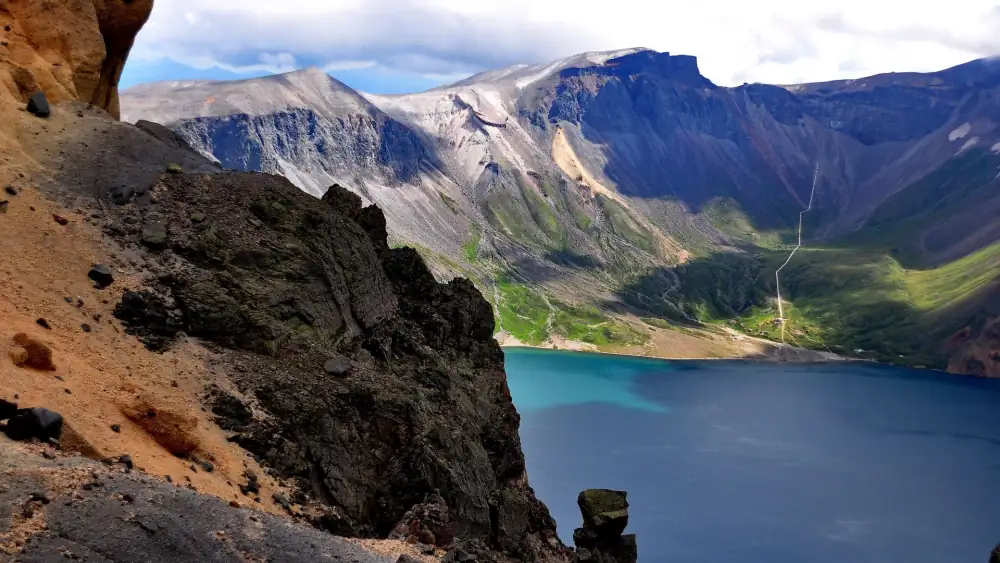
Most visitors to Changbai Mountain (长白山) approach from the north via Erdaobaihe. The southern route through Changbai County is less developed but offers distinct advantages: fewer crowds, a different angle on Tianchi (Heavenly Lake), and the beautiful Wangchi (King Pool) scenic area.
The Southern Gate of Changbai Mountain National Nature Reserve is about 50 km from Changbai County town. Entry is ¥171 (¥125 in off-season November–April). Shuttle buses run from the gate to the crater viewpoint (¥85 round trip). From the south rim, you look north across the crater lake toward the more heavily visited north rim — the same stunning water, a fraction of the selfie sticks.
If you are combining Tonghua and Changbai Mountain, plan for at least 3 days: one day for the Goguryeo ruins, one day for the Korean county, and one day for the mountain.
Winter in Tonghua
Skiing at Wanlong
The Wanlong Ski Resort (万龙滑雪场), about 30 km from Tonghua, is one of northeast China’s better mid-sized ski areas. With 16 runs ranging from beginner to advanced, a vertical drop of 560 metres, and reliable snow from December through March, it draws skiers from across Jilin and Liaoning provinces. A full-day lift ticket costs ¥280–380 depending on the date. Equipment rental adds ¥150–200.
Ice and Snow Festival
Tonghua’s winter festival (January–February) features ice sculptures along the Hunjiang River, sledding hills, and a nightly light show. It is a modest affair compared to Harbin’s extravaganza, but that means no elbowing through crowds. The ice sculptures cluster around the riverfront park near the Tonghua Bridge — walkable from most downtown hotels.
Food: Where Dongbei Meets Korea
Tonghua’s position on the Korean border creates a dining scene that fuses hearty Dongbei staples with Korean precision and spice.
Must-Try Dishes
- Cold noodles (冷面): Korean-style buckwheat noodles in icy broth with sliced pear, cucumber, and a hard-boiled egg. The version in Changbai County is the most authentic. ¥15–25.
- Korean barbecue (韩式烤肉): Marinated beef and pork belly grilled at your table, wrapped in lettuce with garlic and ssamjang. ¥60–100 per person.
- Dongbei guobao rou (锅包肉): Sweet and sour crispy pork — the dish that defines Dongbei cuisine. Every restaurant has its own version. ¥30–45.
- Ginseng chicken soup (人参鸡汤): A whole young chicken stuffed with glutinous rice, jujube, and local wild ginseng. Deeply nourishing and surprisingly affordable at ¥50–80.
- Kimchi fried rice (泡菜炒饭): A Korean-Chinese hybrid, spicy and satisfying. ¥18–25.
- Tonghua ice wine: The region’s volcanic soil and cold winters produce excellent ice wine. A bottle of local Vidal ice wine costs ¥80–200 at cellar-door prices — a fraction of what imported versions cost.
Where to Eat
- Ji’an Riverside Food Street (集安江边美食街): Over 20 restaurants specialising in Dongbei and Korean cuisine along the Yalu River. ¥40–80 per person.
- Changbai Korean Restaurant (长白朝鲜族餐厅): In the Changbai County town. The cold noodles and bulgogi are outstanding. ¥50–90 per person.
- Tonghua Old Street (通化老街): The best place for guobao rou and other Dongbei classics. ¥30–60 per person.
- Ginseng Market restaurants (人参市场餐厅): Several small eateries attached to the ginseng wholesale market on the city outskirts. The chicken soup is made with ginseng that was in the ground that morning. ¥40–70 per person.
Where to Stay
- Tonghua Guomao Hotel (通化国贸大酒店): Central, comfortable, and reasonably priced. ¥200–350/night.
- Ji’an Goguryeo Hotel (集安高句丽宾馆): The best option in Ji’an, within walking distance of several tomb sites. ¥180–300/night.
- Changbai Mountain Hot Spring Resort (长白山温泉度假酒店): Near the southern gate of the reserve. Rooms from ¥350–600/night, with access to natural hot springs.
- Changbai County Guesthouse (长白县宾馆): Simple but adequate in the Korean autonomous county. ¥120–200/night.
Best Time to Visit
September and October offer the best combination of comfortable weather, autumn foliage, and clear days for viewing Tianchi. Summer (June–August) is warm and lush but Changbai Mountain is often shrouded in mist — you may travel all the way there and see nothing but fog. Winter (December–February) is cold (-20°C or lower) but ideal for skiing and the ice festival. Spring is brief and muddy — the least appealing season.
Budget Breakdown
| Category | Budget (¥/day) | Mid-range (¥/day) |
|---|---|---|
| Accommodation | 120–200 | 300–500 |
| Food | 40–70 | 80–150 |
| Transport (local) | 20–40 | 60–120 |
| Attractions | 50–100 | 100–200 |
| Total | 230–410 | 540–970 |
Practical Tips
- Layer up. Even in summer, Changbai Mountain can be bitterly cold at the summit. Bring a windproof jacket regardless of the season.
- Book Ji’an guides in advance. English-speaking guides are scarce. Contact the Ji’an Tourism Bureau (+86-435-622-2236) at least a week ahead.
- Bring your passport to the border. Ji’an sits on the Yalu River opposite North Korea. Some viewpoints and the riverside walk require ID checks.
- Try the ice wine. Tonghua is one of the world’s most affordable regions for quality ice wine. Visit the Tonghua Wine Museum (通化葡萄酒博物馆, ¥40 including tasting) to learn why.
- Respect the tombs. The Goguryeo sites are active archaeological areas. Do not climb on the tomb structures or remove any stones or pottery fragments.
- Winter driving caution. Roads between Tonghua, Ji’an, and Changbai can be icy and snow-covered from November to March. If you are not experienced with winter driving, hire a local driver.
- Cash for small towns. While mobile payments work in Tonghua city, smaller vendors in Ji’an and Changbai County may prefer cash.
Tonghua is the kind of place that rewards the curious. It does not announce itself with neon lights or blockbuster attractions. Instead, it whispers — through the stone walls of a 1,700-year-old fortress, through the steam rising from a bowl of ginseng soup, through the bilingual signs of a Korean border county that most maps do not even highlight. Come ready to listen.