
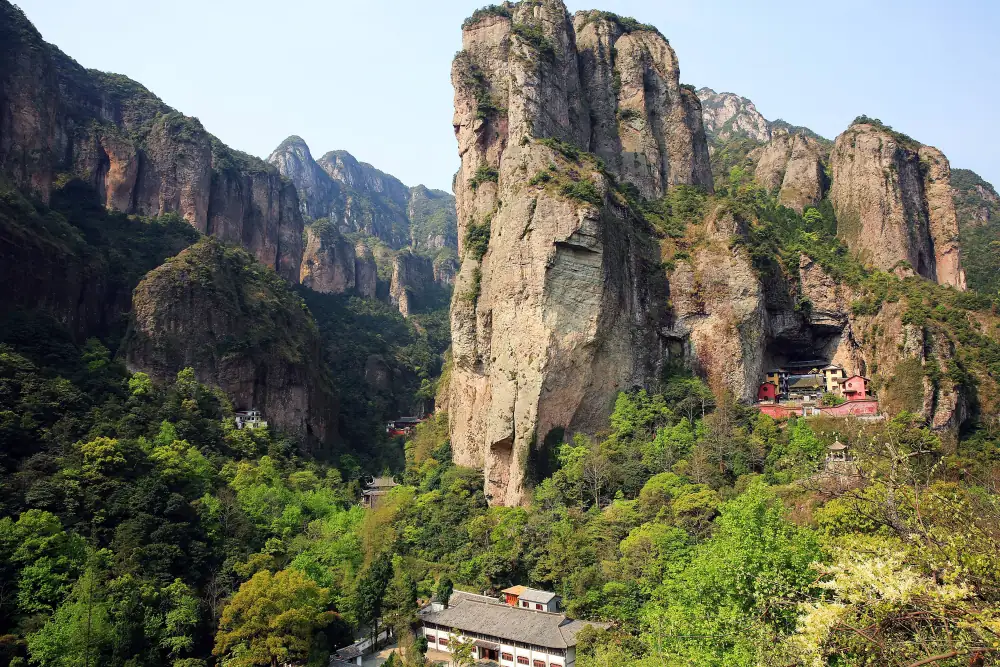
Tiantai Mountain (天台山, Tiāntái Shān) in central Zhejiang Province occupies a singular position in Chinese Buddhist history: it was here that the monk Zhiyi (538–597 AD) founded the Tiantai school of Buddhism — China’s first distinctly Chinese Buddhist school, blending Indian teachings with Chinese philosophical traditions in ways that influenced all of East Asian Buddhism.
Today the mountain remains a destination for Buddhist pilgrims from China, Japan and Korea, many of whom trace the lineage of their tradition back to Zhiyi’s work here. For the general traveler, it offers magnificent mountain scenery, ancient temple architecture, waterfall hiking and an almost complete absence of Western tourists.
Guoqing Temple (国清寺)
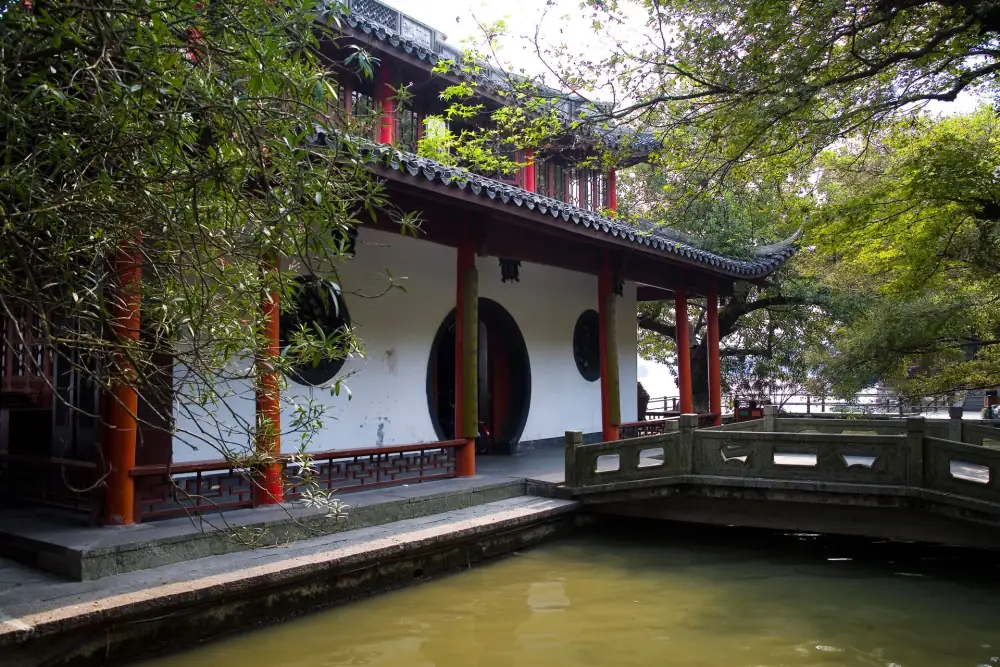
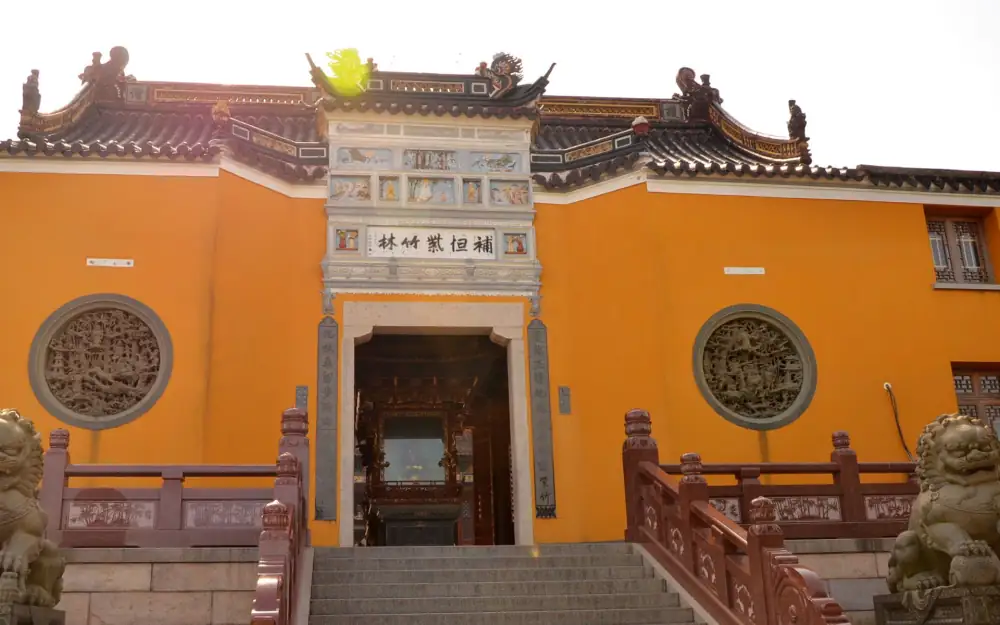
The anchor attraction of Tiantai is Guoqing Temple, founded in 598 AD during the Sui Dynasty on Zhiyi’s deathbed instruction (the name means “when the nation is pure”). The current compound dates primarily from Tang, Song and Qing dynasty reconstructions, organized around four primary halls.
The most distinctive feature: a seven-story pagoda standing 59m high in front of the main temple gate, visible from the valley approach. This隋代 (Sui dynasty) pagoda is one of the few Buddhist pagodas of this era still standing in China — most were destroyed in various persecutions or fell to time.
Inside the complex: Over 600 monks are in residence; this is an active monastic institution with a morning (04:30) and evening (18:00) chanting ritual that visitors may observe respectfully. The interior halls contain exceptional Tang dynasty Buddhist sculptures.
Japanese connection: Japanese Buddhist pilgrims have been coming to Guoqing Temple since the 8th century. The Japanese Tiantai and Shingon schools (日本天台宗) trace direct transmission of their teachings to monks who studied here. A Japanese-style garden and memorial pavilion in the complex commemorates this connection.
Entry: ¥10 (essentially a maintenance fee at active temples in Zhejiang)
Stone Beam Waterfall (石梁飞瀑)
5 km from Guoqing Temple, a natural stone arch bridge (not man-made) spans a narrow gorge with a waterfall rushing beneath it. The stone bridge is 300m long and 29m wide — formed by two cliff faces meeting above the stream. A temple pavilion perches on the stone arch itself; monks have meditated here for over 1,000 years.
The combination of the geological feature, the waterfall sound and the ancient architecture makes this one of the most distinctive natural-cultural sites in Zhejiang.
Access: Bus from Tiantai county town (20 minutes) or Didi.
Fee: ¥40
Huading Peak (华顶峰)
The highest peak of the mountain range (1,098m). A stone path ascends through forest to the summit, where a small temple (华顶寺) sits in isolation. Cloud cover frequently obscures the peak from below, but from the summit on a clear day you see across the entire Zhejiang lowland.
Walking time: 3–4 hours round trip from the bus drop-off point; alternatively take the cable car.
The Cold Mountain Hermit Connection
One of the most beloved poets in classical Chinese literature — Han Shan (寒山, “Cold Mountain,” 7th–9th century) — lived as a hermit on the cliffs of Tiantai Mountain for decades. His poems, surviving in a collection of over 300, are informal, self-deprecating and often humorous — quite unlike the elaborate formal verse of the Tang court poets. They were embraced by the Beat Generation in America in the 1950s (Gary Snyder’s translations of Cold Mountain poems became foundational texts of the counterculture), creating an unusual link between an isolated Chinese mountain hermit and 20th-century Western literature.
Cold Mountain Temple (寒山寺, now the informal name for the cave shrine where he reportedly lived) is accessible via a walking trail from Guoqing Temple.
Getting There
From Hangzhou: Bus from Hangzhou East Bus Terminal to Tiantai County (2 hours, ¥50). From Tiantai County, local bus or Didi to Guoqing Temple (15 minutes, ¥10–20).
From Wenzhou: High-speed rail to Taizhou North (1 hour, ¥60), then bus to Tiantai County (1 hour, ¥25).
From Ningbo: Bus from Ningbo South Bus Terminal (2 hours, ¥55).
Within the mountain area: Local buses and Didi connect the main sites. A Didi for the full circuit (Guoqing → Stone Beam Falls → Huading base) costs approximately ¥80 for the day.
Practical Information
Best season: Spring (April–May) and autumn (September–October). Summer brings mountain mist and cooler temperatures; winter is cold but atmospheric with occasional snow on the upper peaks.
Accommodation: Tiantai County town has standard hotels (¥150–350/night). The area around Guoqing Temple has a small number of guesthouses. Some Buddhist temples in China offer pilgrim accommodation (residential and austere) — Guoqing Temple does not offer this to tourists, but the county’s regular hotels are comfortable enough.
Food: Local Tiantai cuisine features seasonal mountain vegetables, bamboo shoot dishes and freshwater fish. The Tiantai restaurants near Guoqing Temple serve simple Buddhist-influenced meals (vegetarian-friendly).
Why Visit
Tiantai Mountain sits at the intersection of three profound things: natural mountain beauty, 1,500 years of continuous Buddhist practice and scholarship, and an unusual cross-cultural literary legacy via the Cold Mountain hermit. It receives a fraction of the tourist attention given to its more famous neighbors (Putuo Island, Hangzhou, Ningbo) and all the more rewards the traveler willing to make the detour.