
Yuanyang Rice Terraces: A Complete Dawn Photography Guide
The Hani rice terraces of Yuanyang (元阳) in Yunnan’s Honghe Prefecture are not the largest terraced farmlands in Asia — the Banaue Terraces in the Philippines are bigger, the Longji terraces near Guilin are more accessible — but they are arguably the most beautiful and certainly the most photographed.
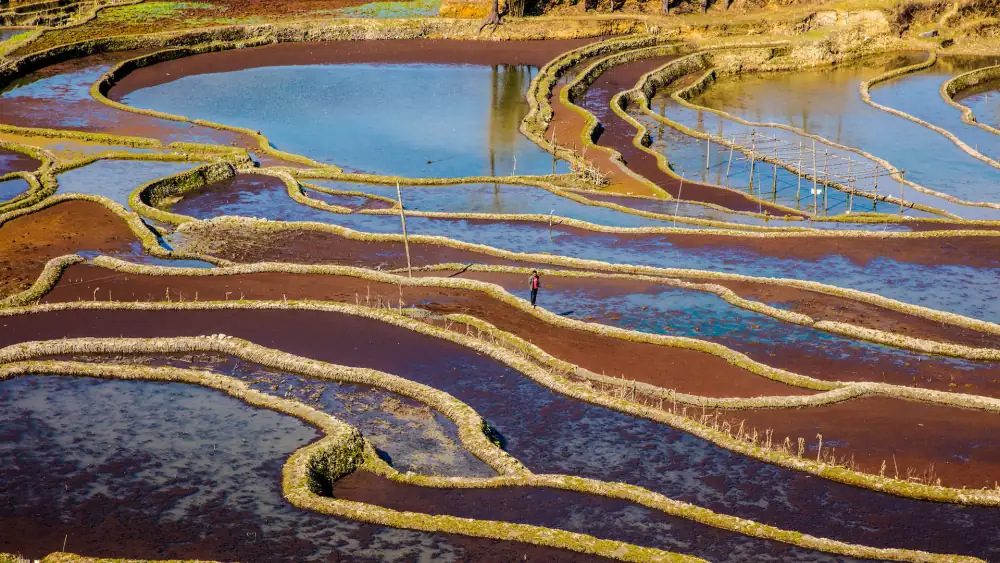
What distinguishes Yuanyang is a combination of scale (over 16,000 hectares of terraces cascading down the southern face of the Ailao Mountain range), elevation (the terraces extend from 140 m to 2,000 m above sea level), the reflective quality of the flooded fields between October and March, and the Hani minority culture that has shaped and maintained this landscape for 1,300 years.
The best experience requires arriving before dawn and staying through the first two hours of morning light — the window when mist, reflection, and golden light combine in ways that justify what may be a 6-hour journey from Kunming.
Understanding the Hani Terraces
1,300 Years of Civilisation
The Hani people (哈尼族) began constructing terraces on the Ailao Mountains’ steep southern slopes during the Tang dynasty — around 700 CE. The terracing system they developed was a response to the region’s challenging topography: slopes of 15–75 degrees that receive abundant rain but have no flat land.
The system is remarkably sophisticated: a network of irrigation channels draws water from the cloud forest at the mountain summit, distributes it through the village zones via a community-managed allocation system, floods the terraces in late autumn after harvest, and drains them in late spring before planting. Each terrace is individually owned by a Hani family; the water management is collective.
The entire system — terraces, villages, forest, and water management — was inscribed as a UNESCO World Heritage Site in 2013 under the category of “cultural landscape.”
The Seasonal Cycle
| Month | Field Condition | Visual Character |
|---|---|---|
| October–March | Flooded (water retention period) | Mirror-like reflection of sky and light |
| April–May | Mud preparation and planting | Brown, rich, not reflective |
| June–September | Growing crop (green) | Vivid green, layered depth |
Peak photography season: November to early February — the flooded terraces act as a series of mirrors, reflecting dawn light and cloud formations in the still water.
Key Viewpoints
Duoyishu (多依树 Sunrise Viewpoint)
The best known sunrise viewpoint for the terraces. Positioned at approximately 1,900 m elevation looking southeast over the largest unbroken terrace section in the Yuanyang area.
From the observation platform (wooden deck, roughly 50 m long), at sunrise you look across approximately 5 km of unbroken terraced hillside, with the valley floor 700 m below. In flooded season, the terraces catch the dawn sky in sequential reflections as the light shifts — from deep purple-blue to gold to white over roughly 40 minutes.
Crowds: This is the most popular viewpoint and can be crowded during Chinese national holidays. Arrive by 6:30 AM (30+ minutes before sunrise) to secure a position on the deck. Access: 40-minute drive from Yuanyang New Town (新街镇) on winding mountain roads.
Bada (坝达 Autumn Colour Viewpoint)
A broader, less steep panorama — better for photographers who want to compose landscape images with strong foreground elements (bamboo groves, Hani house rooflines, irrigation channels) in the frame.
The Bada area has several distinct sub-viewpoints accessible within 1 km of the road; explore on foot rather than staying at the single main parking area.
Best season: September–October when green crop turns to golden harvest, and again October–November when fields are freshly flooded.
Laohuzui (老虎嘴 Tiger Mouth)
Named for its resemblance to a tiger’s open mouth when viewed from across the valley, this viewpoint sits above a particularly deep section of terracing — the drop from the observation cliff to the valley floor is about 800 m. Less visited than Duoyishu; more dramatic for vertigo-inducing perspectives.
Best time: Late afternoon light from the west side paints the terraces in strong directional shadow — excellent for showing the three-dimensional depth of the landscape.
The Hani Villages
Aichun Village (爱春村)
A traditional Hani village of approximately 200 households accessible by a 30-minute walk from the Bada viewpoint. The village retains the traditional mushroom-house architecture — earthen walls with rounded thatch roofs that resemble overturned bowls — in a proportion of roughly 50% old traditional houses to 50% concrete modern construction.
Village tourism here is genuine rather than staged: families invite visitors for tea or a meal (¥30–¥50/person); the Hani women wear traditional indigo-dyed cotton clothing for daily work rather than performance. Photography of daily village life is generally welcomed if done respectfully.
Shengcun Village (胜村)
The largest and best-preserved of the traditional Hani villages — a UNESCO demonstration village where the original architecture has been protected. The village is structured around the traditional Hani principle of vertical social organisation: the forest and water sources at the top, the village in the middle, the terraced fields below.
A village elder (部落长) can sometimes be arranged through the tourism office to explain the water-management system — this is one of the more interesting educational experiences available in the area.
Getting There
From Kunming
By high-speed train to Jianshui (建水): The new high-speed rail connects Kunming to Jianshui in 1 hour (¥75). From Jianshui, take a local bus (2.5 hours, ¥40) or hire a car (¥400–¥500 one-way) to Yuanyang New Town.
By bus: Kunming South Bus Station to Yuanyang takes 5.5–6.5 hours (¥100–¥120). Arrive in Yuanyang before dark if possible.
Self-drive: Recommend for maximum flexibility — 6 hours from Kunming with stops.
Within the Yuanyang Area
The viewpoints are spread across 25–35 km of mountain road. Renting a motorcycle or hiring a driver from Yuanyang New Town (¥200–¥350/day for a driver-guide who knows all viewpoints) is the most practical approach. The mountain roads are narrow and winding; driving yourself requires strong confidence on single-lane mountain curves.
Photography Tips
Equipment
- Wide-angle lens (16–35mm equivalent): For expansive terrace panoramas.
- Medium telephoto (70–200mm): For compressing distant terraces into dense layers.
- Graduated ND filter: The sky is frequently much brighter than the terraces; a graduated filter balances the exposure.
- Tripod: Essential for pre-dawn and long-exposure reflection shots.
Timing and Light
- Civil twilight (30 minutes before sunrise): The sky begins to colour; the terraces turn from dark grey to deep blue-purple. The best moment for deep-blue atmospheric images.
- Sunrise (first light): Rapid colour change from orange-gold to white; 15-minute window of extraordinary reflection conditions.
- 30–60 minutes after sunrise: Mist begins to clear; the terraces lose their mirror quality as wind disturbs the water surface. Last opportunity for atmospheric images.
- Late afternoon (16:00–17:30): The low-angle sun from the west illuminates the terraced walls; different quality from morning but worth a second visit.
Accommodation
In the viewpoint areas: Several guesthouses operate near Duoyishu and Bada — worth paying slightly more (¥200–¥400/night) to be 10 minutes from the viewpoints rather than 40 minutes.
In Yuanyang New Town: Full range of mid-range hotels (¥150–¥350/night).
The Yuanyang terraces at dawn ask nothing of you except attention. The light changes so fast — faster than any photographer can follow completely — that the best photographs are often taken in the moments when you’ve set down the camera to simply watch.