
The Yuanyang rice terraces in the Honghe Hani and Yi Autonomous Prefecture of southern Yunnan are among the most extraordinary agricultural landscapes on earth. The Hani minority people have been carving terraces into the Ailao Mountains here for approximately 1,300 years, creating a staircase of flooded fields that descends from forests at 2,000 metres down to the Red River valley at 144 metres.
The UNESCO World Heritage Site designation in 2013 was long overdue. What makes these terraces exceptional isn’t just their scale (there are approximately 16,600 hectares of them) but the active, living quality of the landscape — every terrace is still cultivated, the Hani villages are still inhabited, and the culture that created this landscape over 1,300 years is still functioning.
Table of contents
Open Table of contents
The Best Season: November to March
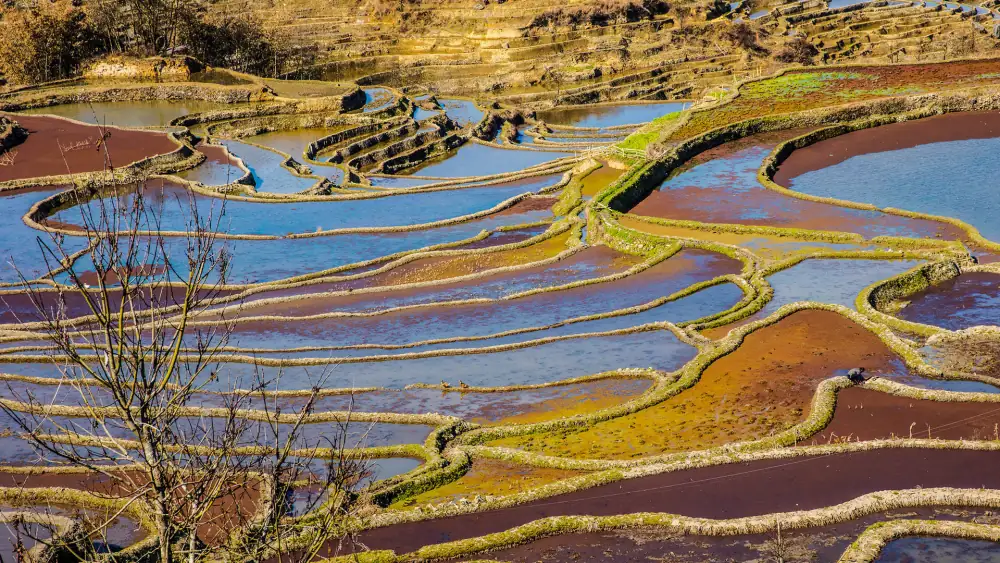
Yuanyang terraces are beautiful year-round, but the most spectacular conditions occur from November to March, when the terraces are flooded for the new planting cycle.
During this period, each terrace acts as a mirror. At dawn, when low cloud and mist frequently sit in the valleys between the hills, the flooded terraces reflect the sky in a layered series of pools that shifts in colour as the sun rises — orange, pink, white, then blue. The cloud and mist are crucial: they provide the middle layer that makes the reflected sky visible by diffusing the direct sunlight.
In summer (April–September), the terraces are planted with green rice — a different and also beautiful sight, but the mirror-reflection phenomenon of the flooded winter terraces is missing.
The busiest period is Chinese New Year (usually late January/early February) and the first weeks of November when the flooding begins — if possible, arrive in mid-December through January for fewer crowds and reliable flooded conditions.
The Three Main Viewpoints
Duoyishu (多依树): The most famous viewpoint and the most photographed location. A hillside platform above a valley of terraces that opens to the east — optimal for sunrise photography. In high season (November–March), photographers arrive before 5am to secure positions on the viewing platform. A second-tier viewpoint above the main platform gives a higher angle. Dawn conditions with mist in the valley produce the terrace photographs that have made Yuanyang famous globally. Entry: ¥100 (included in the Yuanyang scenic area combined ticket).
Bada (坝达): A wider angle view that encompasses multiple hill faces of terraces simultaneously. Less intimate than Duoyishu but more sweeping in scale. Best in the afternoon light. The village of Quanfuzhuang visible in the middle distance gives the human scale that contextualizes the terraces. Entry included in combined ticket.
Laohuzui (老虎嘴, “Tiger’s Mouth”): The most dramatic single-viewpoint shot — a cliff edge that looks straight down 300 metres into a deep valley of terraces falling away in steps. Best at sunset when the western light catches the water surfaces. The engineering feat of the terraces is most viscerally apparent here: steep, near-vertical slopes somehow made into cultivable land through sheer accumulated human effort. Entry included in combined ticket.
The combined scenic area ticket is ¥100 and covers all three main viewpoints. It is valid for multiple days — staying 2–3 nights allows you to hit each viewpoint at its optimal time.
Staying Overnight: The Essential Strategy
Yuanyang’s spectacular conditions are exclusively a dawn and dusk phenomenon. Bus and tour-group day-trippers who arrive at 10am see attractive but unremarkable terraced hillsides. Those who stay overnight and wake before 5am to position themselves at Duoyishu see something completely different.
Accommodation is available in New Yuanyang Town (新街镇), which is the main hub, and in guesthouses within or near the Duoyishu and Bada viewpoint areas. Staying within walking distance of Duoyishu is ideal — guesthouses here typically cost ¥120–¥250 per night for a basic double room.
Practical dawn routine: Guesthouses near Duoyishu organize small group van transfers to the viewpoint at 5am for ¥10–¥20 per person. Alternatively, the walk is about 15 minutes. Dress warmly — temperatures at dawn in December–February regularly drop to 5–10°C, and the wind chill on the open platform adds to that.
Hani Culture: The Villages Still Living
The Hani (哈尼族) are the people who built and maintain these terraces, and visiting their villages is as significant as viewing the terraces themselves. The Hani have their own language (Hani-Lolo group), architecture (the mushroom houses — traditional adobe buildings with thatched roofs that resemble mushrooms), and animist-influenced spiritual practices that coexist with aspects of Buddhism.
Quanfuzhuang Village: Visible from the Bada viewpoint, this Hani village is accessible on foot or by local minibus. The traditional mushroom houses are still lived in. There is a small local market on Saturday mornings.
Mengpin Village: One of the larger Hani communities near the terraces, with a more active local economy. Friday market brings Hani and Yi villagers from surrounding hills for a day of trading.
Respectful visiting: The communities are not tourist attractions but working agricultural villages. Photography of people should always be with consent (gesture asking permission rather than assuming). Buying from local vendors — rice wine, handwoven cloth, dried red peppers — supports the economy directly.
Getting to Yuanyang
Yuanyang (the nearest large town is Nansha/新街镇) is in a remote corner of Yunnan, which contributes to why it remains less crowded than other famous Yunnan destinations despite the UNESCO status.
From Kunming: Direct bus from Kunming South Bus Station to New Yuanyang Town (新街), 6–7 hours, ¥100–¥120. Night buses also available.
From Jianshui or Mengzi: 2–3 hours by bus; more convenient if combining with south Yunnan destinations.
Local transport: Between the viewpoints, local minibuses (¥5–¥15) run during the scenic area’s operating hours. Hiring a local driver for a day (¥200–¥300) gives more flexibility for dawn and dusk timing.
Note on road quality: The roads up to the terraces involve steep, narrow mountain roads. Large vehicles use them regularly but the curves are tight. Normal driving but appropriate for anyone prone to car sickness — sit near the front.