
Yuanyang Rice Terraces: One of Asia’s Great Photographs
The Yuanyang rice terraces (元阳梯田) in southern Yunnan’s Honghe Hani and Yi Autonomous Prefecture are one of China’s most extraordinary landscapes — and one of the world’s great UNESCO World Heritage cultural landscapes (designated 2013). Over 10,000 hectares of terraced fields cascading down the southern slopes of the Ailao Mountain Range have been maintained by Hani people (哈尼族) for over 1,300 years.
What makes Yuanyang uniquely photogenic is the seasonal flooding of the terraces. From October through April, the fields are flooded (water is introduced before rice planting), creating a vast stepped mirror reflecting the sky. The colors shift from the pre-dawn pink and gold through morning blue and silver to afternoon green and bronze. In the evening mist, the flooded terraces create abstract patterns that challenge the ability of any camera to do justice.
This guide covers how to experience this landscape at its best, with attention to photography conditions, village culture, and practical logistics.
Understanding the Landscape
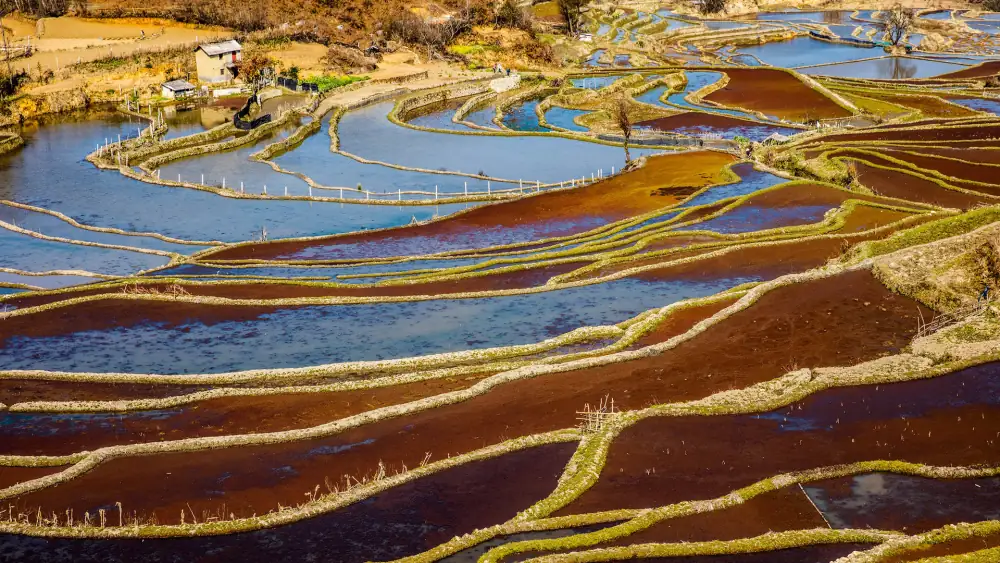
The Hani people began building these terraces over 1,300 years ago, working with the natural topography of the Ailao Mountains to create agricultural land in steep terrain. The engineering is remarkable: a gravity-fed water system draws from forest springs at the mountain summit, distributing water through carved channels to terraces at every elevation. The system works without pumps, based entirely on careful topographic management and communal maintenance.
The Hani relationship with this landscape is deeply ecological — they’ve maintained the mountain forests that feed the springs that water the terraces, preserving a functioning mountain-to-valley water cycle for over a millennium. The UNESCO designation recognized this as an outstanding example of agricultural landscape that is simultaneously a technological, ecological, and aesthetic achievement.
The Best Viewpoints
The Yuanyang scenic area is divided into several clusters of viewpoints, each with distinct visual character:
Duoyishu Sunrise Viewpoint (多依树观景台)
The most famous and most photographed viewpoint — the sea of mist that often fills the valleys at dawn makes this location’s sunrise photographs internationally iconic. The terraces in this area are particularly numerous and regularly stepped, creating the deep geometric complexity that makes the best Yuanyang images.
Timing for the best light:
- Arrive at the viewpoint at minimum 30 minutes before sunrise
- The light quality peaks for approximately 20-30 minutes around sunrise itself
- On foggy mornings, the mist moves through the terraces in patterns that change minute by minute — stay longer
The challenge: Duoyishu is well-known, and during peak season (winter weekends, Chinese New Year) the viewpoint platform is crowded. The photography crowds can be intense. Weekday visits in January-March are significantly more peaceful.
Bada Viewpoint (坝达观景台)
Slightly larger and wider than Duoyishu, with a different viewing angle. Some photographers prefer Bada for its more panoramic view; Duoyishu for its intimate composition possibilities.
Mengpin Sunset Viewpoint (猛品梯田)
Less visited than the main cluster; excellent for afternoon and sunset light hitting the terraces from the west.
Laohuzui Viewpoint (老虎嘴观景台)
Arguably the most dramatic of all viewpoints — looking down at a deep valley of terraces from a high ridge. The scale here is extreme; you’re looking down hundreds of meters at terraces extending to the valley floor. Less foggy than Duoyishu; better for clear-weather panoramic shots.
The Hani Villages
Three main villages are integrated into the scenic area and offer cultural context for the terrace landscape:
Shengcun (胜村): The most organized for tourism; a mix of Hani traditional architecture and modern tourist facilities. The morning mushroom market here (vendors selling wild mushrooms from the surrounding forests) is worth waking up for.
Azheke Village (阿者科村): The most carefully preserved Hani village in the area — declared an official “village museum” and protected from commercial development. The traditional Hani mushroom-shaped thatched houses (蘑菇房) survive here in higher concentration than anywhere else. Entry is free; the village asks visitors not to photograph residents without permission.
Qingkou Village (箐口): A mid-sized village used by the government as a “Hani culture preservation demonstration area” — some staged elements but also genuinely intact traditional architecture.
The Hani People and Culture
The Hani (also called Akha in Myanmar and Southeast Asia) are one of Yunnan’s 26 recognized ethnic minorities, with a population of approximately 1.7 million in Yunnan. Their language (Hani, part of the Tibeto-Burman family) has no traditional written form; cultural knowledge was transmitted entirely orally and practically until romanization in the 20th century.
Traditional clothing: Hani women’s traditional dress is distinctive — dark indigo-dyed garments with bright embroidered bands, silver ornaments at the collar and cuffs, and a specific headpiece style that varies by subgroup. In the villages during festivals, women wearing full traditional dress are spectacular.
Festivals: The major Hani festival is the Harvest Festival (矻扎扎, Kùzhāzhā), held in June after the rice is planted. The Long Table Banquet (长街宴) — where the entire village shares a communal meal along a table stretching hundreds of meters — is one of China’s most visually remarkable folk customs.
Daily life: The agricultural calendar dominates Hani daily life. The terrace-related work schedule is: October-November (flooding terraces for the winter), December-March (most photogenic flooded period), April-May (planting), June-September (growing season, green terraces).
Photography Practical Guide
Equipment Recommendations
Lens choice: Wide angle (16-35mm equivalent) for the panoramic terrace views; standard zoom (24-70mm) for composition flexibility; telephoto (70-200mm) for detail extraction and compressing perspective.
Tripod: Essential for pre-dawn and low-light work. The best images are taken in conditions where handheld shooting isn’t practical.
Filters: Circular polarizer for reducing water reflection when you want to see into the flooded terraces; neutral density for long exposures.
Backup batteries: Cold mornings (temperatures can be 5-10°C even in the middle of the day in January) drain batteries faster than expected.
Timing and Light
The flooded season (October-April): The most photogenic period. Terraces reflect the sky, fog forms in the valleys, and the abstract water patterns are at maximum.
The growing season (May-September): Green rice is beautiful in a different way — the geometric terraces in brilliant green are distinctly striking, particularly with dramatic storm clouds.
Dawn vs. dusk: Both are excellent; Duoyishu is primarily a sunrise location (eastern exposure); Laohuzui works well for late afternoon light.
Weather: Fog is your friend at Yuanyang — it adds depth and atmosphere that clear-sky photography lacks. Check forecasts and prioritize the foggiest days.
Getting to Yuanyang
Yuanyang is genuinely remote — this is part of why the landscape has been preserved.
From Kunming:
- Direct bus from Kunming South Bus Terminal: approximately 7-8 hours (¥80-120)
- High-speed train to Mengzi (蒙自) via Yunnan HSR, then bus to Yuanyang: approximately 4-5 hours total
- Fly to Lüchun (绿春) Airport (small regional airport, limited service) and taxi to Yuanyang
From Jianshui (建水):
- A common itinerary combines Jianshui (excellent Confucian temple, extraordinary traditional architecture, famous tofu street food) with Yuanyang via a 2-3 hour bus ride
Local transport within the scenic area:
- Tourist buses serve the main viewpoints from the Yuanyang new town (元阳县城, also called Nansha)
- Taxis and private vehicles available for flexibility
- The viewpoints are not within walking distance of each other; transport is required
Practical Information
Accommodation:
- In the scenic area villages: Guesthouses exist in Duoyishu area, near the main viewpoints, and in the larger villages. Basic facilities; prices ¥120-250 per night. Staying here allows access to the very early morning viewpoints without long drives.
- In Yuanyang county town (Nansha): More comfortable hotels; requires early morning transport to viewpoints. A 30-minute drive to Duoyishu at 4 AM is manageable.
Entry tickets: ¥100 for the Yuanyang Hani Terrace Scenic Area (covers multiple viewpoints for 2 days).
Best duration: 2-3 nights to properly experience the changing light conditions and visit multiple viewpoints.
Budget: ¥200-400 per day including accommodation, food, transport, and entry (excluding transport to Yuanyang).
Yuanyang’s rice terraces are one of those landscapes that exceed the photographs — a combination of scale, color, historical depth, and living cultural practice that creates an experience photography can reference but not fully contain. The journey to reach them is part of the experience; arriving requires effort, and that effort is completely worth it.