
Beijing Yonghe Lama Temple: Complete Visitor Guide
The smoke from thousands of incense sticks drifts across five successive courtyards, each more elaborate than the last, until it rises past the 18-metre Maitreya Buddha carved from a single white sandalwood tree and disappears into a Beijing sky the colour of pale jade. This is the Yonghe Temple (雍和宫) — the Lama Temple — and it is arguably Beijing’s most atmospheric religious site.
History: From Imperial Bedroom to Sacred Temple
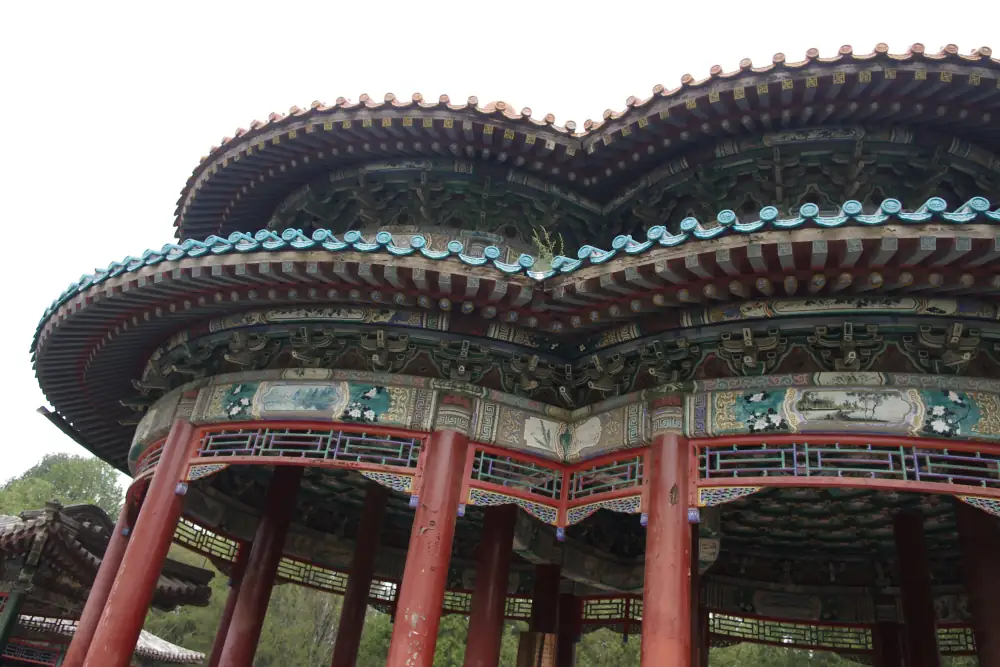
The compound began as a residential palace in 1694 for Yinzhen, the fourth son of the Kangxi Emperor. When Yinzhen unexpectedly became the Yongzheng Emperor in 1722, his private residence was upgraded to imperial status — a step that, according to Qing convention, required it eventually to become a religious institution. In 1744 the Qianlong Emperor converted the entire compound into a Tibetan Buddhist lamasery, partly as a gesture of solidarity toward Mongol and Tibetan peoples, and partly to house monks from the Gelug (Yellow Hat) sect of Tibetan Buddhism.
Throughout the Qing dynasty, Yonghe Temple served as an administrative centre for Buddhist affairs across the entire empire. It survived the Cultural Revolution almost intact — unusual among Beijing temples — because Premier Zhou Enlai reportedly placed it under military protection.
The Five Main Halls
The temple is laid out along a north-south axis through five successive gated courtyards, each rising slightly higher than the last, creating a sense of progressive elevation toward the sacred.
1. Paifang and Zhaobi (Entrance Archways)
Three ceremonial paifang arches and a spirit wall mark the formal entrance. The large incense burner in front is often surrounded by worshippers from the moment the gates open.
2. Tianwang Hall (天王殿)
The first major hall houses four giant Heavenly Kings — one for each cardinal direction — plus a rotund laughing Maitreya (the “Fat Buddha”) at the centre. The contrast between the fierce guardians and the serene laughing figure captures the dual nature of Buddhist protection.
3. Yongyou Hall (永佑殿)
Three major bodhisattvas flank a central Amitabha, depicted in gold lacquer. The hall’s woodwork — dense interlocking carved dragons and phoenixes — represents the peak of Qing imperial craftsmanship.
4. Falun Hall (法輪殿)
The spiritual heart of the complex, Falun Hall houses a 6-metre bronze statue of Tsongkhapa, the 14th-century founder of the Gelug school of Tibetan Buddhism. The surrounding walls are lined with 500 arhat figurines in gilded niches, and the roof is punctuated by five small Tibetan-style pavilions. On special Buddhist festival days, monks in saffron and maroon robes conduct ceremonies here.
5. Wanfu Pavilion (万福阁) — The 18-Metre Buddha
The climax of the visit. Step into this three-storey pavilion and look up: a 18-metre Maitreya carved from a single white sandalwood trunk sent by the 7th Dalai Lama as a gift to the Qianlong Emperor. The statue’s base alone is buried several metres underground. It is listed in the Guinness World Records as the world’s tallest single-piece sandalwood statue. The scale is difficult to process — you notice the toes before you can see the face.
Observing Buddhist Practice
Yonghe Temple is a functioning monastery, not a museum. On any given morning you will find:
- Lay Buddhist worshippers moving clockwise through the courtyards, stopping at each hall to offer incense and bow before each Buddha.
- Monks in yellow robes conducting morning prayers, especially visible in Falun Hall between 9–10 AM.
- Visitors from Mongolia, Inner Mongolia, and Tibetan-inhabited areas for whom this temple has special cultural significance.
The atmosphere is entirely different from a tourist attraction. Quiet respectful conduct is expected; remove hats when entering halls; do not point fingers at statues.
Incense Etiquette
Bundles of incense (¥10–¥30) are sold at the gate and from vendors throughout the complex. Light them from the communal brazier; hold them upright with both hands; bow gently before each hall; plant them firmly in the sand burner. Even if you are not Buddhist, participating in this ritual connects you to something genuine and timeless.
Practical Information
Getting There
Metro: Line 2 or Line 5 to Yonghegong station (雍和宫站). Exit C leads directly to the temple’s south entrance — a 2-minute walk.
Location: 12 Yonghegong Dajie, Dongcheng District.
Hours and Admission
- Hours: 9:00–16:30 (last entry 16:00). Closed Mondays.
- Admission: ¥25 (includes an audio guide headset deposit).
- Note: The entry fee does not include incense; plan on spending ¥30–¥50 if you want the full ceremonial experience.
Best Time to Visit
- Early morning (9:00–10:30): Fewest tourists; monks active in Falun Hall; incense smoke dramatic in low morning light.
- Festival days: The Cham Dance Festival (打鬼节) held on the 30th day of the first lunar month (usually February) features elaborately costumed monks performing ritual dances to dispel evil. This is one of Beijing’s most extraordinary cultural events and draws large crowds — arrive very early.
- Avoid: National holidays, weekend afternoons.
The Surrounding District: Guozijian Street
Yonghe Temple sits at the northern end of Guozijian Street (国子监街), a perfectly preserved Ming-dynasty academic boulevard lined with scholar trees and traditional shops. Walking south you pass:
- Confucius Temple (孔庙): Directly adjacent to the Lama Temple (separate admission ¥30). Its forest of ancient steles recording the names of successful examination candidates is one of Beijing’s most underrated sights.
- Imperial College (国子监): The highest educational institution in imperial China — a 600-year-old complex with a remarkable double-eaved pavilion set on a marble island in an artificial moat.
- Scholar-related shops: Selling ink stones, calligraphy brushes, rubbings from ancient steles, and antique academic curios.
Combining with Other Nearby Sights
| Sight | Distance | Travel Time |
|---|---|---|
| Confucius Temple | 200 m south | 3 minutes on foot |
| Ditan Park (Temple of Earth) | 500 m north | 7 minutes on foot |
| Drum Tower | 1.5 km west | 15-minute walk or short taxi |
| Nanluoguxiang Hutong | 1.8 km southwest | 20-minute walk |
| Houhai Lake | 2.5 km west | Taxi ¥12–¥15 |
Photography Tips
- The Wanfu Pavilion Buddha is extraordinarily difficult to photograph well due to the low ceiling and angled upward perspective; a wide-angle lens and high ISO help.
- Incense smoke creates atmospheric haze in the outer courtyards during late afternoon — one of the better photography windows.
- Monks generally prefer not to be photographed during ceremonies; observe from a respectful distance without pointing cameras.
- The roofline of the five pavilions atop Falun Hall, seen from the Wanfu Pavilion terrace, makes a classic compositional frame with the distant Bell Tower.
Yonghe Temple is more than a Beijing tourist attraction — it is a living bridge between China’s Han heartland and the Tibetan and Mongolian Buddhist worlds. To visit attentively is to understand something important about how the Qing Empire held together its vast multi-ethnic territory.