
Chongqing (重庆) is unlike any other Chinese city — a municipality of 32 million people built across mountains at the confluence of two rivers, where the vertical dimension matters as much as the horizontal. Roads pass through buildings. The metro emerges from a skyscraper. A cable car crosses a gorge with apartment blocks on both banks. The city is a permanent architectural marvel that surprises even repeat visitors.
Table of contents
Open Table of contents
Why Chongqing is Different
Geography shapes everything
Unlike China’s other great cities — which grew on flat plains (Beijing, Shanghai) or river deltas (Guangzhou) — Chongqing was forced to build vertically by the Jialing and Yangtze rivers, which converge at the city’s centre, and the surrounding mountains. The result:
- Multi-level architecture: buildings enter at different floors from different streets; “ground floor” is relative to your approach direction
- Stilted houses (吊脚楼, diào jiǎo lóu): traditional wooden houses built on pillars extending from cliff faces over the rivers
- Staircase streets: entire neighbourhoods connected only by stairs (no vehicles possible)
- 18 Ladder (十八梯): a famous steep staircase district connecting the upper and lower city, recently restored as a heritage area
The famous metro moment
Line 2 of the Chongqing Metro passes through the middle of the Liziba (李子坝) residential building — the train literally enters and exits a hole in an apartment tower on the 6th floor. Trains pass every few minutes. There’s a public viewing platform outside; inside, residents have reportedly grown so accustomed to it they barely look up.
How to see it: take Line 2 and ride it through the Liziba station area, or stand on the viewing platform at street level and watch trains go through the building.
Hongya Cave (洪崖洞)
The most photographed spot in Chongqing: a multi-storey complex of traditional stilted architecture built into the cliff above the Jialing River. The building contains restaurants, shops, and bars stacked up the cliff face over 11 storeys. At night, the illuminated tiers reflecting in the river below produce images that go viral on Chinese social media yearly.
Practical: Hongya Cave is at its most dramatic from 7pm onwards. The interior is primarily restaurants and tourist shops; the attraction is the exterior view and the cliff-face experience. Best viewed from the suspension bridge at Jiefangbei end or from the river-facing side.
Dining here: moderately overpriced; fine for one meal, but not the best hotpot in the city.
Chongqing Hotpot: The Original and Most Intense
Chongqing hotpot (重庆火锅) is the most extreme version of the dish — boiling oil infused with Sichuan peppercorn, dried chillies, doubanjiang (bean paste), beef tallow, and dozens of aromatics. Ingredients are cooked briefly in the bubbling pot and dipped in sesame oil or a garlic-and-fresh-coriander sauce.
What makes it different from Sichuan hotpot
Chongqing hotpot is characterised by:
- Beef tallow base (牛油火锅): traditionally the broth is based on rendered beef tallow rather than vegetable oil — richer, more unctuous, more intensely flavoured
- Higher heat levels: Chongqing versions tend to be spicier even at the “medium” level
- The dip: Chongqing-style uses sesame oil with garlic; different from Chengdu’s dry-roasted sesame paste sauce
Classic ingredients to order
- Beef tripe (毛肚) — the benchmark ingredient: thin, textured, requires only 7–10 seconds in the pot
- Duck intestine (鸭肠) — must be cooked for only a few seconds; becomes rubbery if overcooked
- Brain (脑花) — silky braised brain; texturally unique
- Lotus root (莲藕) and potato slices — for balance against the meat-heavy selections
- Tofu skin rolls (豆皮卷) — absorb the broth flavour beautifully
Where to eat Chongqing hotpot
Dezhuang (德庄) — one of Chongqing’s most respected hotpot chains; multiple locations. Excellent quality control, English-friendly picture menu.
Xiaotianyou (小天鹅) — another major chain with long history.
Local neighbourhood shops: Chongqing has thousands of small hotpot restaurants. Any restaurant with a crowded pavement of tables and red plastic chairs is likely doing something right. Budget ¥60–¥100 per person.
Ciqikou Ancient Town (磁器口古镇)
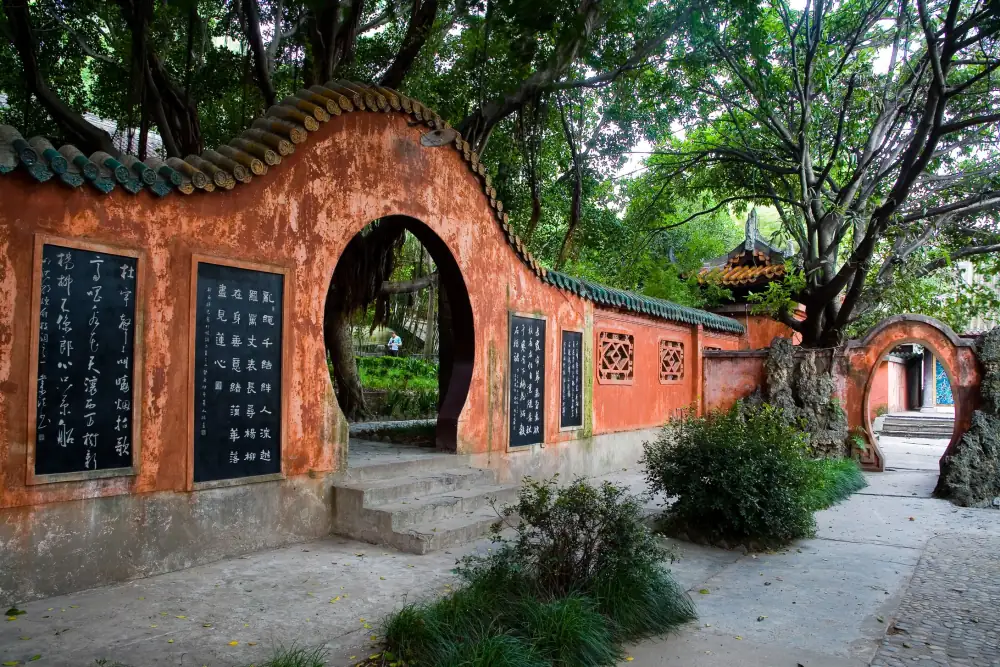
Located on the western bank of the Jialing River in Shapingba District, Ciqikou was Chongqing’s major river trading port during the Ming and Qing Dynasties. The town’s stone-paved lanes, traditional wood architecture, and riverside setting are among Chongqing’s best-preserved historical streetscapes.
What to see and eat here
Qianshou Temple (宝轮寺): a Tang Dynasty Buddhist temple in the back alleys of Ciqikou, away from the tourist shops. Quieter and more atmospheric than the main street.
Street food alley: concentrated along the main pedestrian street:
- Malt candy (麻花): twisted fried dough; Ciqikou is famous for its oversized versions
- Mahua (麻花): spiced fried dough twists in varying flavours
- Noodles: look for restaurants serving Chongqing-style noodles (小面) with numbing-spicy broth
The river end of Ciqikou: walk to the riverside end of the main street (away from the ticket and tourist commercial area) for views of barges on the Jialing River and the stilted houses on the opposite bank.
The Yangtze River Experience
Cable car crossing (长江索道)
The Yangtze River Cableway (长江索道) crosses the river between Xinhua Road on the north bank and Longtou Temple on the south bank. Originally built as a commuter route for people living on both sides, it’s now a tourist attraction for the views of the Yangtze gorge below and the city skyline.
Ride cost: ¥25 one-way, ¥40 round-trip. Takes about 4 minutes. Open daily.
Yangtze River cruise from Chongqing
Many visitors use Chongqing as the starting point for the Three Gorges river cruise to Yichang — a 3–5 day journey through the most dramatic canyon scenery in eastern China. See separate Three Gorges cruise guide for full details.
Eling Park (鹅岭公园) Night Views
Eling Park sits on a ridge in the centre of the Yuzhong (渝中) peninsula and offers arguably the best panoramic views of Chongqing — looking both directions along the Jialing and Yangtze Rivers and across the dense cityscape of skyscrapers built up the hillsides.
At night: the city is spectacular when illuminated; particularly the Yangtze-Jialing confluence, where the two rivers’ different water colours are visible even after dark from the elevated position.
CHONGQING CONVERGENCE POINT (两江汇流处): the exact confluence of the two rivers is a significant landmark; visible from Eling Park and from the Chaotianmen (朝天门) waterfront plaza at river level.
Practical Information
Getting around
Chongqing’s metro system is extensive but complex due to the city’s topology. Key lines for tourists:
- Line 1: connects Shapingba area (Ciqikou) to Jiefangbei city centre
- Line 2: Liziba building and Niujiaotuo
- Line 6: Chongqing North Station (high-speed rail) to central city
Walking: much of central Chongqing is best explored on foot, but expect significant elevation changes. Comfortable footwear essential.
Day trips from Chongqing
- Dazu Rock Carvings (大足石刻): 1.5 hours by bus or train; UNESCO-listed Buddhist rock carvings (Tang Dynasty to Song Dynasty)
- Wulong Karst (武隆喀斯特): 2.5 hours; the Three Natural Bridges and Tiansheng Cave used in the film Transformers: Age of Extinction
- Fengdu Ghost City (丰都鬼城): a mountain shrine complex dedicated to the afterlife, accessible by Yangtze ferry or road
Last updated: May 2026