
Sanya (三亚) is China’s primary beach resort destination — the southern tip of Hainan Island (海南岛), China’s only tropical province. It sits at 18°N latitude, giving it a genuinely tropical climate: warm year-round (27–33°C in summer, 21–26°C in winter), with a dry season that makes it China’s premier winter-escape destination.
Compared to Southeast Asian alternatives (Phuket, Bali, Boracay), Sanya offers a different experience: Chinese resort infrastructure at Chinese prices, beautiful beaches with some world-class resorts, and the specific dynamic of being China’s domestic beach holiday capital.
The Main Beach Areas
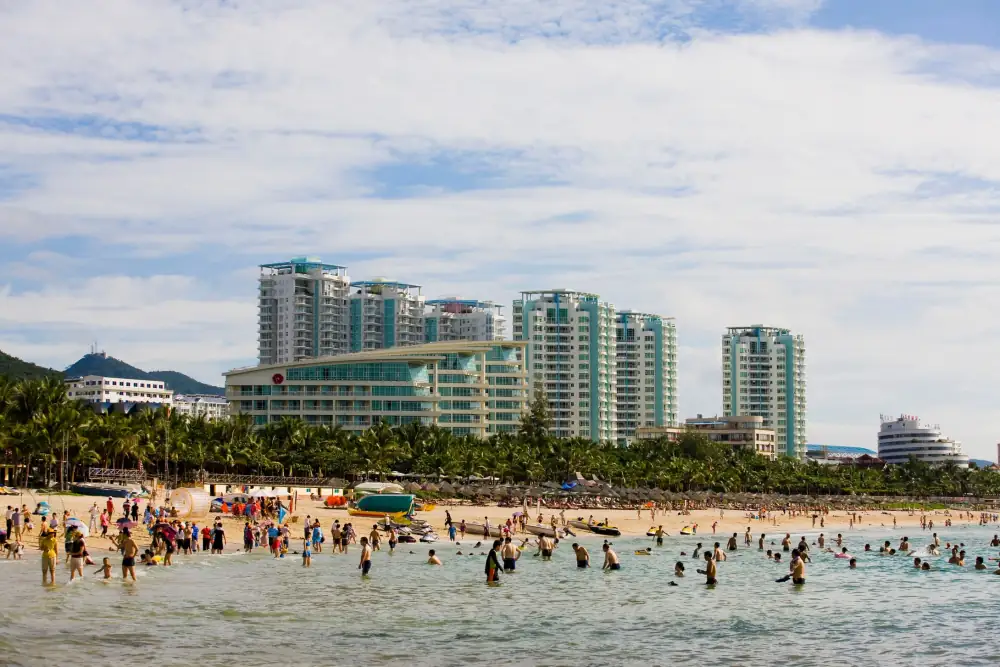
Yalong Bay (亚龙湾)
Best beach quality: The widest (1.5km), longest (7.5km), and most international resort strip. The sand is the whitest in Sanya; the hotel density (Park Hyatt, Ritz-Carlton, Sheraton) makes it the luxury resort destination.
For water clarity: The best in Sanya — visibility 15–20 metres for snorkelling in calm conditions.
The resort strip: The international hotels front the beach directly. The area lacks authentic local character but delivers pure beach resort experience.
For non-resort guests: The public beach area at the east end is accessible without a hotel booking; facilities are basic but the sand and water quality are identical to the resort sections.
Haitang Bay (海棠湾)
Most developed recent area: The newest major beach development — less crowded than Yalong, with several ultra-luxury hotels (Atlantis Sanya, Rosewood, Four Seasons) and the China Duty Free International Shopping Complex (全球最大的单体免税店 — claimed largest single duty-free shopping complex in the world).
For shopping: The duty-free complex sells international luxury brands, cosmetics, electronics, and food at prices significantly below mainland retail (and competitive with major global duty-free hubs).
Dadonghai (大东海)
Most affordable: The oldest resort area, closest to Sanya city, with a mix of Chinese domestic tourists and international visitors. Less pristine than Yalong but more authentic city-beach atmosphere. More budget accommodation options (roughly ¥150–¥400/night), and the surrounding streets have the most concentrated seafood restaurant district.
Tianya Haijiao (天涯海角)
The scenic point: The rocky headland with distinctive rock formations — historically considered the end of the world (“天涯海角” = “Edge of the Sky, End of the Sea”) and inscribed with calligraphy commemorating various banished officials. More scenic than swimable. Worth a half-day visit.
Which Is the Best Beach in Sanya?
Yalong Bay (亚龙湾) is the best beach in Sanya for most visitors, and it is not close:
- Sand: The whitest, finest sand of any Sanya beach, on a 7.5km crescent wide enough that it never feels as packed as Dadonghai.
- Water: The clearest water on the mainland coast — 15–20 metres of visibility in calm conditions, with the best snorkelling short of taking the boat to Wuzhizhou Island.
- Infrastructure: An unbroken strip of international five-star resorts means lifeguards, loungers, water sports and restaurants directly on the sand, and a public section at the east end keeps it accessible to non-guests.
The exceptions: Dadonghai wins for budget travellers and anyone prioritising seafood restaurants and city life over pristine sand, and Haitang Bay wins for newer luxury hotels, duty-free shopping and thinner crowds. But if the question is simply which beach is best, the answer is Yalong Bay.
Water Activities
Diving: Sanya has multiple dive sites with warm clear water. The most popular:
- West Island (西岛): Accessible coral sites, suitable for beginners
- Sanya Marine Park: Protected reef, better coral health
- Wuzhizhou Island (蜈支洲岛): The best overall diving area, also excellent snorkelling, 30 minutes by boat from Haitang Bay
Snorkelling: Strong at Wuzhizhou Island and in the outer Yalong Bay. Mask and fins available for rent at all beach areas.
Surfing: North Hainan (Wanning, Riyue Bay 日月湾) has China’s best surf — not Sanya itself. Riyue Bay works when northeast swells run from October through March.
Nanshan Cultural Tourism Zone (南山文化旅游区)
A Buddhist cultural complex containing the 108-metre Guanyin Statue — a three-faced bronze statue of Guanyin (海上观音) standing on a lotus platform in the sea, the tallest Guanyin statue in the world. The site is a functioning Buddhist pilgrimage destination as well as a tourist attraction.
The path to the statue: An 800-metre causeway walk leads to the statue’s platform; the views back to the coast from the base are excellent.
Admission: ¥150.
Hainan Seafood
The seafood is, without serious competition, one of the best reasons to visit Sanya. Hainan’s South China Sea location provides tropical species not found in northern Chinese waters:
- Tiger prawns (老虎虾): Grilled over charcoal with garlic and soy; remarkable size and sweetness.
- Flower crab (花蟹): The distinctive blue-marked swimming crab of the South China Sea; best steamed with ginger vinegar.
- Grouper (石斑鱼): Steamed with ginger and scallion; quality in Sanya is exceptional.
- Bamboo clams (竹蛏): Grilled with garlic and glass noodles; the standard opening dish at every Sanya seafood restaurant.
Where to eat: The First Market (第一市场) near Dadonghai is the established approach — buy fresh seafood from ground-floor vendors (price negotiation expected), then take it upstairs to restaurants that cook it for a service fee. More authentic and better value than restaurant-procured seafood.
Best Season

November–April: The optimal window. Dry season; water temperature 24–27°C; minimal rain; pleasant land temperatures (22–28°C). This is the peak season for Chinese domestic tourism.
May–October: Typhoon season. Hainan is affected by approximately 5–6 typhoons per year, most hitting between August–October. The summer months can have significant rain and storm disruption.
Practical recommendation: Visit November–March for the best beach experience. Prices are higher but conditions are significantly better.
Getting There
Sanya Phoenix International Airport has direct flights from Beijing (3.5 hours), Shanghai (3 hours), Guangzhou (1.5 hours) and most major Chinese cities. High-speed trains also circle the island from Haikou in the north.
How Sanya Compares to Southeast Asian Alternatives
| Factor | Sanya | Phuket | Bali |
|---|---|---|---|
| Price | Medium-high | Medium | Low-medium |
| Beach quality | Good-excellent | Good-excellent | Variable |
| Diving | Good | Very good | Excellent (Nusa) |
| Culture | Chinese resort | Thai-international | Indonesian-specific |
| Food variety | Chinese-dominant | International | Local-international |
| Crowds | Very busy Chinese holidays | Variable | Variable |
Sanya’s advantage: Chinese-language comfort for Chinese visitors; good value for domestic flights; no visa issues for Chinese nationals. For international visitors, Sanya is a different experience from Southeast Asia — worth visiting as a China holiday component, but not a direct substitute for the Southeast Asian destinations.
Also see: Hainan Island Guide | China Summer Travel Guide | China Beach Destinations Guide