
Shanghai street food is a study in contrasts. The city has some of the best fine dining in Asia, and it also has breakfast dumplings eaten from a paper bag on a street corner. Both are worth your time. The trap most visitors fall into is going straight for the famous names and missing the everyday food culture that runs this city — the lane-side noodle shops, the predawn shengjianbao queues, the working-class seafood markets that restaurants source from.
Table of contents
Open Table of contents
- Xiaolongbao: The Ranking That Matters
- Shengjianbao: The Morning Queue You Should Join
- The Best Street Food Streets in Shanghai
- Yuyuan Garden Area: Tourist Prices, Some Real Food
- Tongchuan Road Seafood Market
- Neighbourhood-by-Neighbourhood Eating
- Classic Shanghai Dishes You Shouldn’t Miss
- Practical Shanghai Food Notes
Xiaolongbao: The Ranking That Matters
Xiaolongbao (小笼包, soup dumplings) are Shanghai’s most iconic food, and there’s a genuine spectrum of quality that most guides don’t bother distinguishing.
Din Tai Fung (鼎泰丰)
The Taiwanese chain is technically excellent. The skin is reliably thin, the soup is always there, the pork-to-soup ratio is calibrated. What it lacks is character. Prices are high for Shanghai at ¥98-138 for a basket of 10, and the branches in Shanghai (Xintiandi, Grand Gateway) feel like airport-quality upscale dining. Go if you’ve never had XLB before. Skip if you have.
Nanxiang Steamed Bun Restaurant (南翔馒头店)
Inside Yuyuan Garden, with a permanent queue that stretches into the street. The ground-floor takeaway counter sells smaller, cheaper versions (¥28 for 6) while the upstairs restaurant serves the full sit-down experience (¥50-80 for baskets). The takeaway line is worth doing once — the dumplings are good, genuinely old-school, and the Yuyuan setting adds something.
The queue is usually 30-60 minutes on weekends. Arrive before 10am or after 2pm for a shorter wait.
Local Neighbourhood Shops
This is where you get the best value. Small xiaolongbao shops in residential areas of Jing’an, Changning, and Yangpu districts serve baskets of 8 for ¥18-28, steamed in bamboo right in front of you. The quality varies but the best local shops rival anything in the tourist areas. Ask your hotel or hostel staff which local spot they actually go to — this is the most reliable way to find them.
How to eat XLB correctly: Use a soup spoon under the dumpling, bite a small hole in the skin, let the soup run into the spoon, drink it, then eat the dumpling. Don’t stab it from the top. Don’t bite it in one go and burn your mouth.
Shengjianbao: The Morning Queue You Should Join
Shengjianbao (生煎包) are pan-fried dumplings — heavier than XLB, with a crispy base, a softer top dusted in sesame and spring onion, and a pork filling with soup inside. They’re properly delicious and eaten primarily for breakfast.
The ritual: queue at a neighbourhood shengjianbao shop before 9am, order by weight (usually ¥12-20 per jin, about 8-10 pieces), wait a few minutes, and eat standing at the counter or on the street.
Best spots:
- Yang’s Fry-Dumpling (小杨生煎) — reliable chain with branches across Shanghai, including near People’s Square. ¥8-10 for 4 pieces.
- Da Hu Chun (大壶春) — the traditional Shanghai institution near the Bund area, open since 1932. Slightly crispier base than Yang’s.
- Local neighbourhood versions — any shop with a griddle pan and a morning queue is worth trying.
The Best Street Food Streets in Shanghai
Shanghai’s old dedicated food streets have thinned out as the city has modernised, but a few concentrations of street eating remain worth targeting.
Yunnan South Road (云南南路), a short walk from People’s Square, is the last proper old-school food street — a single block of century-old eateries and snack counters selling shengjianbao, pork ribs with rice cakes, and roast duck. Cheap, crowded, and open late.
Wujiang Road (吴江路), by Nanjing West Road metro, is the polished modern version — a pedestrian lane of small restaurants and snack stalls including a popular Yang’s Fry-Dumpling branch. Good for a low-effort first night.
The lanes around Yuyuan Garden are the most touristed but still deliver real snacks (see below). And honestly, the best street food in Shanghai is often not on a “street” at all — it’s the breakfast stalls in residential lanes across Jing’an and the French Concession, which only operate until about 10am.
Yuyuan Garden Area: Tourist Prices, Some Real Food
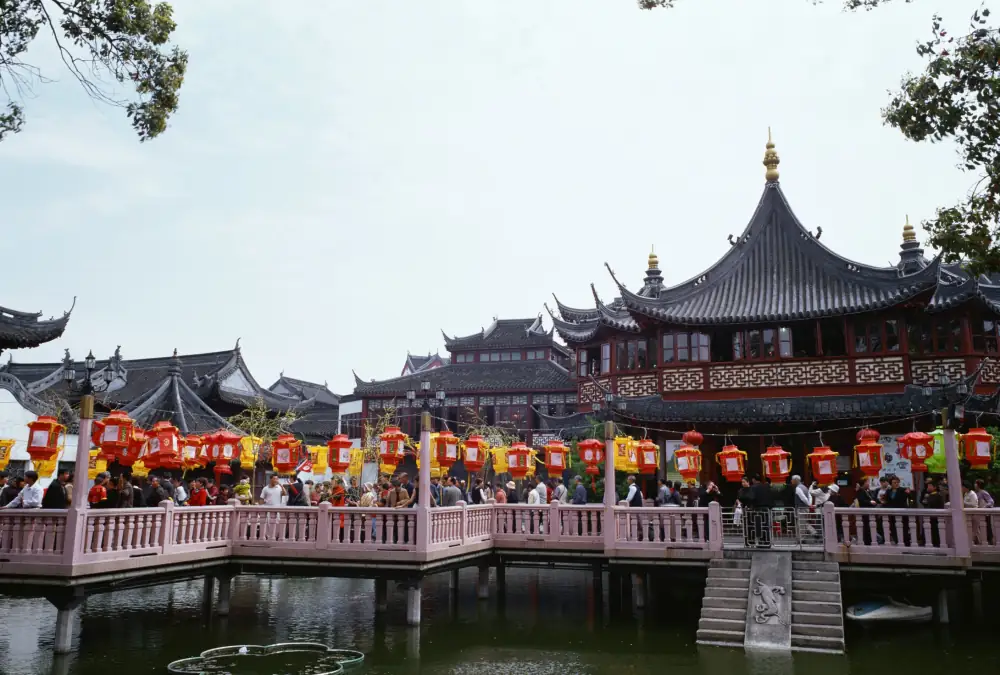
Yuyuan Garden (豫园) tourist area is undeniably commercial. The lanes around the Ming dynasty garden are full of souvenir shops and overpriced restaurants. But there are genuinely good things to eat here if you know what to look for.
Pan-fried crab shell pastry (蟹壳黄, xièké huáng) — a flaky pastry filled with pork or sesame paste, baked until golden, at ¥8-12. The name refers to its crab-shell colour, not the filling. Get it from the small bakeries along the lanes, not the large restaurants.
Osmanthus cake (桂花糕) — sweet rice cake flavoured with osmanthus flowers, a traditional Shanghai sweet at ¥15-25 for a box.
The Nanxiang Xiaolongbao takeaway here is also legitimately good (see above).
Tongchuan Road Seafood Market
Tongchuan Road Seafood Market (铜川路水产市场) in Putuo District is where many of Shanghai’s restaurants source their seafood. It’s not a tourist attraction — it’s a working wholesale market — which is exactly why it’s worth visiting.
The market is biggest in the early morning (5-9am) but some vendors trade through the day. You can buy live crabs, freshwater and saltwater fish, prawns, and shellfish at wholesale-adjacent prices. Some vendors have cooking facilities or will pack purchases for you to take to a nearby restaurant (many restaurants in the area will cook your market purchases for a small fee).
Hairy crab season (大闸蟹, dàzhà xiē) runs October-November, and Tongchuan Road is the best place in Shanghai to buy them at non-restaurant-markup prices. Expect to pay ¥50-150 per crab depending on size and sex (females are more prized for their roe).
Getting there: Zhenru metro station, Line 11, then taxi or walk 10-15 minutes north.
Neighbourhood-by-Neighbourhood Eating
French Concession (法租界)
The most concentrated eating neighbourhood for mid-range dining. The former French Concession streets — Wukang Road, Changle Road, Julu Road — are lined with independent restaurants. This is where Shanghai’s best Western and fusion restaurants are, but also good Shanghainese sit-down places.
Local recommend: Try the lane-side cong you bing (葱油饼, scallion pancake) stalls operating out of converted doorways. ¥5-8 for a pancake. Best eaten immediately.
Jing’an District
More commercial but also more accessible. The area around Jing’an Temple metro station has good street food in the adjacent residential lanes.
Try: Hongshao rou (红烧肉, red-braised pork belly) at the rice plate restaurants — the Shanghainese version is sweeter and more soy-forward than other regional styles. ¥20-35 for a rice plate.
Huangpu/Old City Area
Around the old city (around Laoximen station) is where you find old Shanghai food culture before it got gentrified. Couzhi mian (粗竹面, thick bamboo noodles) shops, traditional breakfast shops, and old-school rice wine bars.
Jiaotong University Area (徐汇)
Surrounded by university students, this area has the best value eating in Shanghai. Budget ¥15-30 per meal. The Nanchang Road and surrounding streets have excellent noodle shops.
Classic Shanghai Dishes You Shouldn’t Miss
Hongshao rou (红烧肉) — slow-braised pork belly in soy sauce, sugar, and Shaoxing rice wine. Meltingly tender. The defining Shanghai flavour profile: sweet-savoury.
Smoked fish (熏鱼, xūnyú) — cold sliced fish marinated in soy and five-spice, served as a starter. Common in Shanghainese homes and traditional restaurants at ¥25-45 per plate.
Scallion oil noodles (葱油拌面, cōngyóu bànmiàn) — noodles tossed in scallion-infused oil and soy sauce. Deceptively simple and genuinely excellent. ¥10-18 at most noodle shops.
Drunk chicken (醉鸡, zuìjī) — cold poached chicken marinated in Shaoxing rice wine. Often served as a cold appetiser at ¥35-65 per plate.
Practical Shanghai Food Notes
Meal times: Lunch is 11:30am-1:30pm; dinner 5:30pm-9pm. For popular local restaurants, arrive at the start of service to avoid waits.
Budget eating: A full meal at a local restaurant costs ¥25-50 per person. Street breakfast ¥8-20. You can eat well in Shanghai on ¥100/day for food.
Payment: WeChat Pay and Alipay are universally accepted. Foreign visitors can link international credit cards to WeChat Pay. Some old-school local shops are still cash only.
Language: Shanghai restaurant staff increasingly have limited English menu capability, but photo menus are common. Google Translate camera works reasonably well on Chinese menus.