
Table of contents
Open Table of contents
A Burmese Jade Treasure in Shanghai
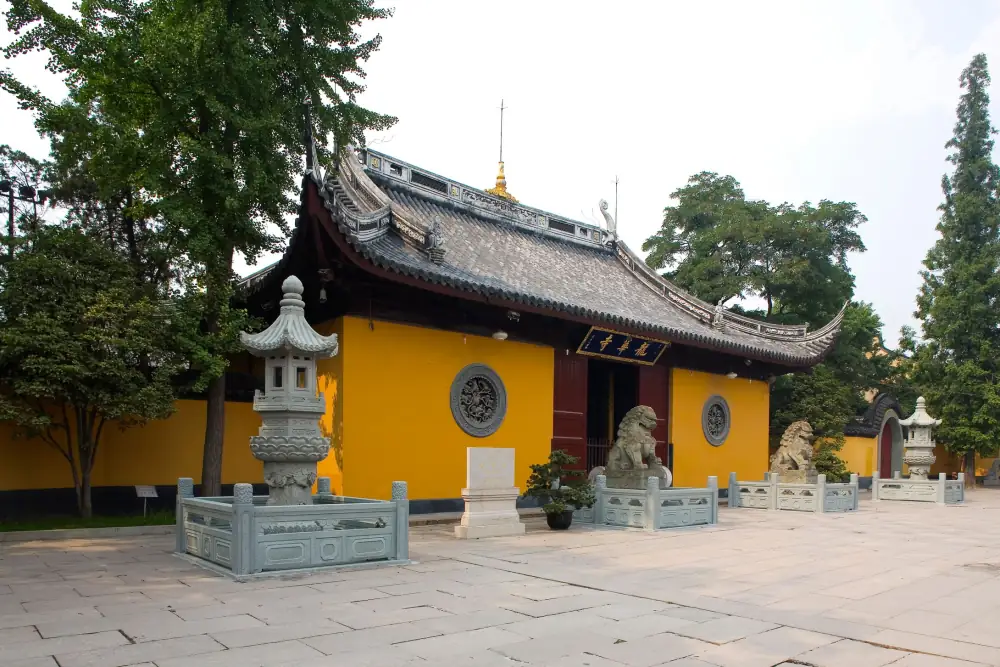
The Jade Buddha Temple (玉佛禅寺, Yùfó Chán Sì) owes its existence to an unlikely chain of events. In 1882, a monk named Huigen travelled from China to Myanmar in search of Buddhist teachings and sacred items. In Rangoon, he was given five jade Buddha statues carved from a single piece of white Burmese jade. He carried them back to China, stopping in Shanghai on his return journey to Putuoshan Island in Zhejiang.
Two of the statues remained in Shanghai when the ship could not accommodate all five on the final leg of the journey. A small temple was built to house them. The current temple — rebuilt in its present form in 1928 after a fire — grew around these two statues: a seated Buddha 1.95 metres tall and a reclining (sleeping) Buddha 96 centimetres long.
The jade used is of extraordinary quality — the finest white Burmese jade, almost translucent, with a natural variation of tone from deep green to pure white that catches light differently throughout the day. The seated Buddha’s eyes and eyebrows are set with precious stones. To see these statues is to understand immediately why jade has been considered the most sacred material in Chinese culture for thousands of years.
The Temple Today: Active Monastery
Unlike some Chinese temples that function primarily as museums, the Jade Buddha Temple is a fully functioning Chan (Zen) Buddhist monastery with monks in residence. Morning and evening chanting rituals are performed daily. The temple is affiliated with the Chinese Buddhist Association and is considered one of the most important Buddhist institutions in eastern China.
The abbot’s lineage traces back to the Caodong school of Chan Buddhism. The temple maintains a library of Buddhist texts, a lecture hall for dharma talks, and accommodation for monks in training. This active spiritual life gives the temple an energy that purely tourist-oriented religious sites lack.
Key Areas to Visit
The Hall of Heavenly Kings (天王殿)
The first hall you enter, guarded by two large bodhisattva protectors. At the centre is the popular Maitreya Buddha — the laughing, fat-bellied figure beloved across China — facing the entrance. On the opposite side of the hall, facing the inner courtyard, is the fierce deity Wei Tuo, protector of Buddhist dharma.
The Grand Hall (大雄宝殿)
The main worship hall houses a triad of large golden Sakyamuni Buddhas. This is where the community gathers for morning and evening chanting, and where laypeople come to burn incense and prostrate in prayer. During ritual periods, monks in grey robes circle the hall in meditative procession.
The Jade Buddha Hall (玉佛楼)
The most visited area of the temple, on the upper floor of a separate building. The seated white jade Buddha commands a dedicated hall, displayed on a raised altar with offerings of flowers and fruit. Photography of the jade statues is typically restricted — confirm at the entrance. Viewing this statue up close is quietly extraordinary; the craftsmanship and the quality of the jade create a presence that goes beyond conventional aesthetics.
The sleeping (reclining) Buddha, representing Sakyamuni’s entry into Parinirvana at death, is displayed in a separate room. At 96cm it is smaller than many expect, but the quality of the jade and the fine carving are apparent even at this scale.
The Sutra Library and Exhibition Hall
Adjacent buildings house a collection of Buddhist texts and periodic exhibitions on Chinese Buddhist art. Check the temple’s schedule for special exhibitions.
Admission and Visiting Practical Information (2026)
Tickets
- Standard entry: ¥50
- Children under 1.2m: Free
- Students with ID: ¥25
The ticket price includes access to all main halls and the Jade Buddha Hall. Photography is permitted in most areas except specifically marked zones.
Opening Hours
Tuesday–Sunday: 8:00 AM – 5:00 PM (last entry 4:30 PM) Monday: 8:00 AM – 5:00 PM (limited access during cleaning/maintenance periods)
During major Buddhist festivals, particularly Lunar New Year, Buddha’s Birthday (Vesak, in late April or May), and the Mid-Autumn Festival, the temple is extremely crowded and has extended hours. Arrive early.
Visiting Etiquette
The Jade Buddha Temple takes its religious function seriously and expects appropriate behaviour from visitors:
- Dress: Cover shoulders and knees. A scarf or light layer is available for borrowing at the entrance.
- Shoes: Remain on throughout. Don’t sit on altar platforms.
- Photography: Ask or check signs before photographing monks, active rituals, or the jade statues.
- Noise: Speak quietly. Don’t make phone calls in the main halls.
- Incense: Burning incense is welcome. Incense sticks are available at booths for ¥10–20.
- Prostrations: You may observe or participate in prostrations (three bows) before the Buddha statues. There is no requirement to participate.
- Entering halls: Stand to the side rather than the centre of the entrance threshold when entering or exiting halls.
The Temple Vegetarian Restaurant
One of Shanghai’s most famous vegetarian restaurants operates within the temple complex. The food is not simply vegetables on a plate — it is a sophisticated expression of Buddhist cooking philosophy, using cooking techniques and flavour combinations that manage to be simultaneously simple and complex.
Signature dishes:
- Mock meat preparations: Buddhist cuisine is famous for creating meat-like dishes entirely from tofu, mushrooms, and gluten. The mock roast duck and mock red-braised pork belly are considered the best in Shanghai by many food critics.
- Vegetarian dim sum: A selection of steamed and pan-fried dumplings, buns, and rolls made without any meat or egg.
- Temple mushroom broth: A clear mushroom consommé of startling depth and flavour.
- Eight-treasure glutinous rice: A classic Chinese dessert with fruit, nuts, and preserved ingredients.
Prices: ¥80–150 per person for a full meal. The quality justifies the cost. Reservations recommended for weekend lunches.
Hours: 11:00 AM – 1:30 PM (lunch), 5:00–7:00 PM (dinner, limited days). Check current hours.
Getting to the Jade Buddha Temple
Metro
Shanghai Metro Line 7 has a stop at Changshu Road (常熟路站), about 10 minutes’ walk. Alternatively, Line 13 to Jiangning Road (江宁路站) is very close.
From The Bund: Take Line 2 east to People’s Square (人民广场), transfer to Line 1 or Line 7. Journey approximately 25 minutes.
From Hongqiao Railway Station: Take Line 2 east toward the city, about 20 minutes to the city centre area, then transfer.
From Pudong Airport: Line 2 direct to central Shanghai, then transfer to Line 7. About 50–60 minutes total.
Taxi/Didi
From Nanjing East Road/The Bund area: 15–25 minutes, ¥25–40 depending on traffic. From Jing’an area: 10 minutes, ¥15–20.
Combining with Nearby Attractions
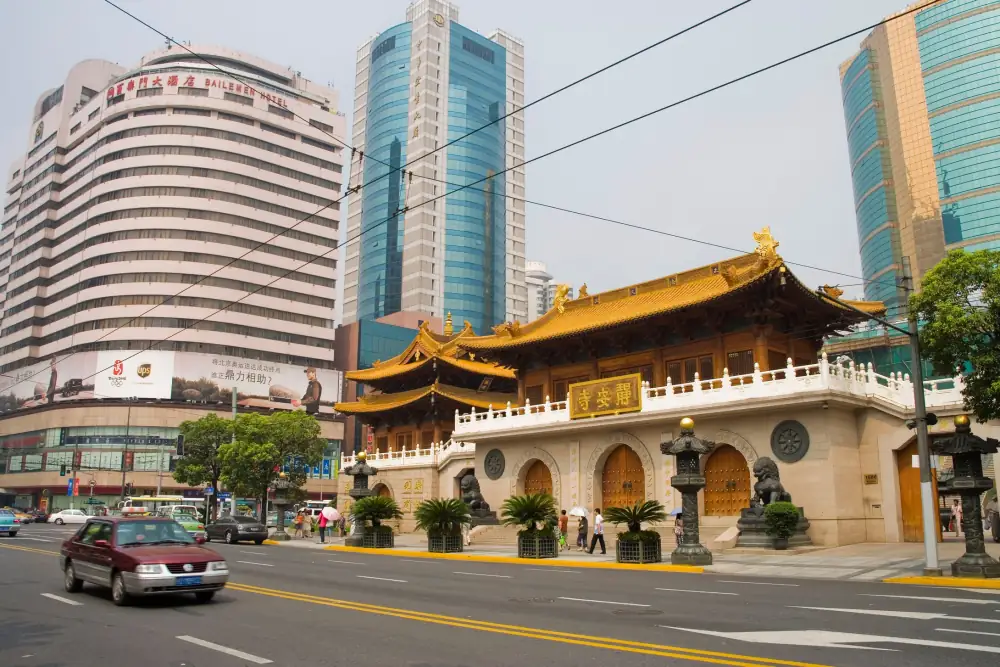
Jing’an Temple (静安寺)
Just 1km south of the Jade Buddha Temple, Jing’an Temple sits in the heart of Shanghai’s most fashionable commercial district — an ancient Buddhist temple surrounded by luxury shopping and glass towers. The contrast is jarring and fascinating. Entry ¥50.
Jing’an District Boutiques and Restaurants
The Jing’an area surrounding both temples is Shanghai’s most interesting neighbourhood for independent fashion, coffee, and restaurants. After the temple, an afternoon walking the streets between Wujiang Road (吴江路) and Nanjing West Road is time well spent.
Xintiandi (新天地)
About 3km south, Shanghai’s most famous heritage commercial precinct — old Shikumen lane houses converted to restaurants, bars, and boutiques. A pleasant evening destination after temple visits.
Seasonal Considerations
Lunar New Year
The temple fills with worshippers burning incense and making offerings during the Lunar New Year period. The first day of the new year sees the most intense crowd but also the most celebratory atmosphere.
Buddha’s Birthday (Vesak, April–May)
A major Buddhist festival at the temple with special ceremonies and processions. Check the lunar calendar for the exact date each year.
Regular Weekends
Can be crowded from 10 AM onward. Visiting at 8:30 AM when the temple opens gives 90 minutes of relative calm before the tourist groups arrive.
A Note on Respect
The Jade Buddha Temple welcomes visitors of all faiths and backgrounds — but it does so as a religious institution welcoming guests into a sacred space, not as a tourist attraction that happens to have religious decor. The distinction matters.
Visiting with the intention of experiencing something genuinely outside your ordinary experience — not just photographing the jade statues for Instagram — tends to produce the most memorable encounters. Sit quietly in the Grand Hall during a ritual period. Watch the monks at their work. Notice the faces of the elderly women prostrating before the Buddhas. This is the living Jade Buddha Temple.