
The French Concession is where Shanghai’s international personality is most visible and most layered. Between the plane-tree-lined avenues, the art deco apartments, the 1930s jazz-age mansions, and the converted alleyways, this neighbourhood holds more architectural and cultural density per square kilometre than almost anywhere else in Asia.
Most visitors come for Tianzifang — a warren of converted shikumen alleyways that became Shanghai’s primary artisan and café district. This guide covers that, but also the broader French Concession, which rewards several hours of aimless walking.
Table of contents
Open Table of contents
What Is the French Concession?
The French Concession (法租界, Fǎ Zūjiè) was the area of Shanghai under French municipal administration from 1849 to 1943. During its peak in the 1920s–30s, it was a sovereign urban territory within China: French law, French police, French schools, and a mixed population of wealthy Chinese, European and Russian émigrés, and a cosmopolitan business class.
The architectural legacy is extraordinary: French baroque apartment buildings, art deco villas, shikumen (石库门) longtang terraced housing — a hybrid form developed for the dense urban conditions of the concession, combining Chinese courtyard principles with Western terrace housing forms — and 60,000 plane trees (Platanus acerifolia) that still shade the main avenues.
After 1949, the architecture remained largely intact; the social fabric changed completely. Since the 1990s, it has transformed again into Shanghai’s most desirable residential and hospitality district.
Tianzifang (田子坊)
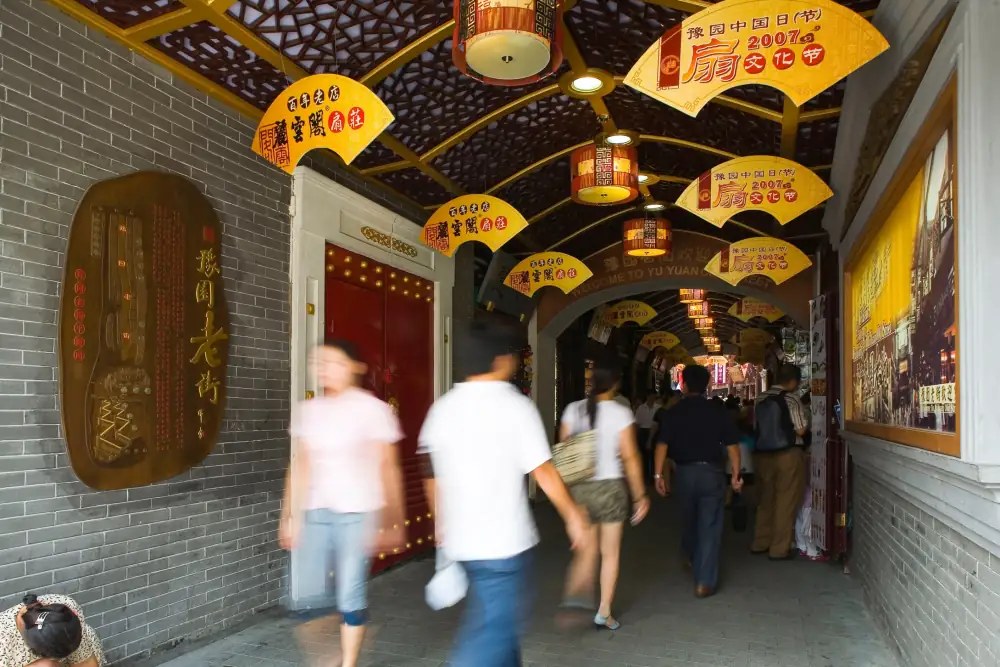
The starting point for most French Concession visitors. Three interconnected shikumen alleyways — Taikang Road lanes 210, 248, and 274 — converted gradually from the late 1990s onward from residential and small manufacturing uses into independent shops, studios, cafés, and restaurants.
Unlike Shanghai’s many top-down development projects, Tianzifang grew organically from artist initiative and resident entrepreneurship. The physical density — narrow lanes, overhead pipes, stairwells climbing to second-floor studios, flower pots on every ledge — reflects this bottom-up character.
Metro: Line 9 to Dapuqiao Station (Exit 1), then 5-minute walk.
What’s Worth Doing
Just walk. The best Tianzifang experience is getting lost in the lanes, turning into dead ends that reveal a welder’s workshop next to a ceramics studio next to a Japanese ramen counter. There is no “right” route.
Coffee: Multiple independent coffee shops in Tianzifang have become genuine craft coffee destinations — in a city that takes specialty coffee seriously (Shanghai has more specialty cafés per capita than any other Chinese city). Look for Sumerian Coffee (苏美咖啡) and the half-dozen others in the inner lanes.
Craft and design shops: The best are hidden in the upper floors and deeper lanes — handmade ceramics, leather goods, hand-block-printed textiles, handbound books. The main-lane shops facing Taikang Road tend toward tourist merchandise; go deeper.
Food: The food in Tianzifang itself is adequate but overpriced. A better strategy: have coffee or a snack inside, then eat at one of the restaurants just outside on Taikang Road or nearby Jiaozhou Road.
Avoid peak hours: 11 AM–4 PM on weekends in summer is extremely crowded. Either arrive before 10 AM or after 5 PM.
The Broader French Concession: Walking Routes
The Plane Tree Avenues
Wukang Road (武康路) is the most architecturally dense street in the French Concession — and increasingly in the broader Shanghai — with the Wukang Mansion (武康大楼) at its northern end: a 1924 American-designed apartment building in a triangular city-block configuration, one of Shanghai’s most photographed buildings.
Walking south from Wukang Mansion along Wukang Road: Spanish baroque, Norman Gothic, art deco, and Tudor revival buildings alternate with plane trees. Embedded among them:
- Zhongguixin Mansion (宋庆龄故居): The former residence of Soong Ching-ling, wife of Sun Yat-sen and a major political figure in 20th-century China. Museum open Tuesday–Sunday, ¥20.
- Several independent bookshops, florist studios, and niche design stores have occupied former residential properties along the street.
Anfu Road (安福路): One block north of Wukang Road — the street where Shanghai’s independent fashion and arts scene concentrated in the early 2020s. Shanghai Dramatic Arts Center (上海话剧艺术中心) anchors the east end; fashion and furniture boutiques run west. The density of interesting independent restaurants and bars on this 700-metre stretch rivals any comparable street in East Asia.
Fuxing Road (复兴路): The main east-west artery through the heart of the French Concession. The wide boulevard lined with massive plane trees is best appreciated in autumn (October–November) when the leaves turn gold. Walking west along Fuxing Road takes you past the former residences of multiple historical figures and into increasingly residential territory.
Former Residences and Historical Sites
Zhou Enlai’s Former Residence (周恩来旧居): 73 Sinan Road. The house where China’s first Premier lived in the 1940s, preserved with period furnishings. Free; open Tuesday–Sunday 9:30 AM–4:30 PM.
Sun Yat-sen’s Former Residence (孙中山故居): 7 Xiangshan Road. The home where the founder of the Republic of China lived during his Shanghai years; also a good example of a restored shikumen mansion. ¥20; open daily 9:00 AM–5:00 PM.
Ruijin Hotel (瑞金宾馆): Once the family villa of the Morris family (a Shanghai business dynasty), now an upscale hotel. The grounds are a public park of sorts — beautiful lawns, century-old trees, and a mix of Tudor and Georgian architecture. Non-guests can walk the grounds and drink at the garden bar.
The Best Streets for Eating
Yongkang Road (永康路): Developed rapidly into a bar street in the 2010s, then overflowed into restaurants, and now functions as a 400-metre strip of serious eating and drinking from breakfast to 2 AM. Outstanding Vietnamese, excellent Japanese ramen, a wine bar that sources natural wine from small producers, and several excellent brunch spots.
Jiaozhou Road (胶州路): Less known, more local, more affordable. Good Shanghainese home cooking, a famous lamb noodle shop, and the kind of street snack economy (fried dough, scallion pancakes, steamed buns) that has largely been gentrified out of the main French Concession.
Ferguson Lane (Wuyuan Road area): A small cluster of international restaurants and upscale Chinese cuisine in a courtyard setting. Good for a more formal lunch or dinner.
What the French Concession Does Best
Coffee culture: Shanghai, led by the French Concession, has one of the most sophisticated specialty coffee scenes in the world. The concentration of independent roasters within the neighbourhood is remarkable — Manner Coffee (now a Shanghai chain) was founded here; Seesaw, Confucius Coffee, and dozens of smaller operations continue to push quality.
Brunch: Shanghai brunch culture centres on the French Concession. Weekend mornings on Anfu Road, Yongkang Road, and around Xintiandi are a major social ritual. Most restaurants take reservations for weekend brunch — book ahead.
Bars: The cocktail bar scene in the French Concession is internationally ranked. Speak Low (and its sequels), The Cannery, and numerous smaller bars have appeared in the World’s 50 Best Bars list. Reservations required for top spots; walk-in to others.
Practical Information
Best season: Autumn (September–November) for the plane tree foliage. Spring (March–April) for the Paulownia trees blooming purple along side streets.
Walking: Most of the French Concession is best explored on foot. From Tianzifang to Wukang Mansion is about 2 km; allow 3–4 hours for an unhurried walk.
Cycling: The dockless bike system (Meituan, Hello Bike) works well for longer stretches. However, the most interesting exploration is on foot through the smaller lanes.
Getting there: Metro Line 9 (Dapuqiao for Tianzifang), Line 10 (Xintiandi for the northern French Concession), Lines 1 and 4 (Changshu Road for the western section).
The French Concession takes multiple visits to understand. The first one covers the architecture and the famous streets. The second finds the restaurants and bars. After that, you start noticing the buildings themselves — their stories, their occupants, the decades compressed into a single block. It’s the kind of neighbourhood you miss when you leave.
Last updated: May 2026