
In 2001, the town of Zhongdian in northwest Yunnan officially renamed itself “Shangri-La” (香格里拉) — borrowing James Hilton’s fictional Himalayan paradise from his 1933 novel Lost Horizon. The branding worked: the town went from backpacker obscurity to major tourist destination within a decade.
The marketing aside, the landscape is genuinely extraordinary. Shangri-La sits at 3,160 metres on the edge of the Tibetan Plateau, surrounded by 4,000+ metre peaks, ancient Tibetan monasteries, and some of the most spectacular alpine scenery in Asia. The culture is equally compelling: this is the southernmost extent of functioning Tibetan Buddhist civilisation, with a continuous tradition going back 500+ years.
Table of contents
Open Table of contents
Essential Information
| Detail | Info |
|---|---|
| Province | Yunnan (northwest corner, bordering Tibet and Sichuan) |
| Getting there | Fly to Diqing Shangri-La Airport (DIG) from Kunming (1 hr), Chengdu, or Lhasa; or bus from Dali (5–6 hrs) or Lijiang (4 hrs) |
| Best season | April–October; best clarity June–September despite some rain; winter (November–March) dramatic with snow but cold |
| Altitude | Old Town: 3,160m; surroundings up to 4,000m+ |
| Altitude sickness | Serious risk — plan 2 days acclimatisation; avoid exertion on first day; carry altitude medicine (acetazolamide) as precaution |
Altitude: The Most Important Practical Issue
At 3,160 metres, Shangri-La is high enough to cause acute mountain sickness (AMS) in a significant percentage of visitors, particularly those arriving directly by air from lower elevations.
Symptoms: Headache, nausea, fatigue, dizziness, shortness of breath. Usually begins 6–12 hours after arrival.
Prevention:
- Arrive from Lijiang (2,400m) rather than Kunming (1,800m) to acclimatise gradually
- Don’t exert yourself on day 1 — no hiking, no strenuous walks
- Drink plenty of water; avoid alcohol on day 1
- Some travellers take acetazolamide (Diamox) as prophylaxis — consult a doctor before departure
- Eat lightly and rest early on the first night
When to descend: If you develop severe headache that doesn’t respond to paracetamol, vomiting, confusion, or difficulty breathing at rest, descend immediately. AMS can progress to life-threatening pulmonary or cerebral edema.
Most healthy visitors acclimatise comfortably within 24–48 hours and experience no lasting problems.
Ganden Sumtseling Monastery (噶丹松赞林寺)
The most important Tibetan Buddhist monastery outside Tibet proper — and the most impressive single structure in Yunnan. Built in 1679 by the Fifth Dalai Lama, Sumtseling is modelled on the Potala Palace in Lhasa, its two golden roofed assembly halls visible from 20 kilometres away across the plateau.
The monastery is actively functioning: approximately 700 monks in residence, daily prayer ceremonies (5:30 AM and 7:00 PM are the most atmospheric), and a full programme of religious and artistic life.
What to see:
- The main assembly hall (大殿): Enormous prayer hall with hundreds of butter lamps, tangka paintings covering the walls, and the sound of monks chanting from the raised platforms. Enter respectfully — remove hat, no flash photography of monks in prayer.
- The monastery circuit: Walk the kora (pilgrimage circuit) around the entire complex — approximately 2 km, passing prayer wheels, whitewashed chortens, and views across the surrounding wetlands. 45–60 minutes.
- The roof terrace: Accessible from the main hall stairs. The view from the golden roof finials across the plateau to the mountains is exceptional.
Tickets: ¥115 general admission. Open daily 8:00 AM – 5:30 PM.
Getting there: 5 km north of the Old Town; taxi ¥20–30 each way, or rental bike (45 min, flat terrain).
The Old Town (独克宗古城)
The “Old Town” of Shangri-La is largely reconstructed — much of the original burnt in a fire in 2014. The rebuilt area is more theme park than genuine heritage, but several original streets in the eastern section survived.
Worth seeing:
- The Giant Prayer Wheel (大转经筒): Claimed to be the world’s largest revolving prayer wheel, 21 metres high, at the top of Guishan Hill. Push the handles to rotate it — full clockwise circuits are merit-generating in Buddhist practice. Free; takes 10 minutes to walk up the hill.
- The Barkhor-style walking circuit: The streets around the prayer wheel form the local equivalent of Lhasa’s Barkhor — locals and pilgrims circling the hill daily with hand prayer wheels. Join the circuit; walk clockwise.
- Tibetan restaurants and cafés: The Old Town has a genuine Tibetan food scene — yak butter tea (酥油茶), tsampa (roasted barley flour), yak meat hot pot, butter lamp cookies. The main Changzheng Road has several good spots.
Honest assessment: The Old Town is atmospheric but not architecturally special post-fire. The monastery and surrounding landscapes are the main reasons to come.
Napa Lake (纳帕海)
A seasonal wetland plateau lake 8 km west of the Old Town at 3,260 metres. In summer (July–October), the lake fills with water and the surrounding grassland is green and flower-dotted. In winter, it partially drains and becomes a birding destination for migratory black-necked cranes.
The grassland in summer is available for horse riding (¥60–100/30 min, negotiable) and provides views of the surrounding peaks. The reflections of the 5,000+ metre mountains in the lake’s still morning surface are extraordinary.
Winter birding: November–February, the lake hosts significant populations of black-necked cranes, bar-headed geese, and other high-altitude migrants. A scope is useful; binoculars essential.
Baishuitai Terraces (白水台) and the Road Beyond
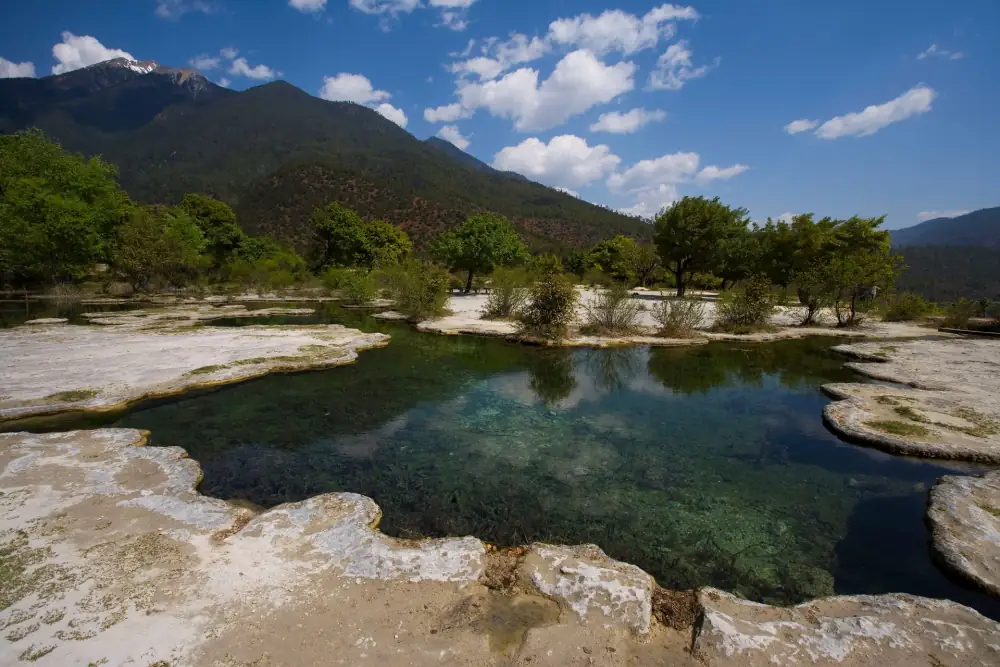
80 km southeast of Shangri-La, the Baishuitai terraces are natural calcium carbonate platforms built up by mineral spring water — the largest natural calcium carbonate terrace in China. Similar in principle to the Pamukkale terraces in Turkey, though smaller. Interesting half-day excursion; access by chartered taxi or tour vehicle.
Hiking: Routes Around Shangri-La
The high-altitude terrain around Shangri-La has genuine wilderness hiking.
The Five-Colour Lake (五彩池): In the Pudacuo National Park (普达措), 22 km east of town. The national park encompasses two lakes, wetlands, and conifer forest at 3,500–4,159 metres. Formal boardwalk circuit (8 km) through the park; ticket ¥258 including shuttle bus. One of the most beautiful alpine environments in China.
Haba Snow Mountain (哈巴雪山): The 5,396-metre peak across the Yangtze gorge from Tiger Leaping Gorge. Non-technical but strenuous high-altitude climb; guides and equipment available from operators in Shangri-La and Lijiang.
Practical Tips
Warm clothing: Even in summer, evenings at 3,160m are cold (10–15°C). Bring a down jacket. Winter temperatures drop to -15°C and below.
Food: Yak butter tea is an acquired taste — very salty, fatty, and warming. If you find it unpalatable, sweet milk tea (甜茶) is an alternative. Tsampa (roasted barley porridge) is nutritious and filling at altitude.
From Shangri-La to Tiger Leaping Gorge: The Gorge is 60 km south, 2 hours by bus. Many travellers combine the two into a 5–6 day circuit from Lijiang: Lijiang → Shangri-La (2 nights) → Tiger Leaping Gorge (2 nights) → Lijiang.
The name “Shangri-La” is marketing, but the place behind the name is real. The monastery, the plateau landscape, the Tibetan culture — these don’t require the branding to justify the trip.
Last updated: May 2026