
Hukou Waterfall: The Yellow River’s Great Thundering Gateway
The Yellow River (Huanghe) carries so much silt that its water looks like tea with too much milk — a characteristic that earned it its name and that makes its primary waterfall unlike any other in the world. Hukou Waterfall (壶口瀑布) — Kettle Mouth Falls — is named for the narrow gorge (shaped like a kettle’s spout) through which the Yellow River plunges from a broad 400-metre-wide channel into a slot barely 30 metres across.
At peak summer flow, over 1,000 cubic metres per second of yellow-brown water drops approximately 20 metres in this contraction, generating a mist visible 10 km away and a sound that has been described as simultaneously a roar and a howl. It is the largest yellow-water waterfall in the world and, in Chinese cultural imagination, the most powerful symbol of the nation’s primal energy.
The Physical Setting
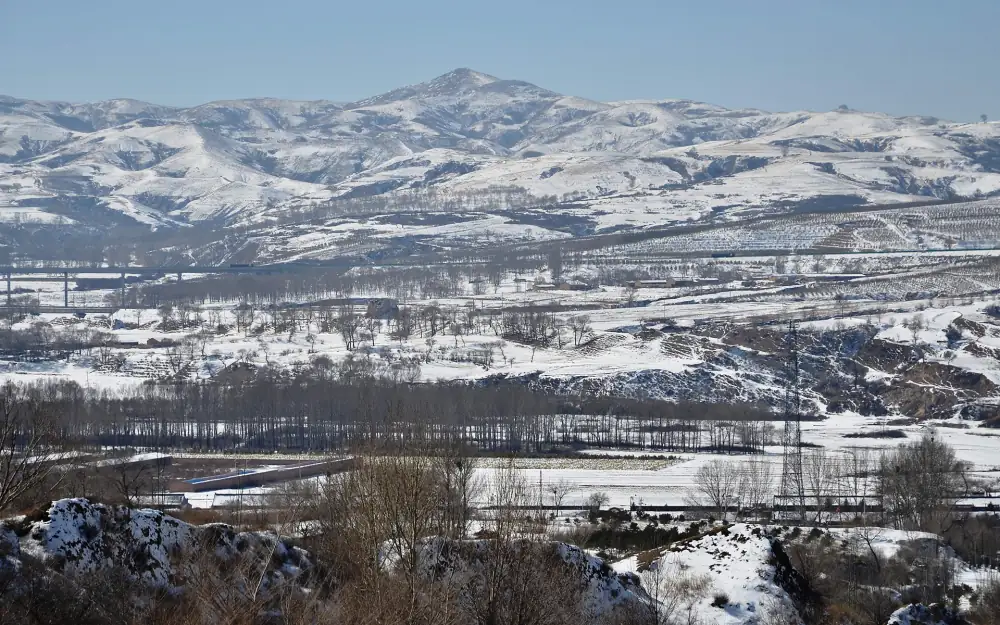
The Yellow River here marks the boundary between Shaanxi Province (to the west) and Shanxi Province (to the east). Both provinces have visitor infrastructure and entrance gates; the Shanxi (east) side is generally considered to provide the best views and is more commonly visited by tourists.
The site sits in a deeply eroded valley of red sandstone — Loess Plateau terrain where centuries of agriculture and erosion have created a landscape of gullies and ridges that looks ancient and almost barren. The Yellow River and its falls are the dominant geographical fact in this landscape.
Four Seasonal Characters
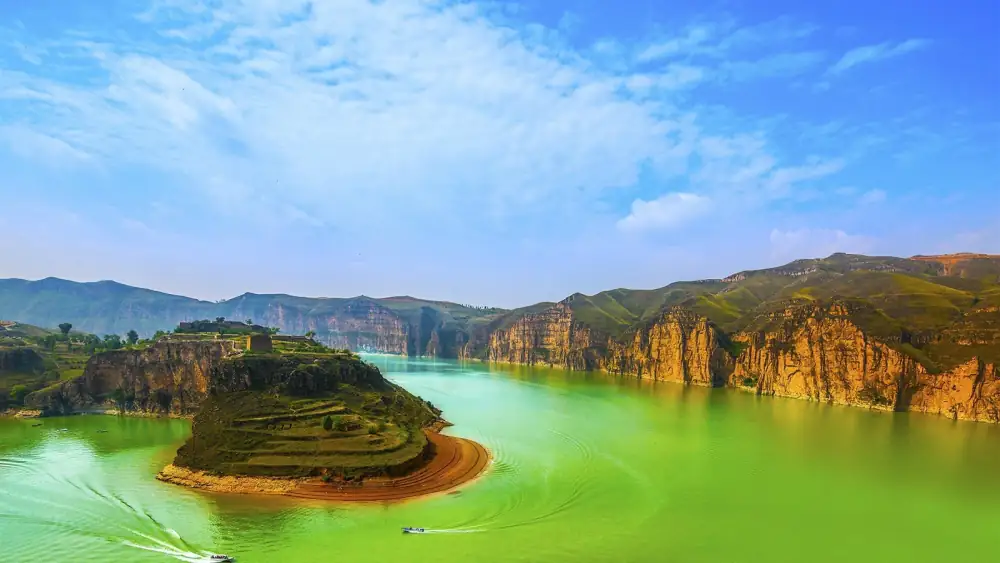
Unlike most waterfalls, Hukou has a dramatically distinct character in each season:
Spring (March–June): The Brown Flood
Spring snowmelt from the northern mountains floods the Yellow River, pushing it to maximum flow — sometimes over 8,000 cubic metres per second. The falls thunders with brown water; the mist rises continuously; the path near the edge is slippery with spray. This is the most cinematically impressive season but also the most challenging to visit.
Photography advice for spring: A rain cover for your camera is essential; the spray zone extends 50+ metres from the falls. A neutral density filter allows longer exposures that capture the motion of the water.
Summer (July–August): Monsoon Power
Monsoon rain augments the already-high spring flow; the Yellow River runs full and wild. The colour deepens to an almost terracotta brown. Access to some lower platforms may be restricted due to flood risk; follow safety instructions from the scenic area staff.
Autumn (September–October): The Golden Clarity
After the monsoon rains end, the river flow drops significantly, and the water takes on a richer, more golden-brown tone. The autumn light over the Loess Plateau turns the gullied landscape amber; the combination with the falls is the best for photography. Many Chinese photography enthusiasts time their visit specifically for late September or October.
Winter (December–February): The Ice Palace
In severe winters, the spray from the falls freezes in extraordinary formations. The mist zone becomes an ice palace — massive icicles, ice-coated rocks, frozen spray in abstract shapes extending 100+ metres from the falls. The river above and below the falls is partially frozen; the falls themselves (fed by the unfrozen deep channel) continue to flow within a frame of ice.
This is arguably the most spectacular and least-visited season. Temperatures reach -15°C to -20°C; dress accordingly.
Viewing the Falls
The Shanxi Side Viewing Area
The primary infrastructure is on the Shanxi side. A series of paved walkways descend from the car park level to the river’s edge, with three progressively closer viewing platforms:
Upper Platform: 200 metres from the falls’ lip; view of the entire contraction and spray column.
Middle Platform: 50 metres from the lip; close enough to feel the spray and hear individual tongues of water separate within the main flow.
Lower Platform (River Level): Reached via steep stairs during non-flood periods; you stand at the level of the river below the falls, looking up at the plunge. In peak flow season this platform is closed.
The Shaanxi Side Viewing Area
A similar infrastructure on the opposite bank provides different perspectives. Standing on the Shaanxi side and looking east, you see the Shanxi plateau rising behind the falls — a different compositional angle.
Crossing between the two sides is not possible at the falls themselves; you would need to drive to the nearest bridge.
Cultural and Symbolic Significance
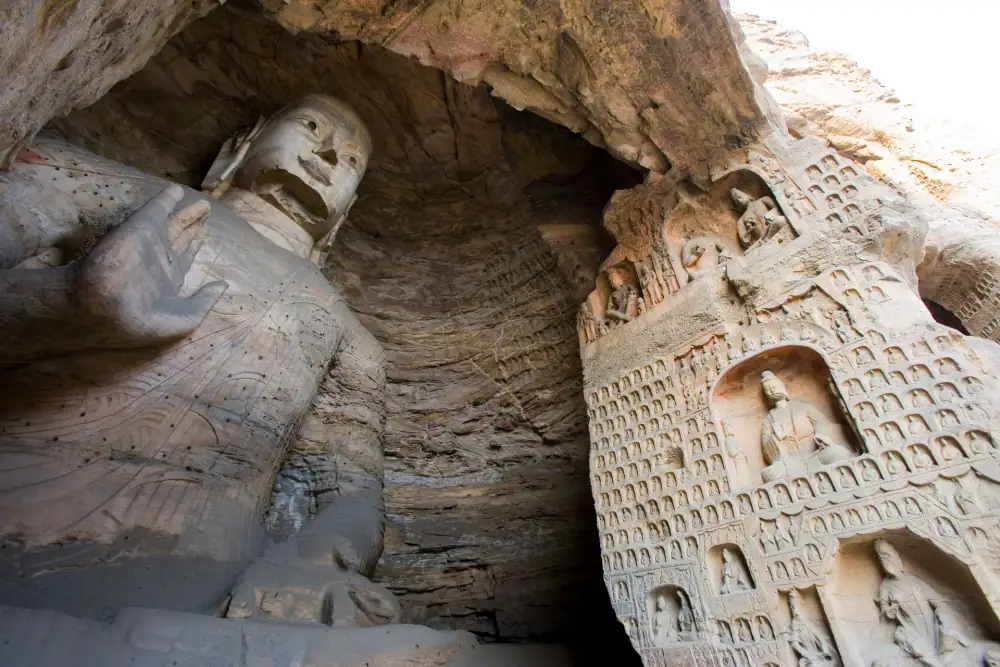
The Yellow River and Hukou Falls appear in Chinese national consciousness in ways that are not fully translatable to outsiders. The river is called China’s Mother River — it is the cradle of Chinese agriculture and, consequently, of Chinese civilisation itself. The Loess Plateau, where Hukou sits, is where the earliest Chinese states formed; the erosion of that same plateau feeds the silt that colours the river.
The poet Guang Weiran wrote Yellow River Cantata (黄河大合唱) in 1939, when the river represented the determination of the Chinese people during the war against Japan; Xian Xinghai set it to music, and it remains one of the most performed pieces of Chinese choral music. Its opening lines describe the river’s headwaters; its climax describes the falls at Hukou.
Visiting Hukou is, consciously or not, an encounter with this symbolic weight.
Practical Information
Getting There
From Xi’an (Shaanxi side):
- Bus from Xi’an to Jicheng or Yichuan counties (3–4 hours); taxi to the falls (30 minutes). Or direct tourist bus in summer (Xi’an Tourism Bureau operates weekend services).
From Taiyuan or Linfen (Shanxi side):
- Bus to Ji County (吉县) from Linfen (2 hours) or Taiyuan (3 hours); local bus or taxi 45 km to the falls.
Self-drive: The most convenient approach. From Xi’an: approximately 300 km (3.5 hours); from Taiyuan: approximately 280 km (3 hours).
Admission
¥95 (Shanxi side; includes all viewing platforms). ¥91 (Shaanxi side). Combination tickets are not issued; visiting both sides requires paying separately.
Best Season
| Season | Flow | Visual Quality | Crowds |
|---|---|---|---|
| April–June | Very high | Powerful, photogenic | Moderate |
| July–August | High | Excellent | High |
| September–October | Medium | Best photography | Low–Moderate |
| November–March | Low to medium | Ice formations (Dec–Feb) | Very low |
Hukou Falls does not invite contemplation — it demands it. Stand close enough to feel the spray and it fills your entire sensory field: sound, vibration, smell of river mud, golden-brown water. In that overwhelming present moment, whatever China means to you becomes more visceral and harder to reduce to language.