
Dehong Dai and Jingpo Autonomous Prefecture (德宏傣族景颇族自治州) occupies the westernmost tip of Yunnan, pressing against the Myanmar border for more than 500km. It belongs geographically and culturally to the Greater Mekong subregion more than to interior China — the tropical climate, the Dai people’s Buddhist traditions, the jade-and-gems trading economy, and the linguistic mix all feel closer to Southeast Asia than to the Chinese heartland.
Ruili (瑞丽) is the main city and the center of China’s jade trading industry. The city sits directly on the Myanmar border — in some sections, the two countries are separated by nothing more than a roadside marker — and the constant cross-border movement of goods, people, and culture has given Ruili a distinctive borderland atmosphere found nowhere else in China.
Table of contents
Open Table of contents
Getting to Dehong
By air:
- Mangshi Airport (芒市机场): Direct flights from Kunming (1 hour, ¥250–450), Chengdu, Guangzhou
- Mangshi is the prefectural capital, about 45km from Ruili; taxis and buses connect them (¥60–80 by taxi, ¥20 by bus)
By bus:
- From Kunming: About 10–12 hours by overnight bus; ¥200–280
- From Baoshan: About 3 hours; ¥70–100
Getting around Dehong:
- Motorcycle taxis dominate short-distance transport in Ruili (¥5–15 for most local trips)
- Electric bikes available for rent (¥50–80/day)
- Taxis for longer trips to temples and border areas (¥20–50)
Ruili Jade Market (瑞丽翡翠市场)
Ruili is China’s dominant jade (翡翠, jadeite) trading center. The city has hundreds of jade shops, wholesale markets, and individual traders, all ultimately connected to the jade mines of Kachin State in Myanmar, which produce the vast majority of the world’s jadeite.
The main jade markets:
- Yuzhe Jewelry Market (玉者珠宝城): One of the largest covered markets; multiple floors of individual stalls selling raw jade stones (毛料), cut and polished cabochons, finished jewelry, and carved objects
- Yuge Jewelry and Arts City (玉格珠宝城): More upscale; finished jewelry and carved pieces; prices higher but quality more reliable
- Wholesale Stone Market (原石市场): For raw uncut jade stones; primarily a trade market open to retail visitors; the daily stone auction (石头拍卖) is a spectacle — buyers bid on lots of raw stones whose interior quality is unknown
Buying jade in Ruili:
- Be realistic: identifying genuine high-quality jadeite requires years of experience
- Treated jade (processed with chemicals or dyed) is widespread and sold as natural at inflated prices
- Get a certificate: reputable dealers provide a lab certificate (鉴定证书) from a certified gemological institute; this costs ¥50–100 and is worth it for any purchase over ¥500
- If buying raw stones, understand that you are gambling — most visitors should stick to finished, certified pieces
- Price range: Small jade pendants start at ¥100–200 for commercial grade; genuine high-quality jadeite starts at ¥2,000–5,000 per piece and escalates rapidly
Market hours: Generally 9:00am–6:00pm; the stone auctions typically happen in the late morning
Dai Buddhist Temples & Pagodas
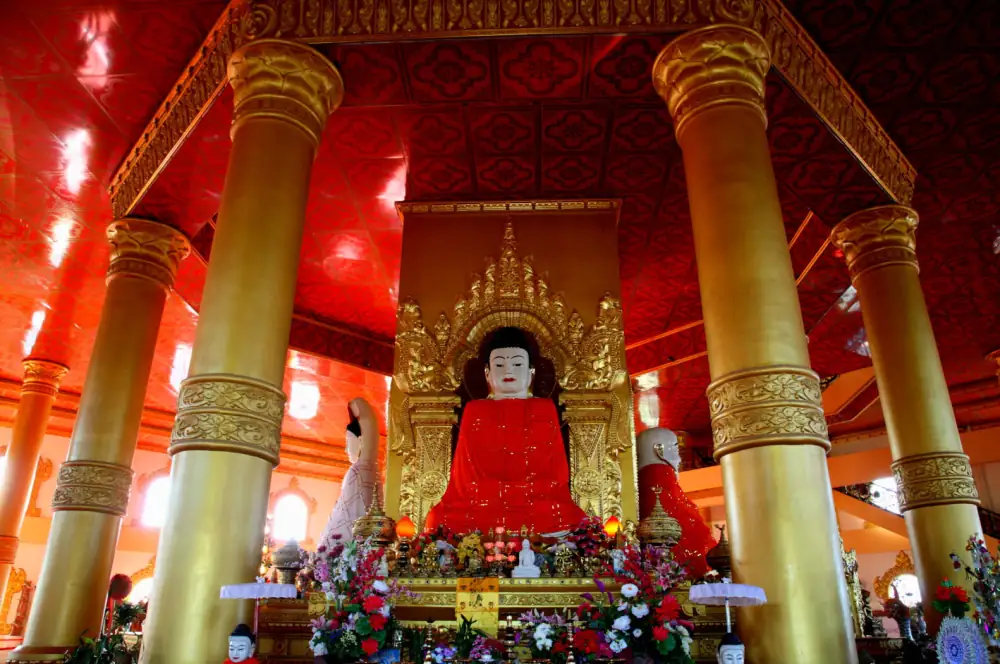
Dehong’s Dai people practice Theravada Buddhism (上座部佛教) — the same tradition found in Thailand, Myanmar, Laos, and Cambodia — rather than the Mahayana Buddhism dominant in the rest of China. The architecture and ritual practice reflect this difference strongly.
Menghuan Silver Pagoda (勐焕银塔): Located in Mangshi, this striking white pagoda complex sits on a hilltop overlooking the city. The main stupa is white (as opposed to the more common gold), and the surrounding complex includes smaller stupas, meditation platforms, and panoramic viewpoints. The contrast between the white stupa and the green hills is striking. Entry ¥40.
Menghuan Golden Pagoda (勐焕大金塔): Adjacent to the Silver Pagoda on the same hilltop, the Golden Pagoda is the more traditional Dai-style structure — a gilded stupa complex reminiscent of the temples of Chiang Mai and Yangon. The interior contains a large Buddha image and murals depicting Jataka tales. Entry ¥50.
Jiele Pagoda (姐勒金塔): About 8km from Ruili city center, Jiele Pagoda is one of the most important Dai Buddhist pilgrimage sites in Yunnan. The main stupa is surrounded by dozens of smaller satellite stupas in a pattern typical of Shan and Burmese temple architecture. The complex is active, with monks in residence and regular lay worship. Entry free (donations welcomed).
Dai temple etiquette: Remove shoes before entering temple buildings; dress modestly (shoulders and knees covered); do not touch Buddha images; women should not touch monks or hand objects directly to them.
Border Area Exploration
The border between China and Myanmar around Ruili is complex and in places porous — villages straddle the line, markets serve both sides, and the cultural boundary is fluid.
Jiegao Border Economic Zone (姐告边境经济合作区): A special economic zone on the Chinese side of the border that functions as a semi-open cross-border trading area. Visitors can walk through the zone and see the border gate (国门), where trucks carrying jade, timber, and agricultural goods cross from Myanmar daily. The gate itself is a monumental structure; photographs of the Chinese and Myanmar flags side by side are a standard tourist shot.
Wanding Border Port (畹町口岸): About 30km south of Ruili, Wanding is a smaller and more atmospheric border crossing. The old bridge (畹町桥) connecting China and Myanmar is the original World War II-era Burma Road crossing point — the route through which Allied supplies reached China during the Japanese occupation. A small museum (¥15 entry) documents the Burma Road history.
One Village Two Countries (一寨两国): A tourist attraction near Ruili where the border literally runs through a single village — one family’s house may be in China while their neighbor’s is in Myanmar. The border is marked by a low stone line through the village lanes. Entry ¥30; this is tourism-organized but the underlying reality (families divided by a border that was drawn through their land) gives it a poignancy beyond the kitsch.
Dai Culture & Festivals
The Dai of Dehong are closely related to the Thai people of Thailand and the Shan of Myanmar — they share language roots, Buddhist traditions, and cultural practices including the famous Water Splashing Festival.
Water Splashing Festival (泼水节): Held in mid-April (the Dai New Year, following the Theravada Buddhist calendar). The festival involves three days of celebrations culminating in a massive water fight where everyone splashes everyone else with water — symbolizing the washing away of the old year’s misfortunes. Ruili’s version is less tourist-managed than Xishuangbanna’s, and more genuinely participatory.
Other festivals:
- Closing and Opening of the Rains (关门节/开门节): Theravada Buddhist observances in July and October respectively; monks retreat to monasteries during the rainy season; the opening festival involves alms-giving and temple ceremonies
- Munao Zongge Festival (目瑙纵歌): The major festival of the Jingpo people (景颇族), held in February; massive communal dancing in traditional costume; held in Mangshi and surrounding Jingpo villages
Dehong Food
Dehong food is essentially Southeast Asian cuisine with Chinese elements:
Dai specialties:
- Lemongrass fish (香茅草烤鱼): Whole river fish stuffed with lemongrass, galangal, and herbs; grilled over charcoal; the definitive Dai dish
- Pineapple rice (菠萝饭): Glutinous rice steamed inside a hollowed pineapple with sugar and coconut; a sweet-savory combination
- Green papaya salad (青木瓜沙拉): Similar to Thai som tam but with local variations in the dressing
- Dai sour meat (酸肉): Raw pork fermented with rice and spices for several days; a specialty that requires cultural openness
Burmese-influenced dishes:
- Mohinga (鱼汤米线): Burmese-style fish broth noodles; widely available in Ruili
- Shan noodles (掸族米线): Rice noodles with chicken curry; the Burmese-Chinese culinary overlap
- Tea leaf salad (茶叶沙拉): Fermented tea leaves with nuts and dried shrimp; a Burmese classic found at Ruili restaurants
Where to eat: The area around Biancheng Road (边城路) in Ruili has the densest concentration of Dai and Burmese restaurants. Meal prices ¥30–80 per person.
When to Visit Dehong
Best season: October to April (dry season)
October–February: Cool and dry (18–26°C); comfortable; the Water Splashing Festival in April is the biggest event
March–April: Hotting up but manageable; the Water Splashing Festival usually falls in mid-April
May–September: Rainy season — heavy tropical downpours; some roads become difficult; high humidity and heat (30–38°C)
Practical Tips
Border permits: Ruili city itself does not require special permits for foreign visitors (as of 2026). However, some border-adjacent villages may require registration. Carry your passport at all times.
Language: Mandarin works in Ruili; Dai language is widely spoken in villages; Burmese is useful in border markets. English is limited outside major hotels.
Money: Bring cash. ATMs are available in Ruili and Mangshi but may not accept all foreign cards. The jade markets are cash-intensive.
Health: Dehong is a malaria-risk zone — consult your doctor about prophylaxis before visiting, especially during the rainy season. Use mosquito repellent consistently.
Combine with: Baoshan (3 hours by road), Tengchong (hot springs and WWII history, 4 hours), and the northern Burma Road route toward Dali make a good circuit.