
Guangzhou Dim Sum: The Origin of Yum Cha
Dim sum (点心, diǎn xīn) and yum cha (饮茶, yǐn chá — “drink tea”) are Chinese institutions that originated in Guangdong province. Guangzhou, as the province’s capital and the center of Cantonese culinary culture for centuries, is the source code for all the dim sum served around the world.
The experience in Guangzhou differs significantly from dim sum outside China: the variety is greater, the quality ceiling is higher, the social atmosphere is more intense, and the ritual of the tea service has greater depth. Understanding the differences — and the etiquette around them — transforms the meal from a confusing round of small plates into one of Asia’s most culturally rich dining experiences.
Table of contents
Open Table of contents
What is Yum Cha?
Yum cha (literally “drink tea”) is the Cantonese tradition of having a morning or midday meal at a teahouse, centered on tea but accompanied by a wide variety of small dishes (dim sum). The meal is explicitly social — it’s where families gather on Sunday mornings, where business deals are discussed over har gow, and where elderly couples have been eating the same dishes at the same table for 40 years.
The food (dim sum) is the accompaniment to the tea, not the centerpiece — though in practice the food often takes center stage.
Key point: “Yum cha” refers to the social practice; “dim sum” refers to the small dishes served. A Guangzhou local might say “Let’s go yum cha” the way a British person says “Let’s go for tea” — meaning the whole meal event, not just the beverage.
The Tea Service
Tea selection is the first step at any Cantonese teahouse. A server brings a menu of teas or recites the available varieties. The selection matters:
Common teas and their characteristics:
- Pu-erh (普洱, pǔ’ěr): Fermented and aged tea, deep reddish-brown, earthy flavor. The traditional choice for dim sum — its slight astringency cuts through the richness of the food. Available as 熟普 (shú pǔ, “cooked” pu-erh, darker and earthier) or 生普 (shēng pǔ, “raw” pu-erh, lighter and more complex).
- Tieguanyin (铁观音): A semi-oxidized oolong from Fujian, floral and slightly roasted. Common choice.
- Chrysanthemum (菊花, júhuā): Caffeine-free herbal tea, sweet and floral. Often mixed with pu-erh (菊普 or 菊普茶) to lighten the pu-erh’s earthiness.
- Narcissus (水仙, shuǐxiān): A floral, fragrant oolong — a classic teahouse choice.
- Jasmine (茉莉花): Fragrant green tea with jasmine; light and accessible.
- Longjing (龙井): Premium green tea from Hangzhou; available at higher-end establishments.
Tea is charged as a cover fee (茶位费, chá wèi fèi) of roughly ¥8-20 per person, which includes unlimited hot-water refills for the session.
Tea customs:
- Tap two fingers on the table to thank someone for pouring your tea (representing a prostrating bow; the story goes that an emperor incognito served tea to his minister, who couldn’t bow publicly without revealing the identity, so he tapped his fingers instead — this custom has remained).
- At traditional teahouses, rinse your chopsticks, spoon, and bowl with a small pour of hot tea before eating — an old hygiene custom still widely observed.
- When you want the teapot refilled with hot water, open the lid slightly to signal the server.
- The youngest person at the table traditionally pours for the elders first, and never lets a guest’s cup go empty.
What to Order: Essential Dim Sum
The classic core dishes that any serious yum cha should include:
Har Gow (虾饺, xiā jiǎo): Steamed shrimp dumplings with a translucent rice-starch wrapper. The benchmark dish that separates excellent dim sum from mediocre — the wrapper should be thin, slightly translucent, and not sticky; the shrimp filling should be fresh and springy; each dumpling should be identical in size and shape. The masterful versions use only whole shrimp, simply seasoned, in a precisely made wrapper.
Siu Mai (烧卖, shāomài): Open-topped dumplings filled with pork and shrimp, sometimes topped with fish roe or carrot. Properly made siu mai have a thin yellow skin (colored with egg), precisely portioned filling, and are served in groups of four on small bamboo trays.
Char Siu Bao (叉烧包): Barbecue pork buns. Two versions:
- Baked (焗叉烧包, jú chā shāo bāo): A glazed, slightly sweet bun with a characteristic split at the top; soft and slightly caramelized.
- Steamed (蒸叉烧包, zhēng chā shāo bāo): A fluffy white bun; more subtle flavor.
Cheung Fun (肠粉, cháng fěn): Rice noodle rolls. The basic version is a thin rice noodle sheet rolled around filling (shrimp, beef, or char siu pork), served with soy sauce and sesame oil. The version specific to dim sum teahouses (as opposed to street food) tends to be thinner and more delicate.
Turnip Cake (萝卜糕, luóbo gāo): A pressed cake of turnip (daikon radish), rice flour, and dried shrimp, pan-fried until crispy on the outside and soft within. One of the most satisfying textures in dim sum.
Egg Tart (蛋挞, dàntǎ): Custard tart in a flaky pastry shell. Portuguese influence via Macau. The Guangzhou version uses a deeper, more eggy custard than Hong Kong versions; some teahouses make them fresh throughout the morning.
Deep-fried Taro Dumplings (芋角, yù jiǎo): A delicate, slightly crispy exterior of mashed taro surrounds a pork and mushroom filling. The skin creates a slight honeycomb texture when fried correctly.
Lo Mai Gai (糯米雞, nuòmǐ jī): Glutinous rice with chicken, mushroom, and sausage, wrapped in lotus leaf and steamed. An entire meal in a single parcel. Rich and fragrant with the lotus leaf perfume.
Liu Sha Bao (流沙包): Salted egg yolk custard bun — bite in and molten golden custard flows out. A more modern addition to the dim sum canon, now ubiquitous in Guangzhou.
Spare Ribs with Black Bean (豉汁排骨): Steamed chopped pork ribs in a fermented black bean and garlic sauce. Savory and deeply flavored.
Cheung Tsoi Gao (韭黄饺): Delicate steamed dumplings filled with yellow chives — fragrant and lighter than the pork-heavy standards.
Chicken Feet (凤爪, fèng zhuǎ): Braised and deep-fried chicken feet in a black bean sauce, then steamed. A cultural touchstone of Cantonese dim sum — for the uninitiated, the texture (gelatinous, no meat per se — just skin and cartilage) can be surprising; for enthusiasts, this is one of the meal’s most anticipated dishes.
Turnip Soup (蘿蔔湯): Various slow-cooked soups served at the end of the meal, typically clear broths with turnip and meat.
The Best Teahouses in Guangzhou
Guangzhou Restaurant (广州酒家)
One of the most historically significant names in Cantonese cuisine — the Guangzhou Restaurant has operated in various forms since 1935. The flagship location on Wenchangnandajie still offers the full traditional yum cha service.
Arrive before 9 AM on weekends for a seat; the wait can be 30-60 minutes by 9:30. The servers use the traditional push-cart service (you flag down carts carrying specific dishes) on weekends, which is the most traditional format.
Highlight: The weekend brunch service is exactly what a Guangzhou yum cha should be — enormous, noisy, filled with multiple generations of families, and producing food of consistent quality.
Tao Tao Ju (陶陶居)
Founded in 1880, Tao Tao Ju is one of Guangzhou’s oldest teahouses. The recent renovation (including a newer flagship location in Panyu district) has brought the quality and presentation to a high contemporary standard while maintaining traditional recipes. The egg tarts are exceptional.
Lian Xiang Lou (莲香楼)
Founded in 1889, Lian Xiang Lou is arguably the most historically significant teahouse in Guangzhou, spread across multiple floors of a colonial-era building in the Xiguan (西关) neighborhood. No English menu — point at neighboring tables’ dishes or use a translation app. Best for the most authentic old-school atmosphere.
Bao She (炳胜品味)
Considered by many food critics to serve Guangzhou’s most technically accomplished dim sum — impeccable har gow, ingredients sourced from across Guangdong, in a modern interior. Reservations are essential. Expect ¥100-150 per person. Best for quality-focused visitors willing to splurge.
Pan Xi Restaurant (泮溪酒家)
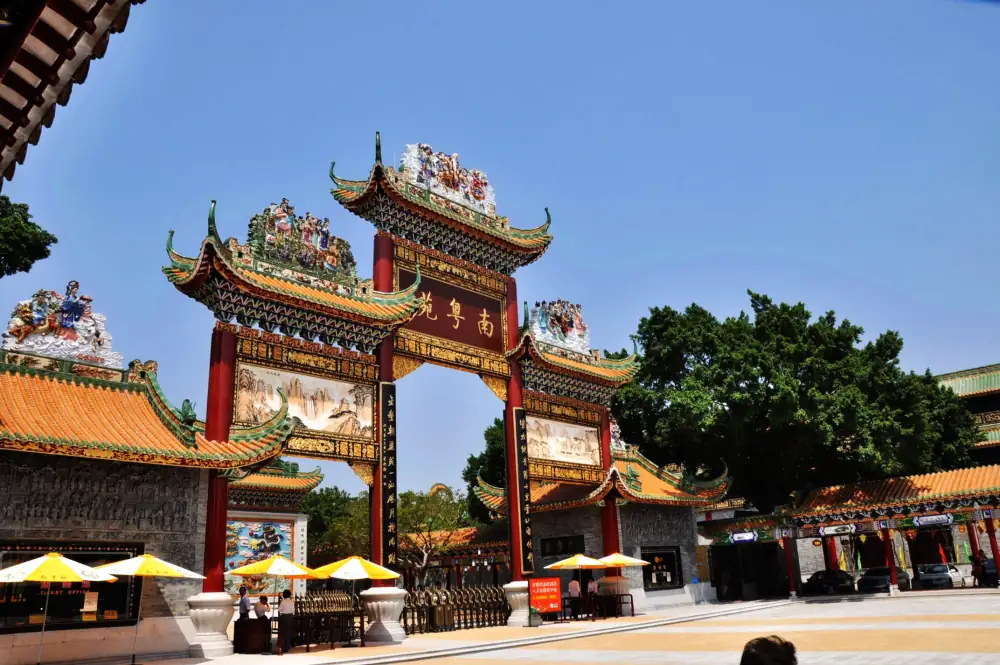
Famous particularly for its enormous variety of dim sum — reportedly over 400 distinct items in the full menu. The restaurant is set on a lake in Liwan district with traditional Cantonese garden architecture. The experience of eating dim sum in a garden setting with ornamental fish ponds and pavilions captures the classical Guangdong teahouse ideal.
Yindu Restaurant (银都酒家)
A reliable everyday choice popular with Guangzhou’s business community. More accessible for visitors unfamiliar with the full traditional teahouse format — written menus available alongside cart service.
Five-Star Hotel Teahouses
The White Swan Hotel and the Garden Hotel both run excellent dim sum restaurants popular with business travelers — English menus, English-speaking staff, and consistently high quality. More expensive than the traditional houses, but the most stress-free option for a first yum cha.
How to Navigate the Ordering System
Traditional push-cart service (推车服务): Servers push carts loaded with specific dim sum throughout the dining room. When a cart passes with something you want, wave to the server. They’ll stamp your paper order card (kept at your table, totaling the bill).
Paper order sheet (纸质点单): At many teahouses, particularly those with large menus, you mark quantities directly on a printed checklist and hand it to your server. More systematic than cart service; less theatrical.
iPad/Digital ordering: Increasingly common at newer or recently renovated teahouses.
Practical tip for non-Chinese readers: Ask the server which items on the cart are what. Pointing and asking “Zhè shì shénme?” (这是什么?) — “What is this?” — works for everything.
Morning vs. Afternoon Yum Cha
Traditional yum cha is a morning event (7-11 AM) — this is when the most diehards arrive, when the freshest dim sum comes out, and when the oldest traditional clients have been coming for decades.
Afternoon dim sum exists at many restaurants (typically 2-5 PM) — slightly smaller menu, similar quality.
Evening dim sum is available at some restaurants but is less traditional and often uses a different menu format (more like ordering from a regular restaurant menu with some dim sum items alongside main dishes).
For visitors: The Sunday morning yum cha is the most authentic experience — arrive at a traditional teahouse between 8-9 AM, expect a possible queue of 30-90 minutes at popular venues, and plan to spend 1.5-2 hours eating slowly through multiple dishes with frequent tea refills.
Practical tips:
- Dim sum is prepared in batches — arriving after 9:30 AM means some items may have sold out or be sitting in warmers. Early is better.
- Weekday mornings are quieter and have better availability; weekends are the major social event.
- There is no dress code — Guangzhou teahouses are democratic, and locals show up in everything from pajamas (literally, at 7 AM) to Sunday best.
Budget
A standard yum cha at a mid-range Guangzhou teahouse costs approximately ¥60-100 per person (including tea, 5-8 dim sum dishes). At Guangzhou Restaurant or Tao Tao Ju, the same experience might be ¥80-120 per person. Premium establishments charge more.
The portion logic: 3-4 dim sum dishes per person as a guideline, with some dishes (har gow, siu mai, cheung fun) being non-negotiable, then additional dishes based on curiosity and appetite.
Guangzhou is the place to understand why Cantonese cuisine is internationally considered one of China’s finest regional traditions. The dim sum is the most accessible entry point — approachable, sociable, and genuinely excellent.