
Southeastern Guizhou is one of the last places in China where you can walk through a working village and feel that nothing has been staged for your benefit. Congjiang County sits in a valley carved by the Duliu River, and its villages — Dong, Miao, Yao, and Zhuang all living in close proximity — have maintained their distinct cultures, languages, festivals, and architecture with a tenacity that’s striking.
Zhaoxing is the headline attraction, and it deserves the attention it gets. But Congjiang rewards the traveler who stays longer and reaches further than the famous village. The bat cave temple at Gaozeng, the weekly markets where minority women sell silver jewelry and embroidered cloth, the rice terraces climbing the hillsides above Basha — these are places where the phrase “off the beaten track” actually means something.
Table of contents
Open Table of contents
Getting to Congjiang
Congjiang used to require genuine effort to reach. The opening of the Guiguang High-Speed Railway changed that dramatically, though the county still feels remote once you’re inside it.
By high-speed train:
- From Guiyang: About 2.5 hours to Congjiang Station; multiple daily services; tickets ¥150–210 second class
- From Kaili: About 1 hour; ¥60–90
- From Guilin (Guangxi): About 1.5 hours; useful entry point from the south
- From Guangzhou South: About 4 hours direct; good option for travelers arriving from Guangdong
Congjiang Station location: The high-speed station is about 8km from the old town center. Taxis meet trains (¥20–25 to town), and minibuses run to the town square for ¥5.
Getting around the county:
- Local buses and minibuses connect the town with surrounding villages; frequency varies from several daily to twice-weekly depending on destination
- Motorcycle taxis are cheap and faster on mountain roads (¥20–50 depending on distance)
- Renting a scooter in town is possible with some negotiation (¥80–120/day with a local guide’s help)
Zhaoxing Dong Village (肇兴侗寨)
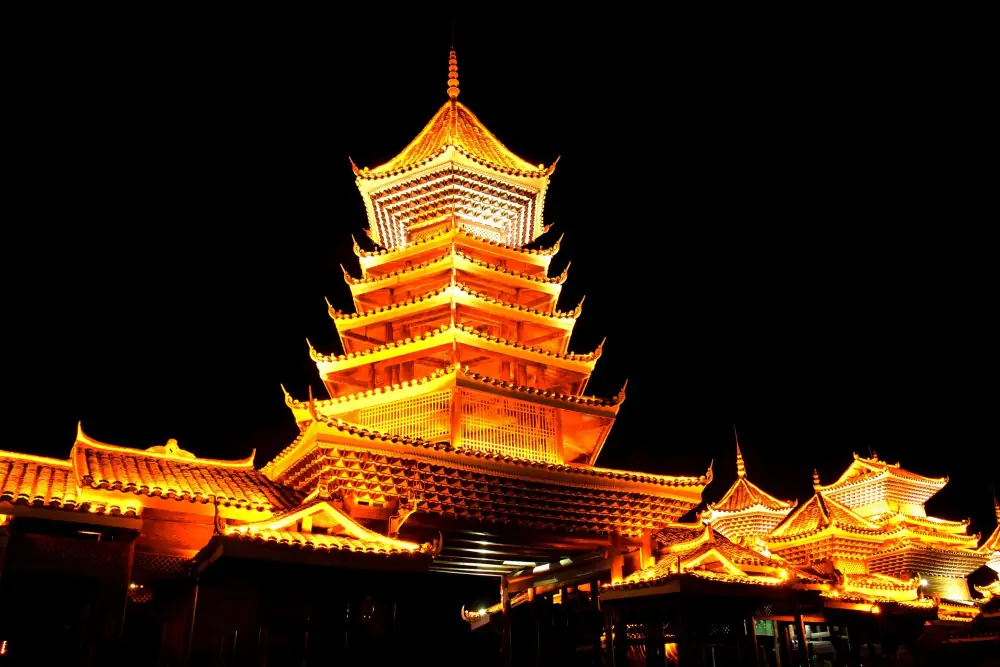
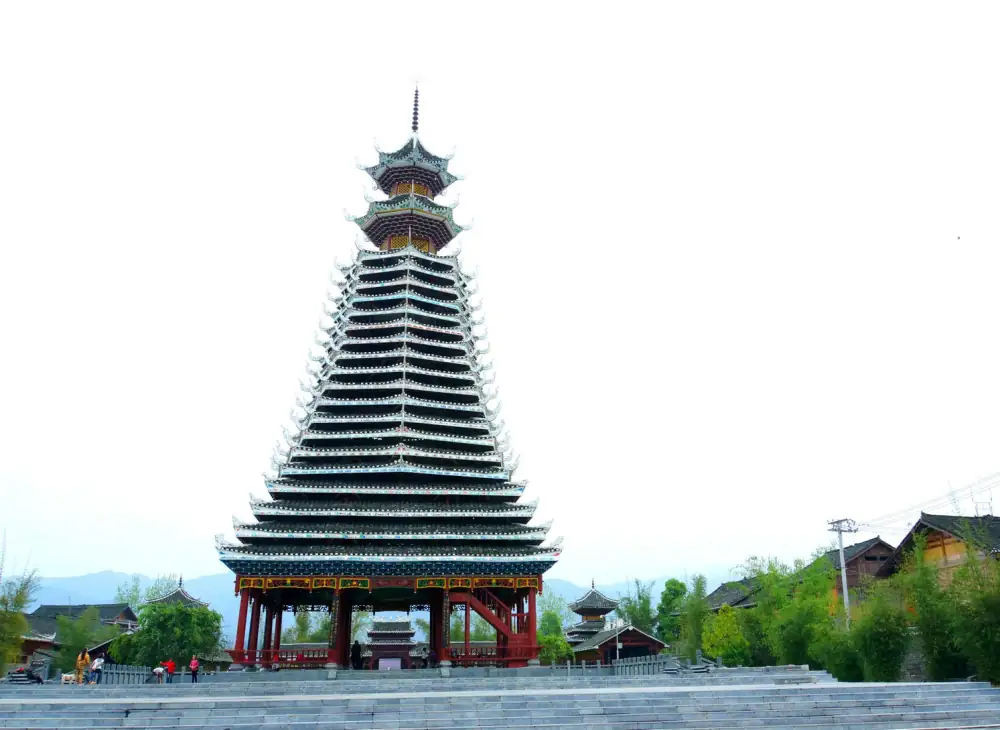
Zhaoxing is the largest and best-preserved Dong village in China, and its five drum towers — each belonging to a different clan — are the defining architectural feature. No other Dong settlement has five towers; the villages you’ll pass on the way usually have one.
The five drum towers: Each of the five clans (仁、义、礼、智、信 — the five Confucian virtues) has its own tower, its own wind-and-rain bridge, and its own opera stage. The towers are multi-tiered wooden structures, built without a single nail, rising 20–27 meters above the slate-paved lanes of the village.
- Ren Tower (仁团鼓楼): The oldest and tallest; the gathering point for village ceremonies
- Yi Tower (义团鼓楼): Adjacent to the main performance stage used for Dong grand song performances
- Evening performances of Dong Grand Song (侗族大歌) — polyphonic choral singing with no lead vocalist — happen most evenings at the Yi stage during peak season; check with your guesthouse for timing
Wind-and-rain bridges: Five covered wooden bridges, each with pavilion-style roofing, span the stream running through the village. They’re used as shelters, social gathering points, and overflow sleeping areas during festivals. The light through the slatted roofs in morning hours is excellent for photography.
Entry and tourism: Zhaoxing now charges an entry fee of ¥50 per person for the scenic area. The village itself is still inhabited — around 4,000 people live here — and you’ll see daily life alongside tourism. Early mornings (before 8am) and evenings (after 6pm) are when the tourist flows ease and the village feels most authentic.
Staying in Zhaoxing: Guesthouses and small hotels have multiplied in recent years. Most are family-run and occupy traditional wooden houses with basic amenities:
- Basic guesthouse rooms: ¥80–150/night
- Mid-range options: A few renovated guesthouses charge ¥200–350 with en-suite bathrooms and better mattresses
- Booking: Most guesthouses can be booked through Ctrip or directly; arriving without a booking is generally fine except during major festivals
The Bat Cave Buddhist Temple (蝙蝠洞)
About 15km from Congjiang town, near the village of Gaozeng (高增), is one of the most unusual religious sites in Guizhou — a Buddhist and Taoist temple complex built inside a large limestone cavern that houses a colony of thousands of bats.
The bats are considered sacred by local people. Every evening around dusk, they pour out of the cave mouth in a dense spiraling column — the numbers are genuinely staggering, and the sound is remarkable. The local belief is that the bats bring good fortune and should not be disturbed or harmed.
Practical information:
- The cave is a 20-minute walk from Gaozeng village
- Entry fee: ¥20–30 (collected by the village committee)
- Best time to visit: Late afternoon, arriving 30–45 minutes before sunset to watch the bat emergence
- Transport: Minibuses from Congjiang to Gaozeng run several times daily (¥10–15); motorcycle taxi from Congjiang ¥30–40
The temple interior has incense burners, deity statues, and butter lamps — all coexisting with the bat roost above. The combination of religious devotion and natural spectacle is genuinely strange and memorable.
Basha Miao Village (岜沙苗寨)
Basha, just 7km south of Congjiang town, is home to a Miao sub-group that has maintained traditions virtually unchanged for centuries. The men of Basha still carry flintlock muskets, wear their hair in a topknot (禁区发髻), and perform a traditional razor hair-shaving ceremony using a sickle blade.
What makes Basha distinctive:
- Men carry guns openly — a special government exemption allows this community to maintain their tradition of carrying muzzle-loading firearms
- Hair topknots secured with a bamboo comb; this was the standard Han Chinese male hairstyle during pre-Qing dynasty eras
- Women wear dark indigo-dyed cloth embroidered with geometric patterns
- Eco-conscious forest worship: Basha people plant a tree for every child born and cut one down only when a community member dies; their surrounding forests are dense and ancient
Visiting Basha:
- Entry fee: ¥40 per person
- Daily performance of the musket-firing ceremony and dancing: approximately 10am and 3pm (confirm with the village committee)
- Guesthouse accommodation available for those who want to stay overnight (¥100–180/night); staying overnight gives access to evening ceremonies and early morning village life
Getting there: Bus from Congjiang town (¥8–10, 20 minutes) or motorcycle taxi (¥20–25).
Dong Grand Song & Festival Calendar
The Dong people of southeastern Guizhou maintain one of the world’s oldest polyphonic choral traditions. Dong Grand Song (侗族大歌, Galu in Dong language) was inscribed on UNESCO’s Intangible Cultural Heritage list in 2009. It’s performed without instruments, typically involves multiple vocal parts singing simultaneously, and deals with themes of nature, love, labor, and community.
Hearing Dong Grand Song:
- Evening performances in Zhaoxing: check notice boards in the village for the schedule; typically ¥80–150 per person for organized performances
- Spontaneous singing at drum towers during festivals is free to observe
- The most authentic performances happen at the local song festivals, not the tourist-facing shows
Major festivals in the Congjiang area:
Dong New Year (侗年): Usually in November (lunar calendar). The most significant festival — villages host singing competitions, bullfighting, and feasting. Timing varies by village, so confirm dates locally.
Sa Festival (萨岁节): Spring festival honoring the Dong deity Sa. Held in different villages at different times; involves offerings, singing, and communal dancing around the Sa shrine.
Miao New Year (苗年): Held in October-November depending on the village. Basha and other Miao villages celebrate with horse racing, lusheng (reed pipe) music, and elaborate costume displays.
Ganba Festival: Autumn harvest festival in many Dong villages, involving the cooking and sharing of smoked meat and rice wine.
The Duliu River Corridor
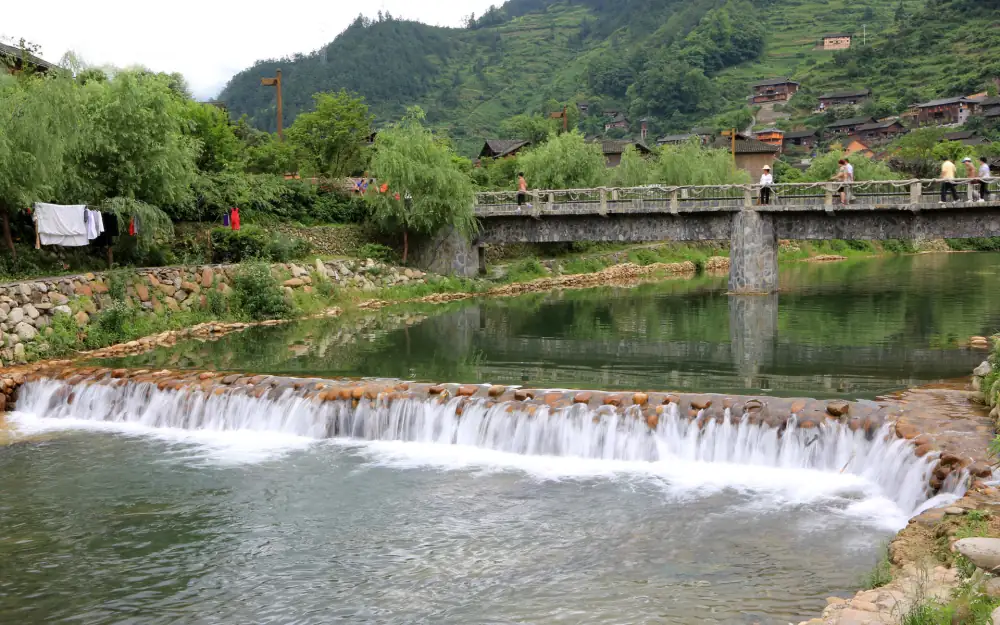
The Duliu River (都柳江) runs through the heart of Congjiang County and historically connected these mountain communities with the outside world. Today it offers a scenic backdrop for cycling or walking routes through villages that few visitors bother to reach.
Congjiang to Zhaoxing by riverside path: A walking route of approximately 40km follows the river valley before ascending to Zhaoxing. It’s doable in two days with an overnight in one of the midpoint villages (Tung’ai or Xiaohuang). The path is not always well-marked; a local guide (¥150–200/day) is recommended.
Xiaohuang Village (小黄村): Known as the “home of Dong Grand Song” — more villages here sing than anywhere else, and it’s a less-visited alternative to Zhaoxing.
Eating & Local Food
Congjiang’s food reflects the Dong culture’s relationship with preserved, fermented, and smoked ingredients.
Must-try dishes:
- Sour fish (酸鱼): Fish fermented in salt and glutinous rice for months or years; deeply funky flavor, love-it-or-hate-it. Considered a delicacy and served at important occasions
- Smoked pork (腊肉): Pork cured and smoked over wood fires; appears in nearly every meal
- Glutinous rice dishes (糯米飯): Black glutinous rice steamed in bamboo tubes; a staple of Dong and Miao diet
- Dog meat hotpot: A cultural norm in parts of Guizhou; widely available in local restaurants; food-sensitive travelers should be aware this is on most menus
Eating options:
- Family guesthouses typically serve meals ¥30–60 per person including rice, vegetables, pickled dishes, and meat
- The night market along the Duliu riverfront has stalls selling grilled meats, fried snacks, and local rice wine (米酒)
When to Visit Congjiang
Peak season (best conditions): April to June, and September to November
- Spring brings fresh green terraces and mild temperatures
- Autumn offers golden rice harvest colors and clearer mountain air
- Major festivals cluster in autumn and early winter
Summer (July-August): Hot and very wet — rainstorms are frequent and heavy, roads into villages can become impassable. The waterfalls are spectacular but travel is harder.
Winter (December-February): Cold but not extreme (rarely below freezing in the valley), very few tourists, some guesthouses close. The drum tower communities burn wood fires in the towers in winter — an atmospheric experience if you can find somewhere open.
Festival timing advice: The lunar calendar governs most festivals, so exact dates shift each year. Check the Congjiang Tourism Bureau website or ask your guesthouse owner the week before arrival — they’ll know what’s happening in nearby villages.
Practical Tips
Language: Mandarin is understood in town and in tourist-facing parts of Zhaoxing, but minimal in remote villages. Learning a few words of Dong or having a translation app (with offline Guizhou dialect support) helps.
Photography etiquette: Most people in the villages are comfortable with photography, but ask first for portraits, especially of elders and during ceremonies. A gift of ¥10–20 for posed photos is customary. During some rituals, photography is prohibited — watch for cues from locals.
Phone signal: Good in Congjiang town and Zhaoxing; weak to nonexistent in most remote villages. Download offline maps (Maps.me or Baidu Maps offline) before leaving town.
Money: Bring cash. ATMs are available in Congjiang town center; Zhaoxing has one ATM that sometimes runs out of cash during peak season. Remote villages are strictly cash-only.
Altitude and terrain: The county is hilly; the main village areas are at 400–800 meters elevation, comfortable year-round. Trails above 1,200 meters require proper footwear.
Recommended time: Three to four nights minimum to do Congjiang justice — one night in Zhaoxing, one night in Basha, one day for the bat cave and river corridor. Travelers who come for only a day trip from Kaili miss most of what makes this area special.