
Guizhou is China’s best-kept tourism secret — largely because of an old saying: “no three days without rain, no three li of flat ground, no three fen in anyone’s pocket.” This wasn’t an endorsement. But the difficult landscape and relative poverty that gave the province its reputation also preserved something extraordinary: a living network of Miao, Dong, Buyi, and dozens of other minority villages that have maintained their festivals, costumes, architecture, and agricultural traditions largely intact.
Guizhou tourism has improved dramatically in the last decade. High-speed rail now connects the main cities, roads are paved, and the Miao village homestays have become some of the best in southwest China.
Table of contents
Open Table of contents
Getting There & Around
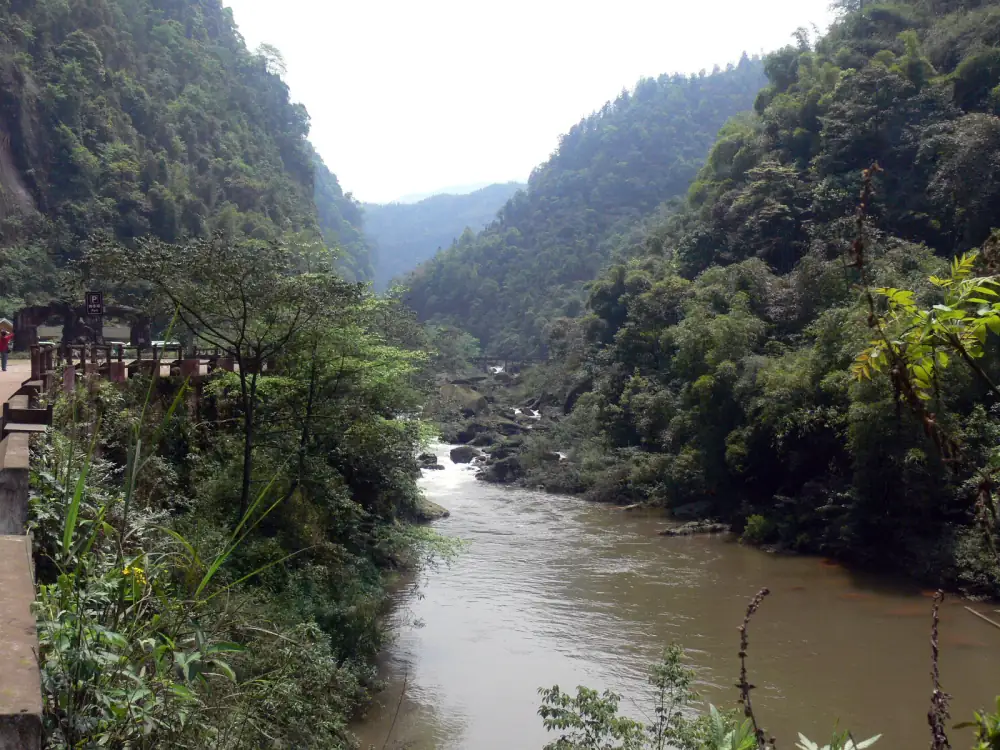
Entry: Guiyang Longdongbao International Airport (KWE) has domestic connections and some international routes. HSR connections: Guiyang → Chengdu (2 hours, ¥180), Guiyang → Kunming (3 hours, ¥200), Guiyang → Guangzhou (5 hours, ¥370).
Getting around Guizhou: The HSR connects Guiyang, Kaili, and Zhenyuan on the main east-west line. Buses fill everything else — reliable, cheap, and the driver culture is generally calm. For the Miao villages around Kaili, minibuses run frequently between the main villages.
Language note: Most Miao villages have older residents who speak Miao dialects and limited Mandarin. Having a basic Mandarin phrase sheet helps, though younger residents typically speak Mandarin. English is uncommon outside Guiyang.
Day 1: Guiyang
Guiyang (贵阳) is Guizhou’s capital — a mid-sized city that has reinvented itself as a big data hub (Apple’s Chinese data servers are here). As a transit base it’s functional; there are a few good sights.
Qianling Mountain Park (黔灵山公园, free) is Guiyang’s lungs — a forested park with Buddhist temples, hiking paths, and hundreds of semi-wild macaque monkeys that will steal your food if given the chance. The Hongfu Temple (弘福寺) at the summit is a working monastery with good views.
Jiaxiu Pavilion (甲秀楼, ¥20) sits on a rock in the Nanming River — a landmark Ming Dynasty pavilion that’s been Guiyang’s symbol for 400 years.
For food, Guizhou cuisine differs from both Sichuan and Yunnan: sour (酸) is the dominant flavor rather than spicy or sweet. Key dishes: sour soup fish (酸汤鱼, ¥60-100 per pot), silk tofu (豆腐圆子, deep-fried tofu balls with filling, ¥10-15), Guizhou rice noodles (肠旺面, pork intestine and blood tofu noodles, ¥12-18), and hot and sour noodles (花溪牛肉粉, ¥15-20).
The Qingyan Ancient Town (青岩古镇, ¥30) is 30km south of Guiyang — a Ming Dynasty fortress town with well-preserved walls, church, and Taoist and Buddhist temples coexisting on the same streets. Half-day trip.
Day 2: Huangguoshu Waterfall
Journey: Direct buses from Guiyang Jinyang Bus Station (¥65, ~2.5 hours) to the Huangguoshu scenic area.
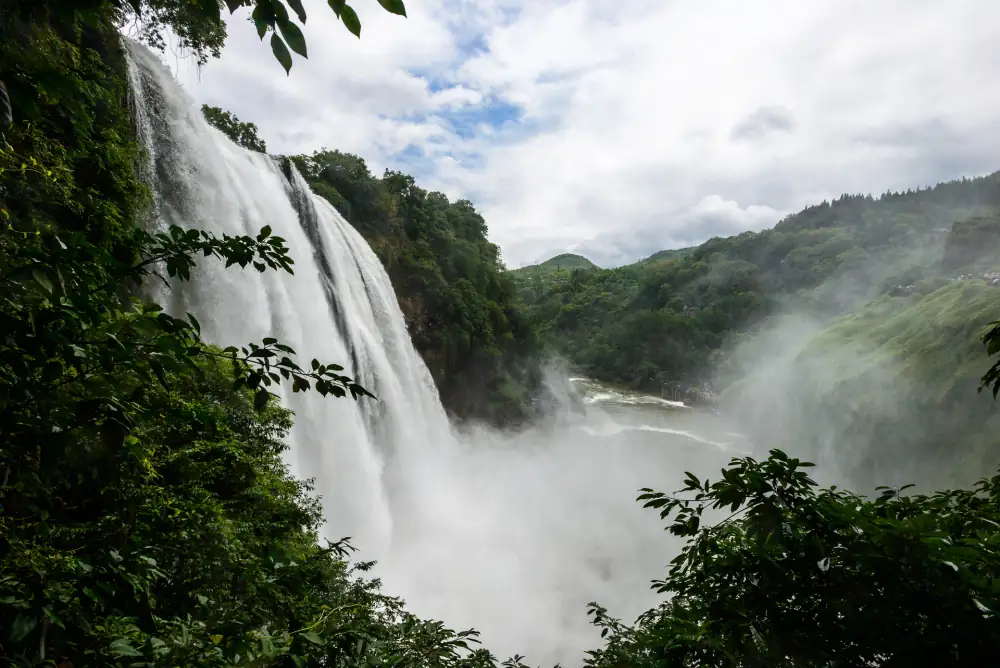
Huangguoshu Waterfall (黄果树瀑布, ¥220 combined ticket) is the most famous waterfall in China — 77.8m high and 101m wide, fed by the Baishui River. It’s genuinely impressive. The combined ticket includes the main waterfall, the Water Curtain Cave (水帘洞) behind the cascade (you walk through a cave with the waterfall visible through rocky windows), and the smaller Doupotang cascade.
The best viewing time is peak water flow — June-September after monsoon rains. In April-May and October-November water levels drop but the site is less crowded.
Tianxing Bridge Scenic Area (天星桥景区, included in combined ticket) is a separate section connected by shuttle bus — a karst rock garden with water channels and stone formations covered in ferns. Allow an additional 2 hours.
Return to Guiyang in the evening or continue directly to Kaili (buses from Huangguoshu → Guiyang → Kaili, or backtrack via Guiyang HSR).
Days 3-5: Kaili & the Miao Village Circuit
Journey: HSR from Guiyang to Kaili South (凯里南), ~1 hour, ¥40-55.
Kaili (凯里) is the capital of the Qiandongnan Miao and Dong Autonomous Prefecture — a small city surrounded by dozens of traditional minority villages within a 1-2 hour radius.
Xijiang Qianhu Miao Village
Xijiang (西江千户苗寨, ¥100 entry) is the largest Miao village in China — 1,300+ households of wooden stilted houses (吊脚楼) climbing the valley slopes. It’s the most touristified of the Kaili villages, but the sheer scale of the settlement, the embroidery work done by Miao women, and the evening performances are impressive.
The village comes alive at night when the terraced wooden houses light up with lanterns. Stay overnight inside the village — homestays run ¥100-200/night including breakfast.
Getting there: Direct buses from Kaili Bus Station (¥20, 1.5 hours).
Langde Upper Village
Langde (朗德苗寨) is smaller and more intimate than Xijiang — 120 households on a hillside above a river. It’s famous for receiving foreign heads of state (the village has hosted Chirac, Blair, and others) and the women here perform a particularly fine version of the Lusheng pipe dance.
Getting there: Minibus from Kaili (¥10, 45 minutes) or from Xijiang (¥8, 30 minutes).
Basha Miaozhai
Basha (岜沙苗寨) is the most unusual and least commercially developed of the major Miao villages near Kaili — the Basha men carry guns (a historical right going back centuries) and the male hairstyle involves shaving the outer scalp and binding the remaining hair in a topknot. It’s the only village in China where civilians legally carry firearms.
Getting there: Minibus from Kaili (¥15, 20 minutes). Less than 1 hour from the city.
Practical Miao Village Notes
- Miao festivals (especially the Lusheng Festival in October and the Sister’s Rice Festival in April) transform the villages completely — if your dates coincide, plan around them
- Photography of people is usually welcomed but ask first, especially for ceremonies
- Buy embroidered goods directly from the women who make them — quality and prices are far better than tourist markets in the city
- Village entry fees go directly to the community management committee; these are not the corrupt tourist fees found elsewhere
Day 6: Zhenyuan Ancient Town
Journey: HSR from Kaili to Zhenyuan (镇远), ~40 minutes, ¥30-45.
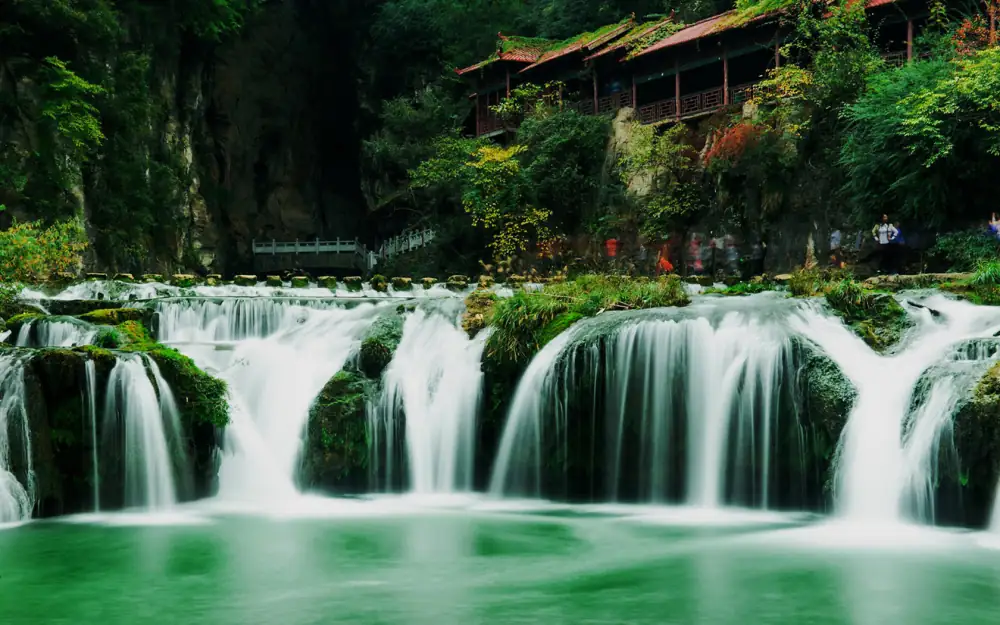
Zhenyuan (镇远) sits at a bend in the Wuyang River (舞阳河) where the river turns sharply and the ancient town clings to both banks. The setting is dramatic — cliff walls on both sides with wooden houses reflected in the clear green water.
The Old Town (¥50 for a combined site ticket) has the best-preserved Ming and Qing Dynasty architecture in Guizhou. The Qinglong Cave (青龙洞, included) is a temple complex built directly into the cliff face — Taoist and Buddhist temples sharing the same cliff, connected by walkways and stairs cut from rock.
Walk the Wuyang River riverfront in the evening when the old buildings and bridges are lit. Boat rides along the river (¥50, 30 minutes) give the best perspective on the canyon setting.
Zhenyuan is small enough to cover fully in one day, making it a satisfying final full-day destination before returning to Guiyang.
Day 7: Fanjingshan or Return
Option A: Fanjingshan Sacred Mountain
Fanjingshan (梵净山, ¥80 + ¥200 cable car return) is Guizhou’s UNESCO Natural Heritage Site — a granite mountain with cloud forests, ancient Buddhist temples, and remarkable rock formations at the summit including the famous Red Clouds Golden Summit (红云金顶), a mushroom-shaped rock pinnacle with twin temples on top.
Getting there: 4 hours from Guiyang by HSR to Tongren + bus, or direct bus from Guiyang (3-4 hours).
This works best as a standalone day trip from Guiyang rather than bolted onto Day 6 at Zhenyuan. Adjust the itinerary to do Fanjingshan on Day 6 and return to Guiyang on Day 7, or extend to 8 days.
Option B: Return to Guiyang for Departure
Take the morning HSR from Zhenyuan back to Guiyang (1.5 hours) and explore the Guiyang city market around Qianling Park before departure.
Practical Information
| Item | Cost |
|---|---|
| Huangguoshu Waterfall combined | ¥220 |
| Xijiang Miao Village entry | ¥100 |
| Xijiang homestay | ¥100-200/night |
| Zhenyuan combined sites | ¥50 |
| Fanjingshan entry | ¥80 |
| Fanjingshan cable car | ¥200 return |
| Guiyang → Kaili HSR | ¥40-55 |
| Kaili → Zhenyuan HSR | ¥30-45 |
| Village minibus (between villages) | ¥8-20 |
Best time to visit: April-October. The Miao festivals are concentrated in spring (April-May: Sister’s Rice Festival) and autumn (October: Lusheng Festival). The waterfalls are most dramatic June-September. Winter is cold, grey, and the villages are quieter — some festival preparations and markets still run.
Accommodation note: Kaili has numerous mid-range hotels (¥200-400/night). Village homestays in Xijiang are an excellent cultural experience but facilities are basic — squat toilets, communal showers, no air conditioning. Most foreign visitors find them comfortable enough for 1-2 nights.