
Guizhou province in southwest China is still underappreciated as a travel destination, though this is changing rapidly. The province is defined by its karst topography — a vast landscape of limestone plateaux, river gorges, waterfalls, and cave systems — and by its extraordinary diversity of ethnic minority cultures: Miao, Buyi, Dong, and dozens of smaller groups who have maintained distinct languages, dress, and customs.
The Huangguoshu Waterfall area in the southwest of the province is the most accessible introduction to both dimensions — the landscape is spectacular and the surrounding Buyi villages give immediate context for Guizhou’s minority culture complexity.
Table of contents
Open Table of contents
Huangguoshu Falls (黄果树大瀑布)
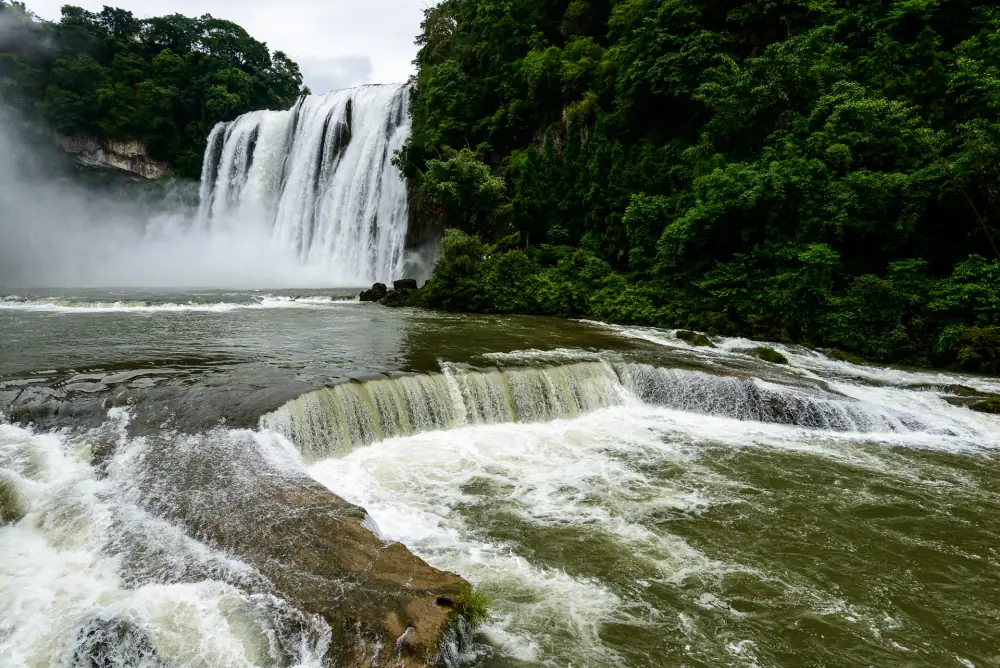
Huangguoshu is China’s most famous waterfall and one of Asia’s largest. At peak flow (July–September, monsoon season), the falls are 77.8 metres wide and 77.8 metres high — a coincidence of measurements that the Chinese tourism industry emphasizes heavily. At peak flow, the roar is audible from kilometres away and the spray soaks everything within 200 metres.
Opening hours: 7:30am–6:00pm (summer), 8:00am–5:30pm (winter)
Entry fee: ¥180 per person
Location: 45km from Anshun city; direct buses from Anshun ¥15–20 (30 minutes)
The Waterfall Viewing
The scenic area has multiple viewing platforms and walkways approaching the falls from different angles:
Main viewing platform: Direct frontal view, reached by a short walk from the entrance. Good for the full-width photograph.
The Water Curtain Cave (水帘洞): The unique feature of Huangguoshu — a cave behind the waterfall, with 6 windows and 2 corridors within the falling water itself. Walking through the cave with the falls immediately outside the windows is genuinely extraordinary. The cave is about 134 metres long and is accessible via a path from the main viewing area. Wet — bring a waterproof cover for cameras and expect to get damp.
Left bank path: A walkway following the left bank of the Baishui River below the falls, giving a different perspective and good views of the full height of the falls.
Access trail from below: A descent path leads to the base of the falls for the most immersive experience — standing below the full 77-metre drop. The roar and mist at close range at peak flow is overwhelming.
Peak Flow Timing
The falls are dramatically different by season:
- July–September: Peak monsoon flow; widest and most powerful. Water volume can be 5–10 times the dry-season flow. Most impressive but also most crowded.
- October–November: Reduced but still substantial flow; crowds decreasing. Good compromise season.
- December–April: Dry season; the falls can reduce to a fraction of peak width. Dramatically less impressive but also essentially crowd-free.
Best time to visit: August–September for the full experience; mid-October for a balance of flow and manageable crowds.
Tianxing Qiao Scenic Area (天星桥景区)
About 6km downstream from the main falls, the Tianxing Qiao area is a karst landscape of small pools, channels, and rock formations that some visitors find more visually interesting than the main falls. The “star bridge” (天星桥) — actually a natural rock arch over a stream — gives the area its name.
Entry fee: ¥80 per person (or included in combined Huangguoshu tickets)
Time: 1.5–2 hours to walk through
The path through the Tianxing Qiao area passes through bonsai forest scenery — old trees growing from karst rock, reflected in clear pools — that is very different in character from the main waterfall area.
Buyi Villages (布依族村寨)
The Buyi people (布依族) are one of Guizhou’s 18 recognized ethnic minority groups, with a population of about 2.9 million concentrated in the southern and southwestern parts of the province. Buyi villages cluster in the valleys around Huangguoshu and are easily combined with a waterfall visit.
Shitou Village (石头寨)
One of the best-preserved Buyi stone villages, about 20km from Huangguoshu. The village is built almost entirely from local limestone — stone walls, stone roads, stone roofs. The effect is a uniform grey that’s austere but striking.
Buyi women weave and dye batik cloth (蜡染) using traditional wax-resist dyeing techniques — the blue-and-white patterned fabric is the distinctive Buyi textile. In Shitou Village, you can watch the process at family workshops and buy finished cloth or garments.
Entry: ¥15 per person
Getting there: Local bus from Huangguoshu (ask at the scenic area tourist office for current routes), or hire a car
Buyi Textile and Batik
The Buyi batik tradition uses hot beeswax applied with a small tool to create geometric and floral patterns on cloth. The cloth is then dipped in indigo dye; when the wax is removed, the resist-dyed pattern is revealed in white against blue.
Buying Buyi textiles: Look for:
- Hand-woven cloth (more expensive, irregular weave — the sign of handmaking) vs machine-woven (uniform)
- Genuine batik (slight wax drips visible on close inspection) vs printed imitation
- Traditional patterns (geometric, stylized natural motifs) vs modern souvenir designs
Expect ¥50–200 for a genuine piece of hand-made Buyi cloth.
Silong Gorge (石龙沟)
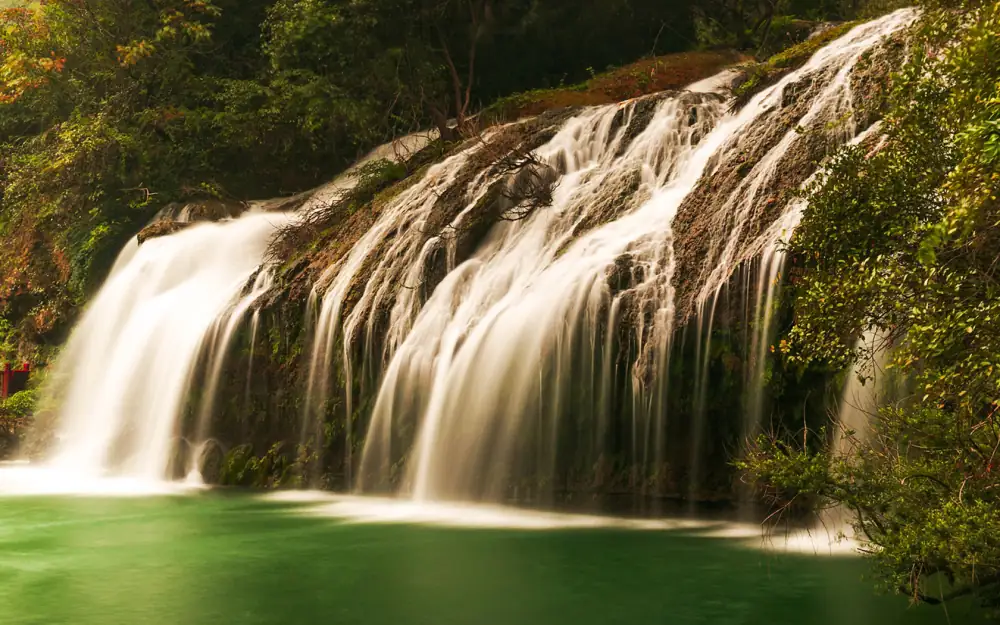
The Silong Gorge, accessible from within the Huangguoshu scenic area, is a karst gorge walk that many visitors skip but shouldn’t. The gorge path follows a narrow limestone canyon carved by a tributary of the Baishui River, with natural pools, small waterfalls, and vertical cliff faces on both sides.
Access: From within the main scenic area, follow signs to Silong Gorge
Length: About 4km one way; round trip about 3 hours
Best season: July–September when water levels are high enough to fill the pools
Anshun (安顺)
The nearest city to Huangguoshu is Anshun (45 minutes away by bus), a mid-sized Guizhou city with its own attractions:
Anshun Old District: Traditional town houses and commercial streets from the Ming and Qing periods. Less touristy than many preserved areas; genuine daily commerce continues.
Longgong Caves (龙宫景区): About 20km from Anshun, an extensive cave system with underground lakes and river sections navigable by boat. Entry ¥170; one of China’s most scenic cave systems.
Getting to the Huangguoshu Area
From Guiyang (Guizhou capital): High-speed train to Anshun West, about 30 minutes, ¥35–50. Then bus to Huangguoshu (45 minutes, ¥15–20). Total journey: about 1.5 hours.
From Guiyang by direct tourist bus: Direct buses from Guiyang to Huangguoshu operate in peak season; about 2 hours.
From Chengdu: High-speed to Guiyang (about 2 hours), then connect to Anshun.
From Lijiang/Yunnan: Bus or train via Guiyang.
Combining with the Rest of Guizhou
Huangguoshu fits naturally into a broader Guizhou itinerary:
Guiyang (贵阳): The provincial capital, 1.5 hours away — good food and the Qianling Mountain National Forest Park within the city
Zhenyuan (镇远): Ancient river town with excellent Qing Dynasty architecture, 2 hours by HSR from Guiyang
Congjiang/Zhaoxing (从江/肇兴): Dong ethnic villages in eastern Guizhou with drum towers and wind-rain bridges; 3–4 hours from Guiyang
Kaili (凯里): Heart of Miao culture, with some of the most elaborate traditional costume and festival culture in China
A 7-day Guizhou itinerary might cover: Guiyang (2 days) → Huangguoshu/Anshun (2 days) → Kaili/Miao villages (2 days) → Zhaoxing Dong village (1 day)
Where to Stay
In Anshun: Most practical base. Hotels ¥200–450/night; multiple international-brand hotels and comfortable Chinese chains.
Near Huangguoshu: Several hotels within walking distance of the scenic area entrance, ¥250–500/night.
In Buyi villages: Some village guesthouses (民宿) available, ¥80–200/night; basic but immersive.
Practical Tips
- The path to and within Huangguoshu involves considerable stairs and uneven surfaces — comfortable shoes with grip are essential
- At peak flow in August, expect significant mist spray — waterproof bags for cameras are advisable
- The surrounding Buyi village visits can be done independently but a local guide significantly enriches the cultural context (¥150–300/day)
- Guizhou uses Beijing time (UTC+8) but the sun rises and sets later in practice