
Marco Polo called Hangzhou the most beautiful city in the world. The Song Dynasty emperors made it their capital. Eight centuries of poets, painters, and pilgrims have tried to put into words what exactly makes West Lake different from other scenic lakes.
The honest answer: it’s the combination. The lake itself is relatively modest — 3.2 kilometres across, 6 metres deep. The hills around it rise gently. The architecture is classical without being overwhelming. But the proportions between water, hill, cultivation, and sky are extraordinarily well balanced — and have been consciously managed for over 1,000 years. UNESCO recognised this in 2011, inscribing West Lake as a cultural landscape: not just a scenic area but a human achievement.
Table of contents
Open Table of contents
Essential Information
| Detail | Info |
|---|---|
| Province | Zhejiang (2.5 hours from Shanghai by bullet train) |
| Getting there | High-speed rail: Shanghai Hongqiao to Hangzhou East station (49 minutes to 1.5 hrs); Beijing to Hangzhou (4.5–5 hrs) |
| West Lake entrance | Free; always open |
| Best season | March–April (spring flowers, new Longjing tea); June (lotus); October–November (autumn colours) |
| Avoid | October National Golden Week holidays — extremely crowded |
West Lake: How to See It
West Lake (西湖, Xī Hú) covers 6.39 square kilometres and is surrounded by a 15-kilometre lakeside path. You can walk the full perimeter in 3–4 hours, or take a combination of the following:
Boat Tours
The classic West Lake experience. Several options:
Traditional wooden passenger boats (游船): Depart from Hubin Road pier and Zhongshan Park pier; circuits of the lake stopping at the two central islands. ¥45/person, approximately 50 minutes. Included in many attractions passes.
Private rowing boats: Available from multiple rental points around the lake; ¥100–150/hour. Best for exploring the smaller inner causeways and the quieter eastern sections.
Electric boats: Quieter than motorised passenger boats; available from Yuehu Park.
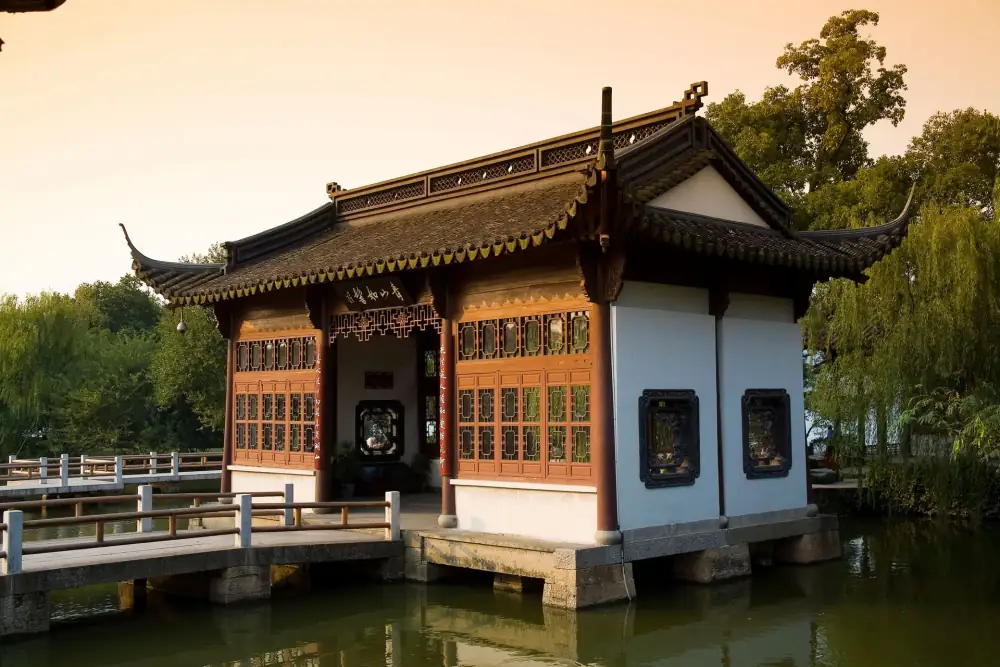
The boat trip to Xiaoying Island (小瀛洲) — one of three man-made islands — is particularly worthwhile. The island contains a pavilion complex surrounded by lotus beds, with the lake visible through moon gates that create a series of perfect circular framings. Entry included in the boat ticket.
The Two Causeways
Su Causeway (苏堤): The main north-south causeway, 2.8 km long, built by the poet-administrator Su Dongpo in 1090. Lined with willows and peach trees, with six stone bridges creating different lake views. Best in spring (March–April) when the peach trees bloom simultaneously. Walking the full causeway takes 45–60 minutes. No motorised vehicles — cyclists, pedestrians, and e-bikes only.
Bai Causeway (白堤): The shorter east-west causeway, named for the Tang Dynasty poet Bai Juyi who governed Hangzhou. Connects Gushan Island to the east shore. The causeway’s northern edge has sweeping views of the Solitary Hill and the Baochu Pagoda on the hillside. About 1 km; 15 minutes to walk.
The West Lake Ten Scenes (西湖十景)
A canonical list of viewpoints established in the Song Dynasty and refreshed in subsequent dynasties. The most visited:
Spring Dawn at Su Causeway (苏堤春晓): The causeway at dawn in spring — peach and willow in flower, mist on the water. Genuinely extraordinary.
Lotus in the Breeze at Crooked Courtyard (曲院风荷): The large lotus field on the northwestern shore, best in June–July when the lotus is in bloom.
Three Pools Mirroring the Moon (三潭印月): The three small stone lanterns set in the water south of Xiaoying Island. On the Mid-Autumn Festival, candles are lit inside and the reflections of the flames create an effect of 33 moons in the water.
Autumn Moon on Calm Lake (平湖秋月): A viewing terrace on the northern shore where, in mid-autumn, the combination of the full moon and the still water creates the classical image of classical Chinese painting. Free; accessible at any hour.
Longjing Tea (龙井茶)
Longjing (Dragon Well tea) is China’s most famous green tea, grown in the hills immediately west and south of West Lake. The combination of specific soil conditions, microclimate, and processing technique — flat-pressed by hand in a heated iron wok — produces a tea with a distinctive chestnut-sweet flavour and flat needle leaves.
The peak of the Longjing season is the first two weeks of April — Qingming tea (明前茶), picked before the Qingming festival. This is considered the finest of the year.
Visiting the Tea Villages
Longjing Village (龙井村): The original and most famous tea village, 20 minutes by bus from the West Lake southern shore. In April, you can watch the hand-picking of fresh leaves and the hand-frying process in the tea farmers’ kitchens.
Meijiawu Village (梅家坞): A larger tea village 3 km southwest, with a long road lined with tea-selling farmhouses and small restaurants. More touristy than Longjing Village, but the tea quality is still genuine. The restaurants here serve Longjing shrimp (龙井虾仁) — local river shrimp stir-fried with first-flush Longjing tea leaves. One of the few genuinely local dishes.
Tea Museum (中国茶叶博物馆): Near the Shuangfeng Village, a free outdoor museum with beautiful landscaping and informative exhibitions on Chinese tea culture. Underrated. The surrounding tea gardens can be walked freely.
Buying tea: Beware of tourist-trap pricing everywhere in the Longjing area. The best approach is to visit in the shoulder season (May–June), when the tourist pressure has relaxed, and buy directly from a farmer family whose production you’ve watched. Genuine first-flush Longjing costs ¥500–2,000 per 500g depending on grade. Anything substantially cheaper is likely a lower-grade tea or a fake.
Beyond West Lake: What Else to See
Lingyin Temple (灵隐寺)
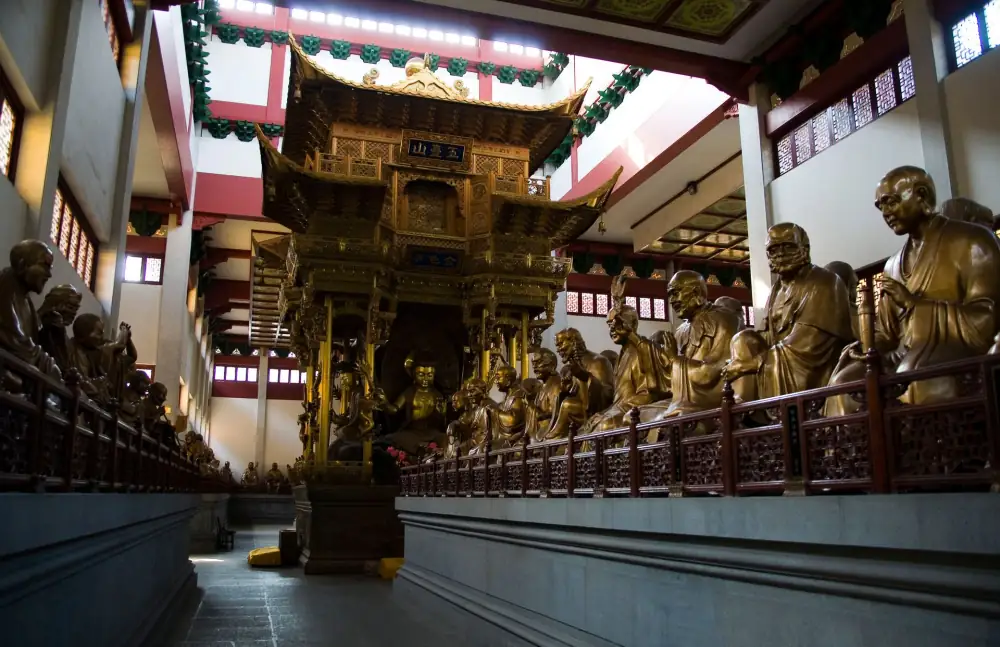
One of China’s largest and most impressive Chan (Zen) Buddhist monasteries, set in a forested valley in the hills west of West Lake. Founded in 328 AD; the current structures are primarily from Tang, Song, and later dynasties.
The approach through Feilai Feng (飞来峰) — a limestone hill carved with 470 Buddhist relief sculptures from the 10th–14th centuries — is extraordinary. Ticket ¥45 (includes both Feilai Feng and the temple).
Practical: The monastery is actively functioning — several hundred monks resident, multiple ceremonies daily. Arrive early (8–9 AM) to see morning chanting. Dress modestly.
Hefang Street (河坊街) & Old Town
The reconstructed Qing-style pedestrian street in the old city centre has excellent local snacks: osmanthus glutinous rice, lard pastry with red bean, fried tofu with five spice. More importantly, it connects to the Hu Qingyu Tang Traditional Medicine Museum (胡庆余堂) — the most beautiful historic pharmacy building in China, an extraordinary example of Qing Dynasty commercial architecture. Free museum; the pharmacy still sells traditional medicines.
National Tea Museum (中国茶叶博物馆)
Actually two campuses: the Longjing branch (more garden-focused) and the Shuangfeng branch (more exhibition-focused). The best free attraction in Hangzhou outside of West Lake itself.
Where to Eat
Grandma’s Home (外婆家): The Hangzhou restaurant chain that has become an institution — Zhejiang home cooking done very well at reasonable prices. Multiple locations; always queues on weekends. Arrive before 11 AM for lunch.
Zhiweiguan (知味观): Famous for traditional Hangzhou snacks and pastries, particularly the lotus leaf glutinous rice (荷叶粉蒸肉) and various sticky rice preparations.
Alongside West Lake: The strip of restaurants along Hubin Road is scenic but overpriced. One block back into Pinghai Road is better value with more local-focused cooking.
Practical Tips
Electric bikes are the best way to explore the West Lake area and reach the tea villages. Available for hire at multiple points around the lake; ¥20–30/day, no driving licence required.
West Lake free bikes: A public bicycle scheme with docking stations throughout the lakeshore — ¥200 deposit, then free for rides under 1 hour.
Tea village buses: Bus 27 from Yuewang Temple to Longjing Village. Bus 87 from Hubin Road to Meijiawu.
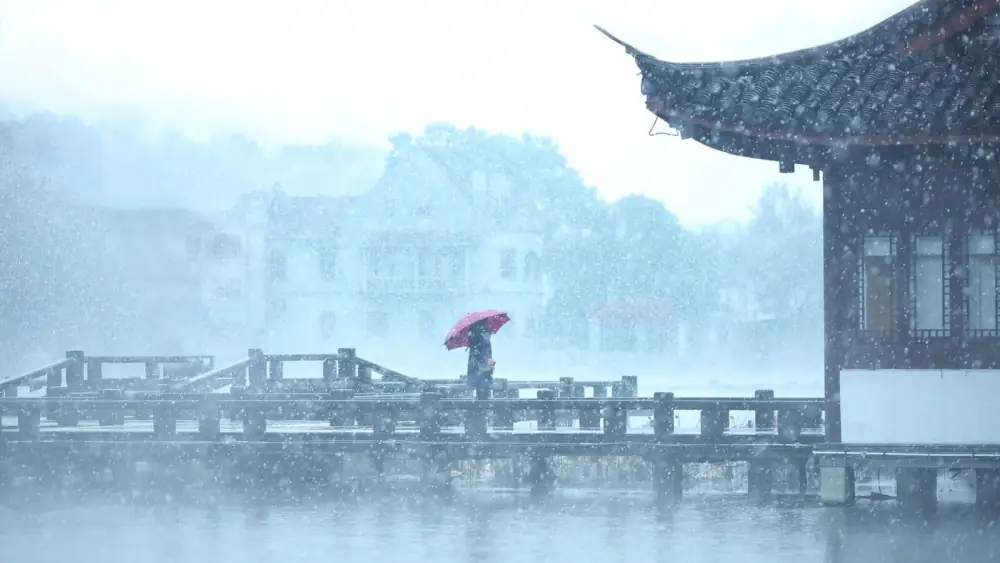
Hangzhou is one of the few places in China that looks exactly like the Chinese paintings you’ve seen. The connection between the landscape and the way it has been depicted in ink for 1,000 years is direct and obvious when you’re standing on the Su Causeway in autumn mist.
Last updated: May 2026