
This guide focuses on two of Hangzhou’s most rewarding half-day activities: cycling the West Lake circuit, and visiting the Longjing tea farms in the hills above the lake. Both complement each other well and can be combined into a single full day.
Table of contents
Open Table of contents
West Lake Cycling Circuit
Renting Bikes
Public bike stations (公共自行车): Docked rental bikes available at stations throughout the West Lake perimeter. ¥200 deposit (refundable), then free for rides under 1 hour. The Hangzhou Public Bicycle system is one of the best-maintained in China.
Private hire: Multiple private hire shops near the Su Causeway and East Gate area; ¥20–30/day for a regular bike, ¥50–80 for electric.
The Route
The full West Lake cycling circuit is approximately 15 km — 2–3 hours at a leisure pace.
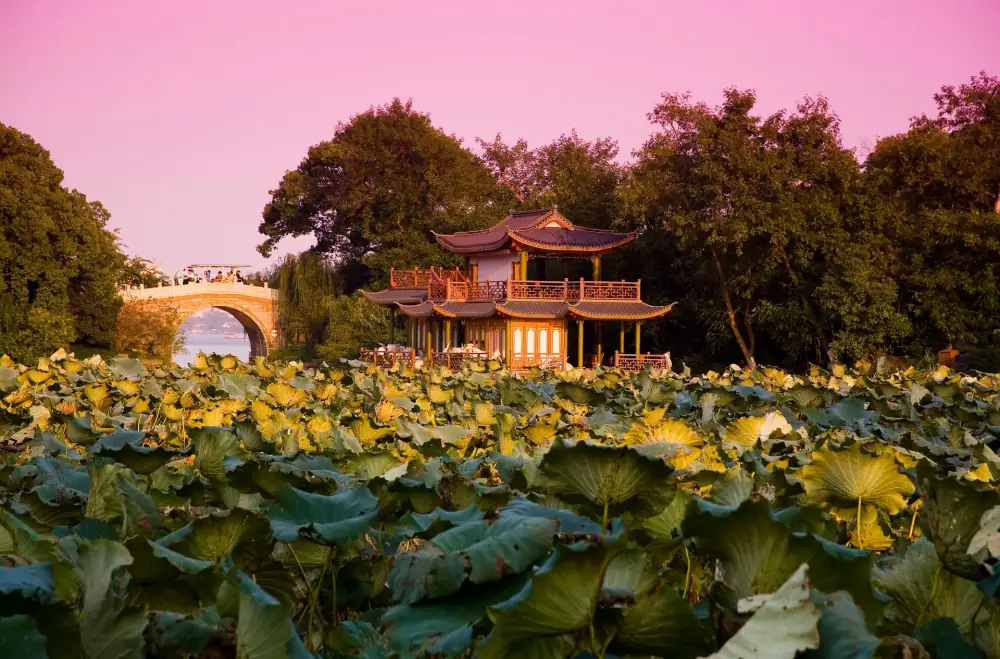
East shore route (lakeside path): The dedicated cycling/walking path along the eastern shore from Hubin Road south to the Leifeng Pagoda. Flat, car-free, excellent lake views. The northern section passes through the willow-fringed Bai Causeway access point.
Su Causeway (苏堤): The 2.8 km causeway running north-south through the middle of the lake — cyclists and pedestrians only, no motor vehicles. Best in spring (March–April) when the peach trees on both sides bloom simultaneously with the willows.
Westshore botanical gardens: Continue west of the Su Causeway into the botanical garden area — a series of themed gardens with peonies, bamboo, herbs, and native plantings. Quiet mid-week.
South shore and Leifeng Pagoda (雷峰塔): The reconstructed five-storey pagoda on the southern hill. The exterior of the original Tang Dynasty pagoda collapsed in 1924 — the current structure (2002) stands over the excavated remains of the original. Ticket ¥40; the underground exhibition of the original structure is excellent.
Longjing Tea Village
Getting There
From the West Lake area: Bus 27 from Yuewang Temple to Longjing Village (20 min). Or bicycle from the Su Causeway area (uphill, 25 min).
The Village
Longjing Village (龙井村) is the origin-of-origin for Dragon Well tea — the specific village from which the name comes, whose surrounding hillsides grow the highest-grade Longjing.
The village itself is small — a cluster of farmhouses surrounded by tea terraces rising up the hill. In April, during the harvest, the terraces are dotted with pickers in traditional bamboo hats.
What to do:
- Walk the terraces: The path above the village leads through the tea gardens — rows of knee-height tea bushes, intensely green. In April, the newest growth (single leaf and bud) is visible.
- Watch the frying process: Tea farmers often demonstrate hand-frying in the kitchen on a heated iron wok — the hot-wok hand-pressing technique that distinguishes Longjing from other green teas. Watch for approximately 20–30 minutes; the fresh tea smell is extraordinary.
- Buy direct: Purchasing from the farmer family whose process you’ve watched provides some quality assurance. Expect ¥300–800/100g for good spring Longjing; ¥100–300 for later-harvest grade.
Tasting Session
Several farmhouses offer sitting tea sessions — a proper gongfu-style tasting of different grades of Longjing with the farmer explaining the differences. This is the best educational experience available in the area. Typically free if you buy tea; ¥30–50 tasting fee otherwise.
The three quality markers:
- Appearance: Flat, straight needles of similar size; bright green; no stems
- Aroma: Grassy, nutty, slightly floral; the chestnut note that Longjing is famous for
- Taste: Clean and sweet on the palate; the umami depth of first-flush; no bitterness if infused at correct temperature (70–75°C)
Meijiawu Village (梅家坞)
3 km west of Longjing Village — a longer tea valley with a road lined by farmhouse restaurants and tea shops. More tourist infrastructure than Longjing Village but the valley itself is beautiful.
Longjing shrimp (龙井虾仁): The specific Hangzhou dish — local river shrimp stir-fried with fresh first-flush Longjing tea leaves. Available in season (April) from the restaurants along the valley. The tea leaves add a grassy freshness that complements the shrimp.
Practical Tips

Combine in a day: Morning — West Lake cycling circuit (3 hours). Lunch near the lake. Afternoon — bus to Longjing Village (half-day, return by 5 PM).
April timing: The Qingming Festival (清明节, early April) marks the official start of the Longjing picking season. The 1–2 weeks before and after Qingming are the peak for genuine first-flush tea (“明前茶”).
Crowds: West Lake cycling is best on weekday mornings. Longjing Village is quieter than most West Lake attractions but gets busy on spring weekends.
The combination of cycling the lake at sunrise and watching tea being picked and fired in the hills above is as close as Hangzhou gets to the ideal day: beauty, activity, food, and the specific pleasure of understanding how something is made.
Last updated: May 2026