
The Taihang Mountains (太行山) form the dramatic natural boundary between the North China Plain and the Loess Plateau, running roughly north-south for 400km along the borders of Hebei, Henan, and Shanxi. In the Jiyuan (济源) and Jiaozuo (焦作) area of northern Henan, the mountains produce some of the most striking geological scenery in central China — red sandstone canyons, sheer cliff faces, waterfalls, and dense forest that transforms with the seasons.
Yuntai Mountain (云台山) is the centerpiece — a UNESCO Global Geopark that draws over 3 million visitors annually and contains the Red Stone Gorge (红石峡), widely considered one of the most beautiful narrow canyons in China. Further west, the Guoliang Cliff Road (郭亮挂壁公路) — a road carved through the cliff face by villagers using hand tools — has become one of China’s most famous engineering landmarks.
Table of contents
Open Table of contents
Getting to the Taihang Region
By train:
- To Jiaozuo (焦作): High-speed trains from Zhengzhou (30 minutes, ¥35–50), Beijing (2.5 hours, ¥180–260), and Xi’an (2 hours, ¥100–160)
- To Jiyuan (济源): About 1 hour from Zhengzhou by train; ¥40–60
By bus:
- Direct buses from Zhengzhou to Jiaozuo run every 30 minutes; ¥30–50
Getting to Yuntai Mountain from Jiaozuo:
- Bus from Jiaozuo Bus Station: about 1 hour; ¥15
- Taxi: ¥60–80 one-way
Getting to Guoliang Village from Jiaozuo:
- About 80km; taxi or hired car ¥200–300; or bus to Huixian (辉县) then local transport
Yuntai Mountain (云台山)
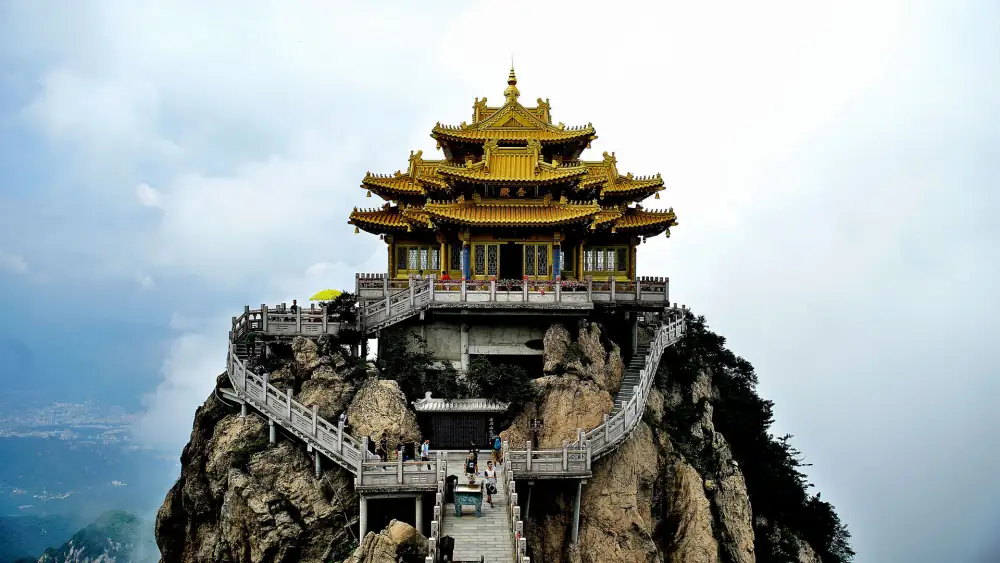
Yuntai Mountain is the largest and most developed scenic area in the Taihang Mountains, covering about 280 square kilometers. It contains multiple distinct scenic zones, each requiring a half-day to visit properly.
Entry and tickets:
- Three-day pass: ¥180 per person (valid for 3 consecutive days; covers all scenic zones and internal shuttle buses)
- One-day pass: ¥120 (covers limited zones)
- The three-day pass is strongly recommended — there’s too much to see in one day
Internal transport: Electric shuttle buses connect the entrance gate with each scenic zone; frequency every 10–15 minutes in peak season.
Red Stone Gorge (红石峡)
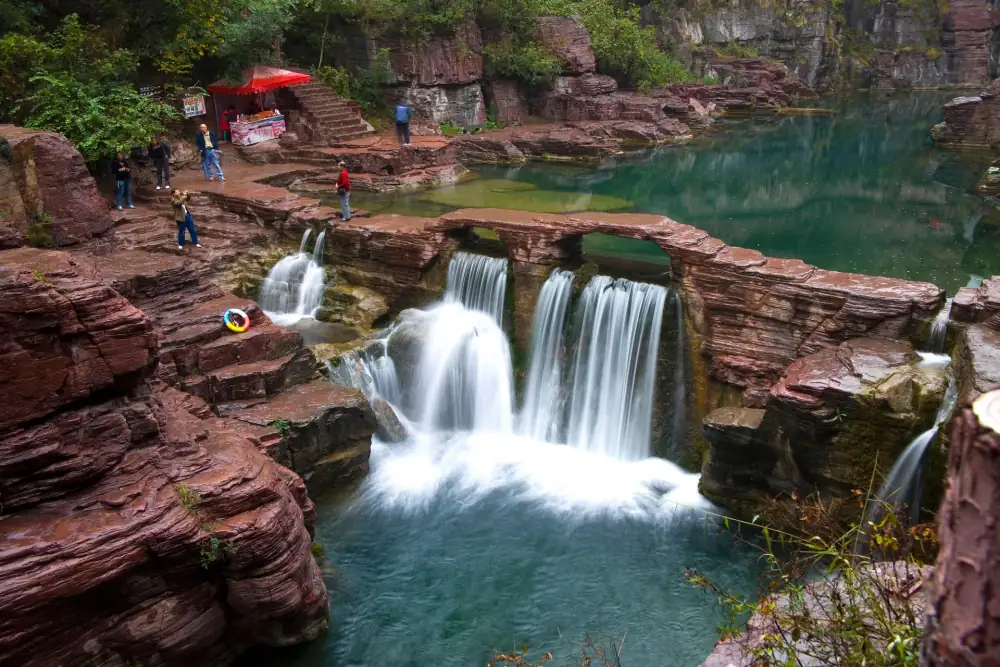
The single most famous sight in Yuntai Mountain, and the reason most visitors come. The Red Stone Gorge is a narrow slot canyon cut through red sandstone by the Zifang River, with vertical walls 50–80 meters high in places narrowing to just a few meters wide.
What makes it extraordinary:
- The red sandstone walls — oxidized iron minerals give the rock its distinctive color — contrast with the green water and white waterfalls
- Multiple small waterfalls cascade from the canyon walls into the river below; the spray keeps the canyon cool even in midsummer
- A well-constructed walkway clings to the canyon walls, crossing the river on small bridges and passing behind waterfalls
- The light in the canyon changes dramatically through the day; the morning light entering from the east creates the most dramatic illumination
Time required: 2–3 hours for the full canyon walk
Best time: Morning (8–10am) for the light and to beat the peak crowds
Difficulty: Easy — the walkway is flat and well-maintained
Yuntai Skyline Waterfall (云台天瀑)
At 314 meters, this is the highest single-drop waterfall in China. It’s a seasonal waterfall — most impressive after heavy rain in summer, reduced to a thin trickle in dry winter months.
Getting there: 30-minute walk from the nearest shuttle bus stop
Best months: June–September after rain; avoid October–May when flow is minimal
Qinglong Gorge (青龙峡)
A longer, less-crowded gorge hike through forest and along a clear stream. The gorge walls here are less dramatically red but the forest setting is deeper and more immersive. Allow 3–4 hours for the full hike.
Zifang Lake (子房湖)
A reservoir at the head of one of the valleys, popular for boat trips and for its clear water reflecting the surrounding peaks. The lake-level walkway is pleasant in late afternoon.
Wanshan Temple (万善寺)
A Buddhist temple complex on a hillside within the scenic area, with origins in the Tang Dynasty. Less spectacular than the natural features but provides a cultural counterpoint and a good viewpoint over the valleys.
Guoliang Cliff Road (郭亮挂壁公路)
About 80km west of Yuntai Mountain, in the Xinxiang (新乡) area, Guoliang Village (郭亮村) perches on a plateau 1,700 meters above sea level, accessible only by a road carved through the cliff face — a feat of engineering accomplished by 13 villagers using hand tools between 1972 and 1977.
The road:
- Length: About 1,200 meters through the cliff
- The tunnel is not a conventional road with smooth walls — it’s a rough-hewn passage with irregular rock surfaces, natural “windows” cut to the cliff face at intervals, and a width barely sufficient for one vehicle
- The windows provide dizzying views down the 200-meter cliff face
- The road surface is paved but rough; speed is limited to walking pace
Visiting:
- Private vehicles can drive through the tunnel in both directions (one-way traffic is managed by signals)
- Walking through the tunnel is possible and provides more time to appreciate the engineering
- Entry fee for the Guoliang scenic area: ¥80 per person
Guoliang Village: The village itself is a small stone settlement on the plateau top, now heavily touristed but still maintaining some character. The views from the village edge — looking down the cliff face to the valley 200 meters below — are vertiginous.
Accommodation in Guoliang: Several guesthouses in the village (¥120–250/night); staying overnight allows early morning and evening exploration when the day-trippers are absent.
Jiyuan and Surrounding Area
Jiyuan (济源), about 50km west of Jiaozuo, is an alternative base for exploring the western Taihang area:
Wangwu Mountain (王屋山): A Taoist sacred mountain about 30km west of Jiyuan, associated with the “Foolish Old Man Removes the Mountains” (愚公移山) fable — one of the most famous parables in Chinese culture. The mountain has Taoist temples, forested hiking trails, and a 1,715m summit. Entry ¥60.
Xiaolangdi Dam (小浪底水库): The Yellow River dam about 30km south of Jiyuan; the seasonal silt discharge in June is a major spectacle. Boat tours on the reservoir available year-round. Entry ¥50.
Practical Information
Best time to visit Yuntai Mountain:
- Spring (April–May): Moderate temperatures; fresh green foliage; moderate crowds
- Summer (June–August): The canyon stays cool; waterfalls are at peak flow; school holiday crowds are intense on weekends
- Autumn (September–October): The best season — fall foliage colors the gorges red and gold; clear skies; maximum waterfall flow from autumn rain; busiest in October (national holiday)
- Winter (November–March): Frozen waterfalls; icicle formations in Red Stone Gorge; very few visitors; atmospheric but cold
Accommodation near Yuntai Mountain:
- Multiple hotels near the scenic area entrance (¥150–400/night)
- Guesthouses in the surrounding villages (¥80–180/night)
- The Yuntai Mountain Tourism Service Center can arrange bookings
What to bring: Comfortable walking shoes (essential — the gorge walkways can be slippery), water, snacks, camera. The internal shuttle buses make logistics easy.
Time required for Yuntai Mountain: Two days minimum; three days ideal. Day 1: Red Stone Gorge and Waterfall. Day 2: Qinglong Gorge and other zones. Day 3 (optional): Wanshan Temple and Zifang Lake at leisure.
Combining with Guoliang: A 3–4 day trip allows both Yuntai Mountain (2 days) and Guoliang (1 day) with travel between them.