
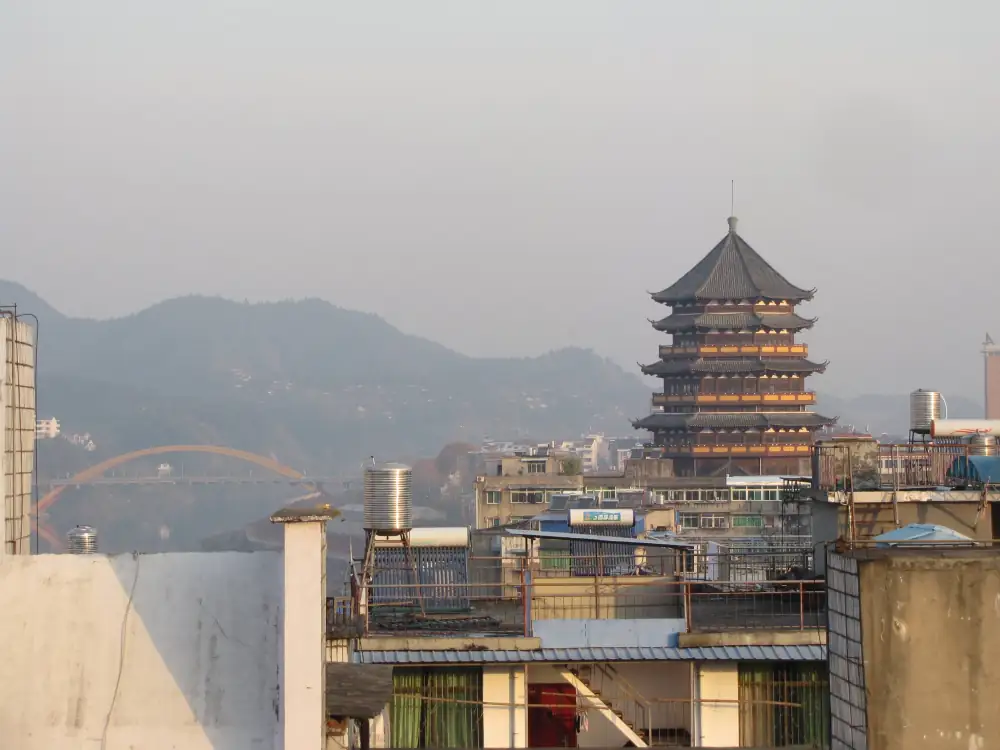
The Tengwang Pavilion (滕王阁) on the west bank of the Gan River in Nanchang has been destroyed and rebuilt 29 times over 1,350 years. The current structure — the 29th reconstruction, completed in 1989 — rises to 57.5 meters in a form that attempts to evoke the Tang Dynasty original, and it stands as one of the most recognizable landmarks in Jiangxi Province.
It owes its enduring fame not primarily to its architecture but to a poem. In 675 AD, a young prodigy named Wang Bo (王勃) attended a banquet at the pavilion hosted by the Hongzhou prefect and spontaneously composed “Ode to the Prince Teng’s Pavilion” (滕王阁序). He was 25 years old. The poem is considered one of the masterpieces of Tang parallel prose, containing lines that have been quoted and memorized for 1,350 years. Wang Bo died the following year, drowned in the South China Sea. The poem outlasted everything.
Table of contents
Open Table of contents
The Poem and Its Significance
Understanding why Tengwang Pavilion matters requires understanding why Wang Bo’s poem matters. The parallel prose composition (骈文) was a supremely difficult literary form — every phrase had to balance grammatically and tonally with its partner phrase, while the content needed to flow naturally. The result Wang Bo produced at 25 is considered to have mastered the form as completely as anyone ever has.
Famous lines from the poem:
- “落霞与孤鹜齐飞,秋水共长天一色” — “The sunset clouds and the solitary duck fly together; the autumn river shares one color with the boundless sky” — frequently cited as one of the most beautiful lines in the Chinese literary canon
- “穷且益坚,不坠青云之志” — “The more impoverished, the more resolute; do not let the aspirations toward the blue sky fall” — a classic statement of perseverance
When the poem was passed to the host prefect, who had prearranged for his own son-in-law to write the composition (a common convention of the time), he reportedly crumpled the paper in annoyance at this presumption — until he began reading, and then uncrumpled it, and read it again, and declared it perfect.
The poem in the pavilion: Carved stone tablets throughout the pavilion reproduce the text; the famous line about the duck and the sunset is reproduced on a large stone at the main entrance. Reading the poem before visiting (available in translation online) significantly deepens the experience of the place.
Visiting the Tengwang Pavilion
Opening hours: 8:00am–6:00pm daily (extended to 9:00pm on summer evenings for the light show)
Entry fee: ¥120 per person (includes access to all floors and the surrounding park area)
The current structure: The 1989 reconstruction follows Song Dynasty architectural conventions (not Tang, as originally planned — the documentation of the Tang original was insufficient) while incorporating Tang artistic elements in its decoration. The building has:
- Nine exterior floors visible from the outside
- Six main interior floors (the building has some mezzanine and utility levels)
- The main hall (滕王阁主阁): The central building rises in the Song-style with upswept roof corners and red lacquer columns
- Side buildings: Two lower flanking structures create a three-building complex connected by covered walkways
What’s inside:
- Massive murals on the main interior walls depicting scenes from Wang Bo’s poem and Tang Dynasty court life
- Recreations of Tang furniture and decorative objects
- A large scale model of Tang Dynasty Nanchang (Hongzhou)
- The topmost floor: 360-degree views of the Gan River, the city, and — on clear days — the mountains beyond
The evening visit: After 6:00pm in summer, the pavilion and surrounding riverfront area are illuminated and the area transforms into an atmospheric night destination. The reflection of the lit pavilion in the Gan River approximates the scene Wang Bo described. A free light and water show runs at 8:00pm and 9:00pm.
The Gan River Waterfront (赣江滨水区)
The development of the Gan River waterfront around the pavilion over the past decade has created one of Nanchang’s more pleasant urban spaces. The promenade stretches several kilometers along the west bank.
Evening walks: The 2km stretch from the pavilion north to the Fuhe River confluence is pleasant for an evening stroll, with food stalls, outdoor seating, and views of the opposite bank’s modern high-rises.
Boat trips: Small evening cruise boats operate from the pier south of the pavilion; the 40-minute circuit views the pavilion from the river — a genuinely different perspective. Cost: ¥80–100 per person.
Rope bridge: A suspension pedestrian bridge nearby the pavilion connects the west bank to Yan’an Island (赣东大堤) in the middle of the river — pleasant for a morning walk.
Nanchang’s Other Sights
Tengwang Pavilion is Nanchang’s single most important attraction, but the city has other significant sites:
Nanchang Uprising Memorial Museum (南昌起义纪念馆): On August 1, 1927, the Chinese Communist forces launched the Nanchang Uprising — the first major military action by the Communist Party against the Nationalist government. This date is commemorated as the founding of the People’s Liberation Army (August 1 remains PLA Day). The museum, housed in the original hotel where the uprising was planned, covers the event in considerable detail. Entry free; ID required.
Bayi Square (八一广场): The central square of Nanchang, dominated by a 45-meter monument to the August 1 Uprising. One of China’s largest central squares; the evening fountain shows are free to watch.
Wanshou Palace (万寿宫): A historic Taoist complex and guild hall built by Jiangxi merchants in 1867. The current “Wanshou Palace Historical and Cultural District” is part authentic restoration, part themed commercial zone, but the core buildings are genuinely impressive examples of late Qing Jiangxi architectural craft.
Qingyunpu (青云谱 / Zhu Da Memorial): A Taoist monastery that was the home of Zhu Da (朱耷, also known as Bada Shanren), the eccentric 17th-century painter considered one of the founders of the Chinese literati painting tradition. His paintings — strange creatures, distorted rocks, a single sleepy fish — were hugely influential on subsequent Chinese and Japanese art. The monastery is now a museum dedicated to his life and work. Entry ¥35.
Nanchang Food
Jiangxi food occupies an underrecognized position in Chinese cuisine — spicier than most people expect, deeply savory, and with excellent freshwater fish preparations.
Nanchang rice noodles (南昌拌粉 / 炒粉): The defining Nanchang street food. Thick round rice noodles (much thicker than Guilin’s), mixed with chili, pickled vegetables, peanuts, and sesame oil; served cold or stir-fried at breakfast stalls throughout the city. Portions typically ¥8–15.
Three Cup Chicken (三杯鸡): A dish that originated in Jiangxi (though it’s now most associated with Taiwan) — chicken pieces braised in one cup each of soy sauce, rice wine, and sesame oil, with ginger and basil. The result is intensely flavored and caramelized. Essential to try in the home province.
Drunk fish (醉鱼): Freshwater fish from the Gan River and Poyang Lake (中国最大的淡水湖) marinated in rice wine and dried; served in numerous forms. The whole dried fish sold in Nanchang’s markets make excellent gifts.
Gan Cuisine restaurants (赣菜馆): Look for restaurants specializing in authentic Jiangxi food rather than generic Chinese. The area around Nanjing East Road (南京东路) has a good concentration.
Getting Around Nanchang
Metro: Nanchang has four metro lines covering the main tourist areas; clean and inexpensive (¥2–5 per journey).
Key transit notes:
- Tengwang Pavilion Metro: Line 2, Tengwang Pavilion Station (滕王阁站)
- Nanchang Uprising Museum: Walking distance from Bayi Square on Line 1
When to Visit Nanchang
Best months: March–May and September–November
Spring: Comfortable; the plum blossoms in late February–early March are beautiful
Autumn: Clear skies; the Gan River is photogenic in autumn light
Summer: Hot and humid (35–38°C common); survivable but not enjoyable
Winter: Mild by northern standards but damp; not at its best
Travel circuit: Nanchang works well as a hub for Jiangxi exploration — Jingdezhen (1.5 hours by train), Lushan Mountain (2 hours), and Wuyuan scenic villages (3 hours) are all accessible as day trips or overnight excursions.