
Wuyuan: China’s Most Beautiful Countryside
The phrase attached to Wuyuan County (婺源) in the guidebooks — “中国最美乡村” (China’s most beautiful countryside) — was coined by a journalist in the early 2000s and has been repeated in virtually every piece of Chinese tourism writing since. The phrase, like most superlatives, is both reductive and, in this case, not entirely wrong.
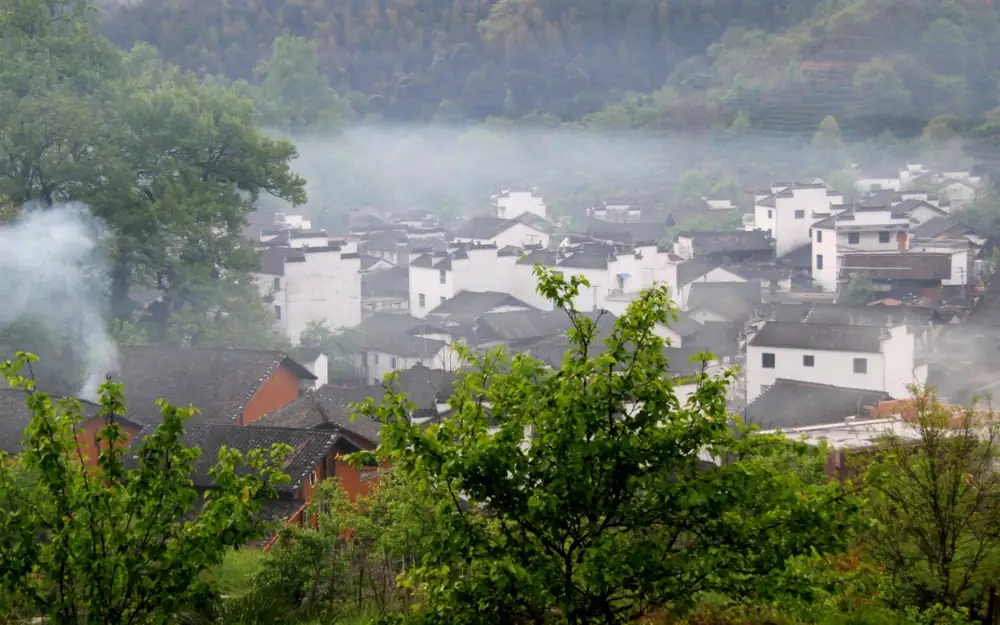
Wuyuan sits in the northeast corner of Jiangxi Province, bordering Anhui, in the historical Huizhou cultural region — the area of dense mountain valleys that produced the remarkable combination of whitewashed walls, black tile roofs, and horse-head gables that became the visual signature of southern Anhui and northern Jiangxi architecture.
What makes Wuyuan distinctive — beyond the architecture, which it shares with parts of Anhui — is the combination of landscapes in an unusually small area: the autumn ginkgo gold, the spring rapeseed yellow, the permanent white-and-black village architecture, and the rivers running through it all.
The Architecture: Huizhou Style
The Visual System
Huizhou architecture (徽派建筑) is one of the most immediately recognisable regional styles in China:
- White plaster walls — lime-washed, sometimes painted with landscape murals near entrances.
- Black tile roofs — compact, dark, low-pitched in the valleys and steeper on hillside buildings.
- Horse-head gables (马头墙, mǎtóu qiáng) — the stepped upward-projecting gables that rise above the roofline, originally designed as fire breaks between terraced houses.
- Carved interior woodwork — the visible interior beams, window screens, and door frames are carved with extraordinary complexity: figures, animals, landscape scenes, mythological narratives.
The carving traditions of Wuyuan are particularly fine. The county was historically one of the wealthiest areas of the Ming and Qing Huizhou commercial culture — the Huizhou merchants made fortunes in salt, tea, and pawnbroking, and spent their wealth on houses whose exteriors were modest (to avoid imperial taxation on visible wealth) and whose interiors were spectacular.
The Villages
Wuyuan has dozens of preserved traditional villages; the most-visited form a loose circuit in the northern part of the county:
Likeng Village (李坑): Positioned along a small stream; the village’s waterways, stone bridges, and waterside architecture create a composition frequently compared to Venice. Best visited before 9 AM when tour groups haven’t arrived.
Wangkou Village (汪口): Famous for the 俞家宗祠 (Clan Ancestral Hall) — one of the finest examples of Ming-dynasty clan hall architecture in the region, with floor-to-ceiling carved woodwork of extraordinary density and quality.
Sixi Yanxi Village (思溪延村): A village that produced many of China’s most successful Ming-Qing period pawnbrokers; the surviving mansions reflect this wealth in their carved entrance halls and hidden interior courts.
Qinghua Town (清华镇): The largest market town in the county; its covered Rainbow Bridge (彩虹桥) — a Song-dynasty covered timber bridge on stone piers — is one of the oldest and finest examples of traditional covered bridge construction in China.
Autumn Ginkgo: Wuyuan’s Most Spectacular Season
The autumn ginkgo display at Wolong Valley (卧龙谷) and the village of Shihucheng (石壶城) is among the most photographed in China. The key sight is simple: ancient ginkgo trees (some centuries old, reaching 30+ metres) whose leaves turn a saturated, almost neon yellow in late October–early November, creating canopies of gold above the white village walls and black river stones.
The Best Ginkgo Villages
Li Keng (篁岭): A village built on a hillside so steep that the lanes wind between buildings with no flat ground; the autumn colour here — ginkgo gold against white walls and the valley below — is extraordinary. A gondola connects the parking area to the village. Admission ¥80.
Caxi Village (查济): 25 km from main Wuyuan tourist zone; a larger village with very old ginkgo trees. Less photographed and more authentic in atmosphere.
Peak Colour Timing
The ginkgo leaf colour at Wuyuan peaks approximately late October to mid-November — typically the 25th of October to the 10th of November, varying by year. The colour appears almost overnight and drops within 2–3 weeks of peak. Check Chinese photography forums (摄影师群) for current-year timing.
Spring Rapeseed Flowers
The spring equivalent of the autumn ginkgo — rapeseed fields (油菜花) bloom in late February to March in the lower valley floors. The combination of the yellow fields, white-walled villages, and the clear light of early spring is what launched Wuyuan’s fame in Chinese photography culture in the early 2000s.
Peak bloom: Late February to mid-March (varying by year and elevation).
The spring season is the most crowded — Chinese photography enthusiasts from across the country descend with tripods and long lenses, and accommodation near the best-known viewpoints sells out months in advance.
Practical Information
Getting There
From Jingdezhen (景德镇, Jiangxi): Bus 1.5 hours (¥40). Jingdezhen has high-speed rail connections to Nanchang, Shanghai, and Wuhan. From Shanghai: High-speed train to Shangrao (上饶), then local bus or taxi to Wuyuan (1.5 hours). Total: 3–4 hours. From Huangshan (Anhui): Local bus 2.5 hours — a natural combination with Huangshan mountain.
Within Wuyuan
The county covers a large area; a rented bicycle is ideal for village-to-village exploration on flat valley roads. Electric scooter rental (¥60–¥80/day) is also available. Without a vehicle, mini-tour buses from the county seat connect the major villages.
Admission
Many villages charge individual entrance fees (¥20–¥80 each). A comprehensive county pass (¥230–¥280) covers most major villages and is better value for those spending 2+ days.
Accommodation
County seat (婺源县城): Full range of hotels (¥150–¥400/night). In-village guesthouses: Several villages have restored courtyard houses operating as family guesthouses (¥200–¥400/night); staying in-village allows early morning and late evening access when crowds are absent.
Wuyuan is most beautiful in the two transition moments — early morning before the tour buses, and the blue-grey dusk when the white walls take on the colour of the sky. Go in those windows and ignore the middle of the day.