
Hongcun’s Nanhu Lake — the most photographed village reflection in China, with 800-year-old merchant architecture mirrored in the still morning water
The historic villages of southern Anhui’s Huizhou region (徽州古村落) are among the most photographed rural landscapes in China — white-walled, grey-roofed merchant houses rising from green mountain valleys, with smoke-darkened interior halls telling stories of merchants who built fortunes on the Ming and Qing Dynasty tea and salt trades, then returned to invest in the most elaborately decorated homes in rural China.
Table of contents
Open Table of contents
Why Huizhou Architecture Is Special
The Huizhou merchant tradition created a specific architectural vocabulary:
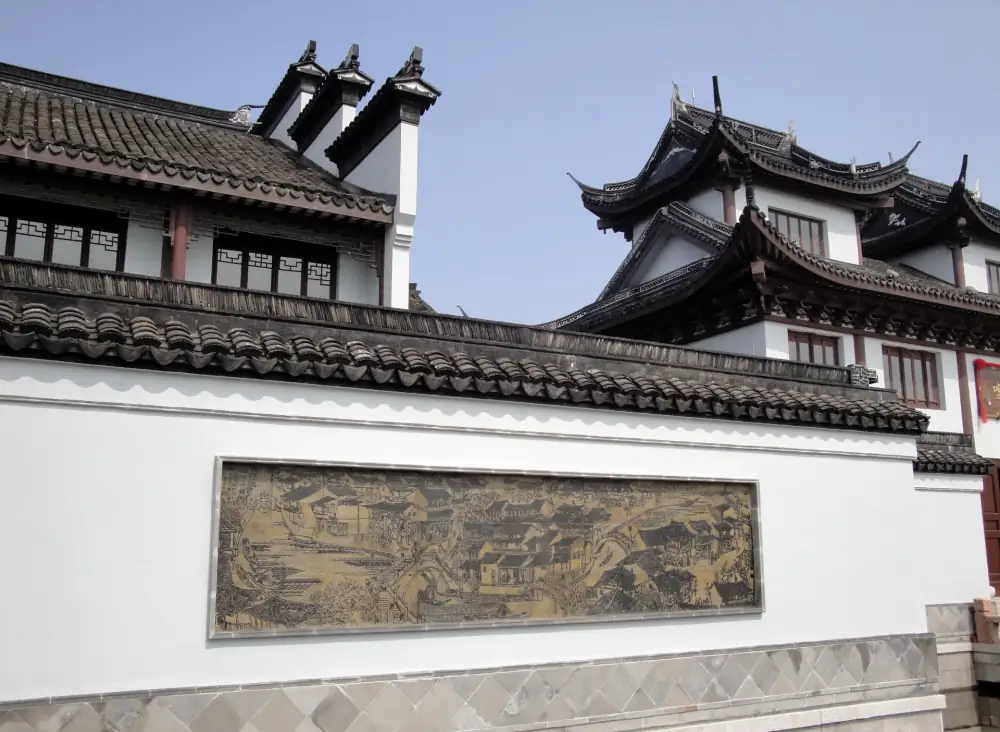
Horse-head gables (马头墙): The stepped white-rendered gable walls that rise above the roofline in stepped profile — designed as firebreaks between adjacent houses (merchants’ houses were densely packed) but evolving into the visual signature of the region.
Moon pools (天井): An interior courtyard open to the sky — every Huizhou house has one. The Chinese philosophical concept of “heaven’s water” coming into the house, collected in the shallow pool below, informs the design. Light in Huizhou interiors comes primarily through these small sky openings.
Three carving traditions (三雕): Huizhou woodcarving (木雕), stone carving (石雕), and brick carving (砖雕) — applied to beams, doorframes, windows, ancestral halls, and gates with a density and quality that represents the peak of Chinese vernacular decorative arts.
Huizhou horse-head gables — the stepped white gable walls designed as firebreaks that became the visual signature of southern Anhui
Xidi (西递): The Merchant’s Village
A UNESCO World Heritage Site (with Hongcun) — a relatively compact village of 124 surviving Ming and Qing houses, all built by the Hu clan of Xidi from the 12th–19th centuries.
The entrance Paifang: The 1578 three-bay stone memorial archway (胡文光刺史坊) at the village entrance — one of the finest examples of Ming commemorative stonework in China.
Jingai Tang (敬爱堂): The clan ancestral hall — the most formal room in the village social hierarchy, with the most elaborate carvings. The contrast between public grandeur and intimate domestic space in the same building is revealing.
The back lanes: Walking away from the main route through the village’s back lanes — where the lanes narrow to 1–2 metres between whitewashed walls, with carved wooden windows overhead and moss-covered stone pavements underfoot — gives the clearest sense of the original village fabric.
Ticket: ¥104.
Xidi’s back lanes — the original Ming Dynasty alley fabric where the walls close to arm’s-width and carved wooden screens are visible above
Hongcun (宏村): The Painted Village
The more visually perfect of the two UNESCO villages — Hongcun was deliberately planned around a water management system that routes a stream through every house and into a central moon-shaped lake.
Nanhu Lake (南湖): The crescent-shaped lake at the south entrance — the classical composition of the village behind the still water, with the horse-head gable walls reflected, is the most-reproduced image in Huizhou photography.
The internal water system: Unique in Chinese village planning — the original hydraulic engineers (12th century) designed a system where the main stream is diverted into a channel running through every kitchen (for cooking and washing), then into the central Moon Pond (月沼), then out to Nanhu. The water still flows.
The artists’ village: Hongcun’s beauty has attracted art students for generations — classes from the nearby art academies are held at the lakeside year-round. On clear mornings, the sight of 20–30 students painting the same composition from the bridge edge is part of the village atmosphere.
Ticket: ¥104.
Shexian Old Town (歙县古城)
The former Huizhou prefecture capital — multiple memorial archways (牌坊) survive on the old city’s main street, particularly the Tangye Archway Group (棠樾牌坊群): seven consecutive archways commemorating Bao family members across five generations, spanning the Ming and Qing periods. The only such continuous multi-archway sequence in China.
Hongcun — China’s most painted village, with art students from academies across the country gathering at the lakeside year-round
Rapeseed Flower Season
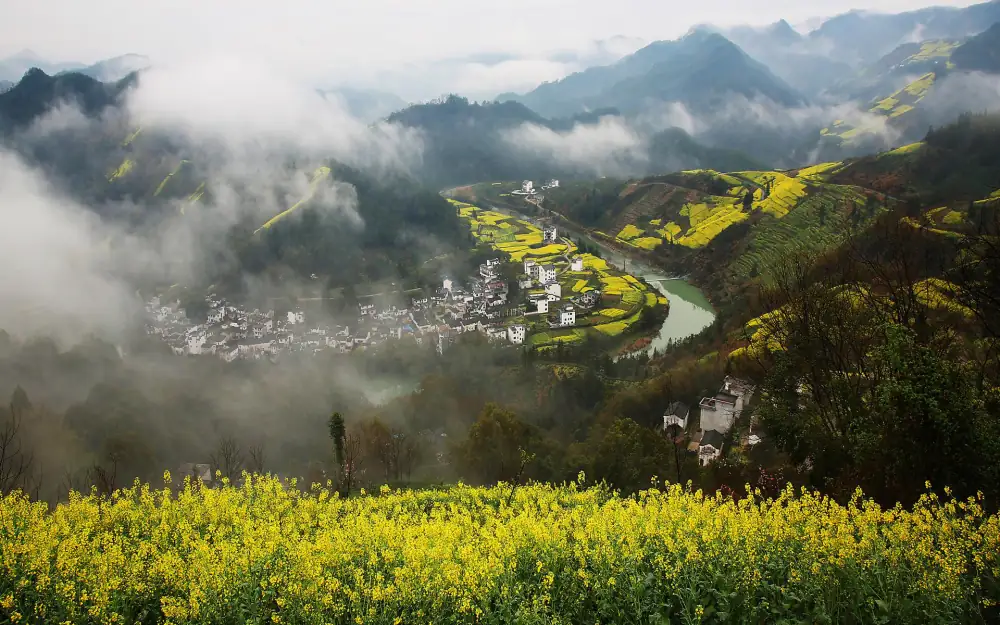
The single best reason to time a Huizhou visit carefully: in late March–early April, the valley floors of Shexian and Yixian turn brilliant yellow with rapeseed (油菜花) flowers. The white villages against the yellow field against the green mountains create a colour composition that is one of China’s most celebrated seasonal landscapes.
Luotan Village (卢村) hills: The view from the hillsides east of Hongcun, looking down at the rapeseed fields and the village rooftops, is the iconic combination. Early morning light and slight mist produce the best conditions.
Huizhou rapeseed season (late March–April) — the valley floors turn brilliant yellow creating China’s most celebrated seasonal landscape
Practical Tips
Getting there: Huangshan Station (黄山站) on the high-speed rail — from Shanghai (2 hrs), Hangzhou (1.5 hrs), Nanjing (2 hrs). Bus from Huangshan Station to Xidi (40 min) and Hongcun (50 min).
Combining with Huangshan: Huangshan Mountain is 60 km from the villages — the natural combination is 2 nights at Hongcun/Xidi (villages and rapeseed), then 2 nights for Huangshan (the mountain).
Last updated: May 2026