
Anhui Province: Where Traditional Architecture Meets Mountain Splendor
Anhui (安徽, Ānhuī) is one of China’s least visited provinces by international travelers, which makes it one of the most rewarding for those who make the effort. The province contains some of China’s most distinctive vernacular architecture (the Huizhou style, with whitewashed walls and black-tiled roofs), two UNESCO World Heritage sites (Huangshan Mountain and the Xidi and Hongcun villages), a remarkable tea culture, and a capital city (Hefei) that is transforming rapidly from provincial center to national science hub.
Hefei: The Capital in Transition
Hefei (合肥, Hé Féi) was a relatively minor provincial city until the late 20th century — known primarily as a junction point and administrative center. Two developments transformed it: the relocation of the University of Science and Technology of China (USTC) from Beijing to Hefei in 1970, and a subsequent deliberate policy of developing Hefei as a national center for quantum computing, artificial intelligence, and semiconductor research.
Today, Hefei hosts one of China’s most impressive clusters of high-tech research — the National Laboratory for Physical Sciences at the Microscale at USTC is at the frontier of quantum research, and several nationally significant tech enterprises are headquartered here.
For travelers, Hefei is primarily a transit hub for Huangshan and the Huizhou villages. But the city is worth a day’s exploration:
Anhui Museum (安徽博物院): One of China’s better provincial museums, with excellent collections of Huizhou woodcarving, calligraphy, and folk art. The new museum building is architecturally significant. Free admission.
Bao Zheng Memorial Temple (包公祠): The temple-memorial to Bao Zheng (包拯, 999-1062 CE), the legendary Song dynasty judge celebrated for his incorruptibility and justice. Bao Zheng was born in Hefei, and the memorial temple on the shore of Bao Gong Lake is considered one of China’s most important sites of “honest official” culture.
Chaohu Lake (巢湖): One of China’s five largest freshwater lakes, about 30 km south of Hefei. Good for cycling, birdwatching, and fresh crab in autumn.
Getting Around Anhui
Anhui has excellent rail connections:
Hefei is on the Beijing-Shanghai high-speed rail line and is a major hub:
- From Shanghai: approximately 2.5 hours
- From Beijing: approximately 3.5 hours
- From Nanjing: approximately 40 minutes
- From Hangzhou: approximately 2 hours
Huangshan (Yellow Mountain) is best reached by high-speed train from Hefei (2 hours) or direct from Shanghai (2.5 hours, via the recently completed high-speed line).
Huangshan city (Tunxi): The gateway city for Huangshan Mountain is called Huangshan city, but the urban area is largely known by its historical name Tunxi (屯溪). The old street (屯溪老街) in Tunxi is one of China’s best-preserved Ming dynasty commercial streets — and is genuinely less visited than more famous heritage streets.
Hongcun and Xidi UNESCO Villages
The most important reason to visit Anhui (besides Huangshan Mountain) is the extraordinary collection of Huizhou-style villages preserved in the mountains south of Tunxi.
Hongcun (宏村)
Hongcun is one of China’s most beautiful preserved villages — a compact settlement of 400-year-old whitewashed, black-roofed houses arranged around an artificial crescent lake at the center of the village. The lake (月沼, Moon Pond) was designed as part of the village’s water system in the early Ming dynasty; canals bring water from the mountains through every house in the village, creating a complete water management system that still functions.
The village was painted by Zhang Yimou’s cinematographer in Crouching Tiger, Hidden Dragon (actually filmed here) and has appeared in numerous Chinese films. The scenes are as beautiful in person as in the films.
What to See:
- Moon Pond (月沼): The central crescent pond, surrounded by the oldest and grandest houses. Best photographed in morning light
- South Lake (南湖): A larger, linear lake at the village’s southern edge
- Chengzhi Hall (承志堂): The finest interior in the village — a merchant’s mansion with elaborately carved wooden screens and furniture. Entry ¥10 (within village ticket)
- Village artisans: Several residents still practice traditional crafts — ink stone carving, paper-cut art, and the making of Huizhou lacquer ware
Entry: ¥104 per person (includes access to all internal halls and a boat ride)
Timing: Arrive before 8 AM to experience the village before tour groups. Many photographers stay overnight in the village to shoot the dawn reflections in Moon Pond.
Accommodation: Several family guesthouses (民宿, mínsu) operate within the village, allowing visitors to stay inside the UNESCO site. Prices: ¥200-600 per night. Book ahead for weekends and national holidays.
Xidi (西递)
Xidi is slightly less visited than Hongcun and perhaps more authentic for it. Founded in the 11th century, Xidi was the ancestral village of the Hu family — successful Huizhou merchants whose commercial prosperity funded the extraordinary architecture that survives.
The village’s street plan follows a fish-bone pattern with a main lane and perpendicular side alleys. The best houses in Xidi have the most elaborate woodcarving in the region — three-story carved wooden screens depicting scenes from mythology, history, and daily life.
Entry: ¥104 per person
Combination: Most visitors do Hongcun and Xidi in the same day (they’re about 30 minutes apart by road). Organized day tours from Tunxi or Huangshan city are efficient.
Other Huizhou Villages
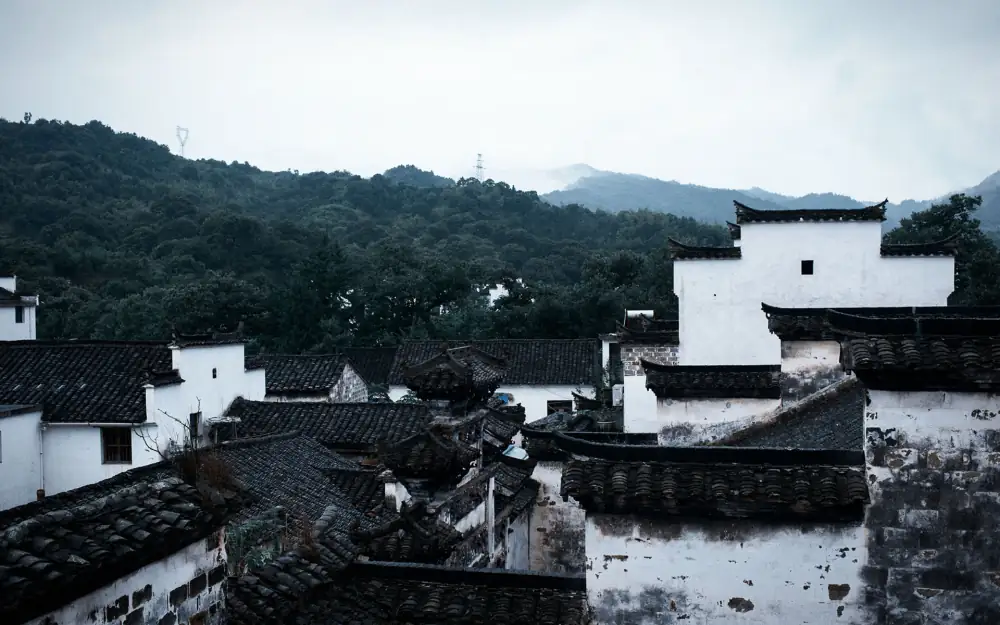
Beyond Hongcun and Xidi, dozens of less-visited Huizhou villages reward exploration:
Chengkan (呈坎): One of the oldest Huizhou villages (Tang dynasty origins), with a village plan based on Eight Trigrams (八卦) cosmological principles.
Tangmo (唐模): Known for the Cypress Garden (槐荫堂) and traditional water gardens.
Guanlu (关麓): An intact complex of eight linked mansions belonging to eight brothers — one of the largest single architectural ensembles in Anhui.
These less-famous villages can be visited independently by car hire (available from Tunxi) and typically have entry fees of ¥40-80 with far smaller crowds than Hongcun and Xidi.
Huizhou Architecture
The Huizhou (徽州) architectural style developed among the merchant communities of southern Anhui between the 14th and 19th centuries. The merchants were often away on business in distant provinces, and their local wealth was expressed through elaborate family compounds and clan halls at home.
Distinctive features:
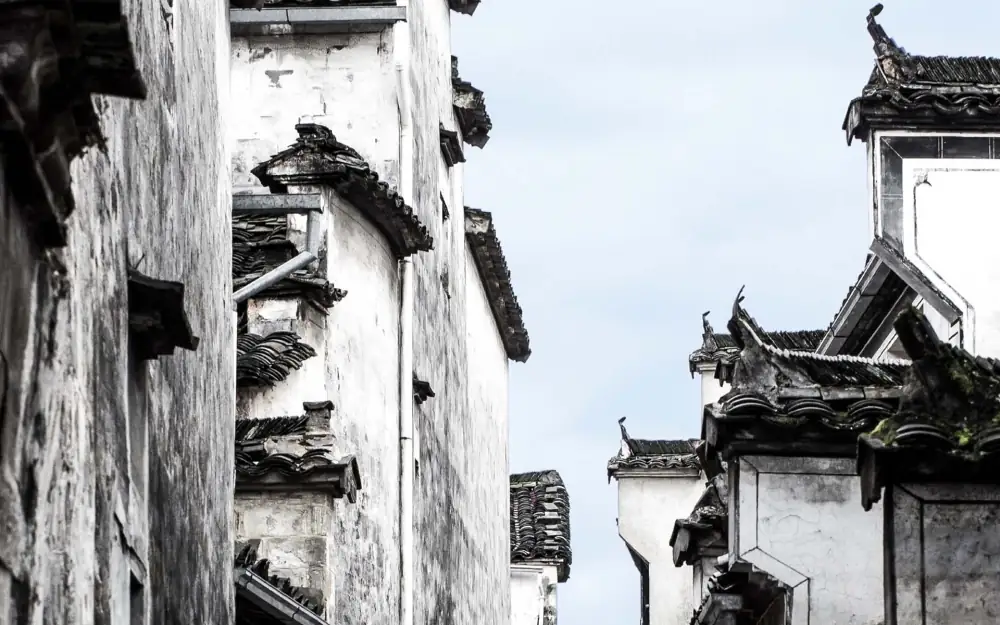
- Horse-head walls (马头墙): Raised gables in stepped profiles that project above rooflines, originally to prevent fire from spreading between adjacent buildings
- Whitewashed walls (白墙): Lime plaster over brick, maintained annually by village households
- Black tiles (黛瓦): Dark gray fired clay tiles
- Sky wells (天井): Light wells within houses that allow daylight into interior rooms and serve as symbolic connections between family and heaven
- Wood carving (木雕): Extraordinarily elaborate carved screens, window frames, and beams depicting narrative scenes, geometric patterns, and auspicious symbols
The style is architecturally distinctive enough that travelers who’ve seen Huizhou architecture once recognize it everywhere else in southern Anhui.
Food in Anhui
Anhui cuisine (徽菜) is one of China’s eight classical regional cuisines, though it’s less internationally known than Sichuan or Cantonese. Key characteristics:
Preserved and fermented foods: Anhui’s mountainous terrain historically required food preservation; fermented vegetables, cured meats, and preserved tofu are important flavoring agents.
Stinky mandarin fish (臭鳜鱼): The signature dish of Huizhou cooking — mandarin fish (桂鱼) fermented for several days until it develops a powerful aroma, then braised in red bean paste sauce. The smell is intense; the flavor is extraordinary. This is the dish that defines Anhui cuisine for those who know it.
Wuhu rice noodles (芜湖米线): From Anhui’s Yangtze River city of Wuhu, these rice noodle soups have become popular nationwide.
Bamboo shoots: Wild bamboo shoots from the Huangshan mountains, preserved in salt or dried, feature in many Anhui preparations.
Yellow tea (黄茶): Huoshan Huangya (霍山黄芽) is one of China’s six types of tea and one of its most prized. Only produced in limited quantities in Huoshan county.
Practical Information
Best Time to Visit:
- Spring (March-May): Huizhou villages are at their most atmospheric in light rain, when the white walls reflect in the puddles. Huangshan’s cloud sea is often visible.
- Autumn (September-November): Clear skies, good for photography.
- Winter (December-February): Snow on Huizhou rooftops creates some of China’s most photographic scenes. Huangshan’s “snow landscape” (雪景) is spectacular but requires careful timing.
Where to Base:
- Tunxi/Huangshan city: Best base for Huizhou villages and Huangshan mountain. Direct trains from Shanghai and Hangzhou.
- Hefei: Best base for city exploration, day trips to Chaohu Lake.
Budget: Anhui is more affordable than coastal China. Guesthouse accommodation: ¥100-300/night. Restaurant meals: ¥40-100 per person. Entry fees are moderate.
Anhui rewards slow travel — the villages are best experienced over multiple days, walking the lanes at different times of day and in different weather. It’s a place where patience yields extraordinary rewards.