
The villages of southern Anhui Province look like the ink-wash paintings that inspired them. White-washed walls, grey tile roofs with upturned eaves, and scattered mountain ridges: this is the Huizhou (徽州) aesthetic — a visual vocabulary developed over 800 years and now among the most distinctive architectural traditions in China.
Two villages — Hongcun (宏村) and Xidi (西递) — are jointly inscribed as UNESCO World Heritage Sites (2000), cited as exceptional examples of Chinese traditional village design. But the broader Huizhou region contains dozens of other historic villages, many equally beautiful and far less visited.
Table of contents
Open Table of contents
Essential Information
| Detail | Info |
|---|---|
| Province | Southern Anhui (Huangshan City / 黄山市) |
| Getting there | Fly or take high-speed rail to Huangshan (Tunxi) — then local bus or car to villages (30–90 min) |
| Hongcun ticket | ¥104 (day); significant discount for those staying overnight inside the village |
| Xidi ticket | ¥104 |
| Best season | March–April (rapeseed flowers); September–November (clearest skies); winter for snow on white walls |
| Best combination | Huangshan Mountain (1 hour away) + Hongcun/Xidi (2–3 days for both) |
What Is Huizhou Architecture?
The Huizhou (徽州) region — centred on modern Huangshan City in southern Anhui — was home to one of China’s most successful merchant classes from the Song Dynasty onward. The Huizhou merchants (徽商, huī shāng) dominated China’s long-distance trade in salt, timber, tea, and ink for 500 years, building enormous fortunes.
The money was expressed architecturally at home. Huizhou merchants built villages for their extended families while they were away trading — and the structures they built were extraordinary.
Characteristic elements:
- Horse-head walls (马头墙, mǎtóu qiáng): The most distinctive feature — stepped triangular extensions of the gable walls rising above the roofline, in profiles that look like horses raising their heads. Originally functional (firebreaks between buildings in dense village layouts), they became elaborate expressions of wealth and status.
- Whitewash (白粉墙): Lime whitewash on all exterior walls — maintenance-intensive but brilliant white when fresh, creating the distinctive palette.
- Black tile roofs (青瓦): Dark grey fired clay tiles, contrasting with the white walls.
- Carved decorations: The interiors of Huizhou merchant houses feature remarkable carved wood (beams, screens, window lattices), carved stone (gate pillars, memorial archways), and carved brick (entrance facades) — all three media elaborately worked. The Three Carvings (三雕) are considered the highest expression of Huizhou craft.
Hongcun (宏村)
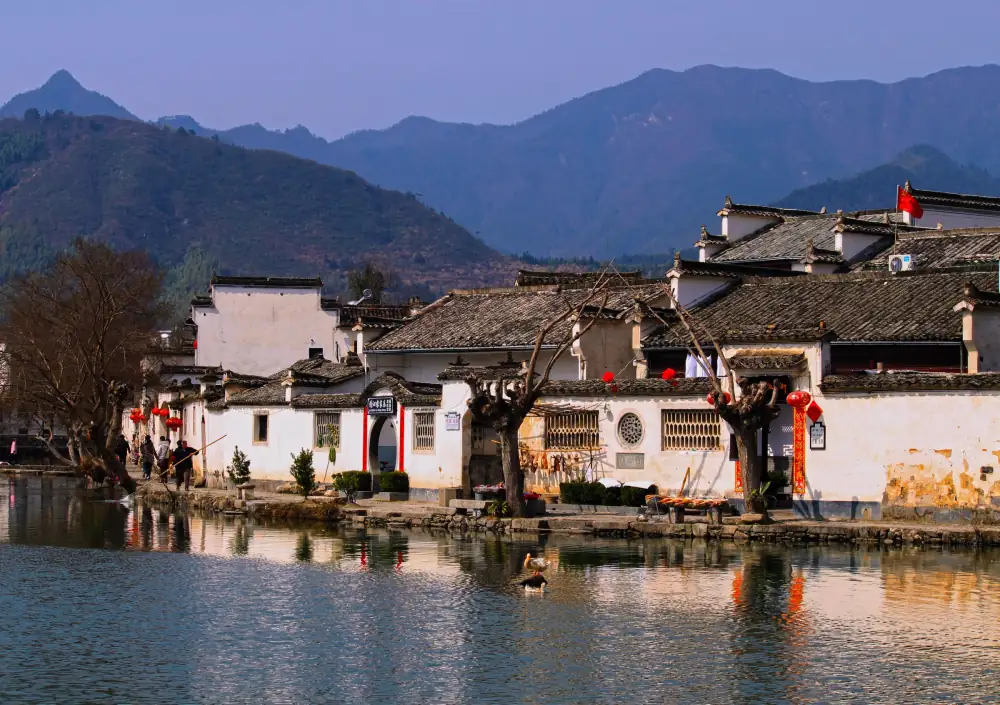
The most photogenic and most visited of the Huizhou villages. Hongcun was built in the 15th century by the Wang clan (汪氏) and designed with a distinctive water system — channels connected to the Leigang Mountain spring flow through every home and pool in the village.
The Moon Pond (月沼)
The semicircular central pond that forms the heart of the village — designed to resemble a half-moon (full completion, in Huizhou symbolism, leads to decline). The pond reflects the surrounding whitewashed houses and curved stone bridges; this image is one of the most reproduced photographs in Chinese travel media.
Best light: The pond photographs best in early morning (reflection undisturbed by wind; warm raking light on the facades) and at sunset (golden light on the walls, often misty on the mountains). Both require arriving before other day-trippers.
Nanhu Lake (南湖)
The larger lake at the southern entrance to the village — a full-moon counterpart to the half-moon central pond. The curved stone bridge and the Academy of Literature (南湖书院) reflected in the surface is a classic composition. Lotus blooms here in July.
Chengzhi Hall (承志堂)
The most elaborate private residence open to visitors — a Qing Dynasty merchant’s house with four courtyards, over 400 carved wooden panels, and the most complex wooden decorative ceiling in any Huizhou village. The salt merchant who built it spent 20 years and enormous wealth on the carvings.
Painting in the Village
Hongcun was the location of Ang Lee’s Crouching Tiger, Hidden Dragon (specifically the water fight scenes). More relevantly, it has been the subject of plein-air painting for a century — art school students come from across China to paint the village, and you will find groups of students with easels throughout the lanes in spring and autumn.
The village produces genuine artistic energy beyond the tourist infrastructure.
Xidi (西递)
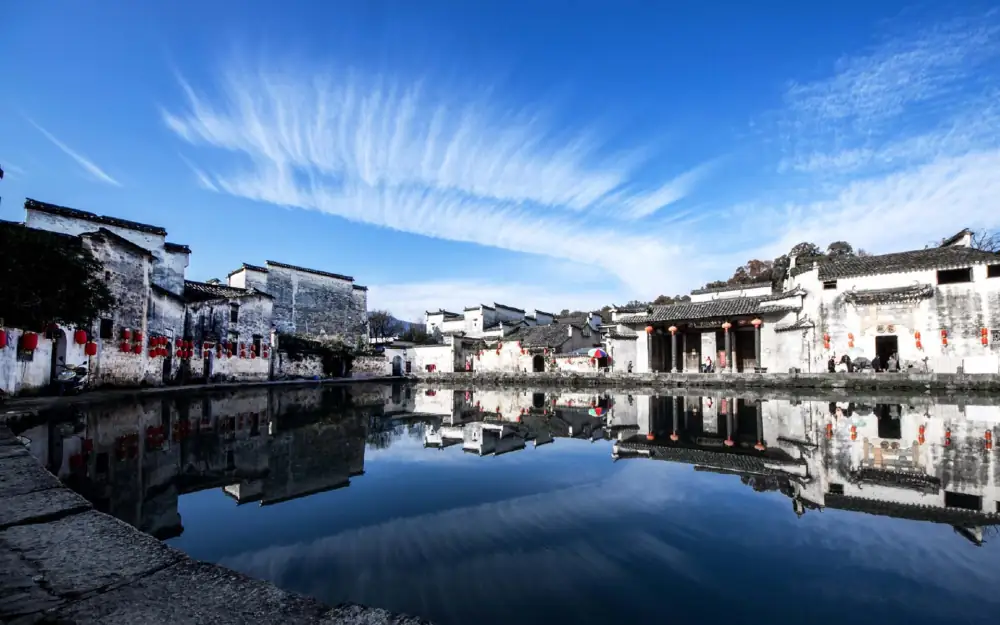
Slightly smaller than Hongcun (600 residents vs 1,000) and architecturally more focused. Xidi was established by the Hu clan (胡氏) in the Song Dynasty.
What’s different from Hongcun: Xidi has no central water feature — it’s a pure streetscape of lanes and houses. The architecture is, if anything, more elaborate: the ratio of extraordinary carved interiors to total houses is higher.
The Memorial Archway (胡文光牌坊): The 3-metre-wide carved stone archway at the village entrance — built in 1578 to honour a senior government official of the Hu clan. The carved figures and calligraphy are extraordinary. This is the most photographed structure in Xidi.
Ruiyu Hall (瑞玉楼) and Daifu Hall (大夫第): The two most elaborate residential halls, each with different specialist carving traditions — Ruiyu Hall for its stone carvings, Daifu Hall for its woodwork.
Less Visited Villages
Lucun (卢村)
11 km north of Hongcun — a smaller, quieter village with the most elaborately carved interior of any Huizhou village: the Wood Carving Building (木雕楼), seven connecting carved-wood reception rooms of escalating elaboration. The village is less visited despite the architecture being extraordinary. No formal admission charge (donation expected).
Nanping (南屏)
Known for its clan halls (宗祠) — seven large ancestral halls surviving in a village of only 1,000 people. The Ye Clan’s Xushu Hall (叶氏叙事堂) is the largest. Multiple film productions have used Nanping, including Ju Dou by Zhang Yimou (the dying vat scenes were shot here).
Chengkan (呈坎)
A village organized according to the Eight Trigrams (八卦) cosmological diagram — the street layout encoded with Daoist spatial symbolism. Architecturally remarkable; the Bao Lun Ge (宝纶阁) clan hall has extraordinary carved stone screens.
Where to Stay
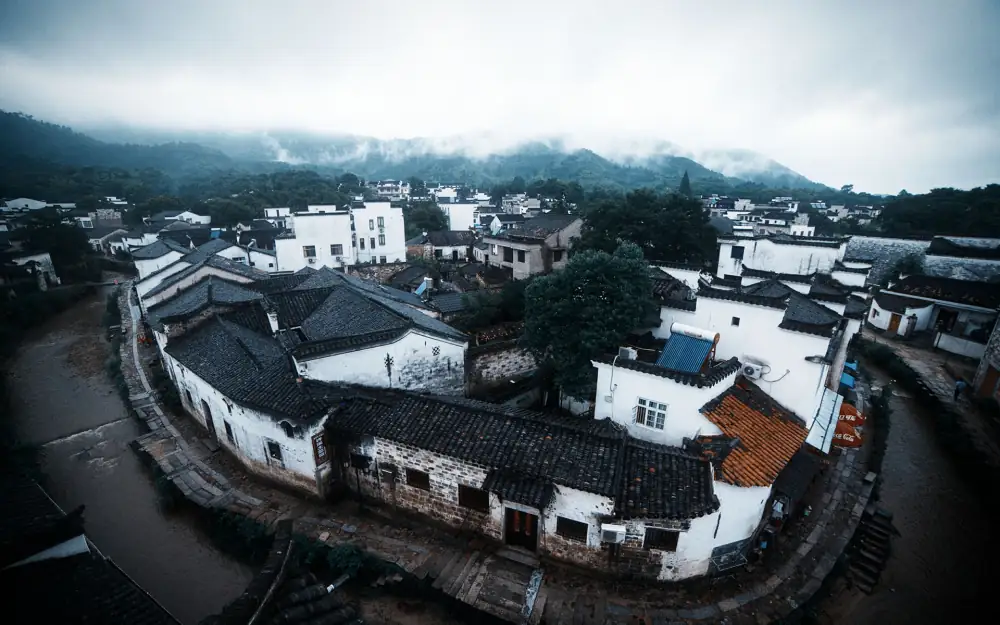
Staying inside the UNESCO villages is genuinely different from day-tripping. After the coaches leave in the afternoon, the villages regain something close to their original character — quieter, more domestic, more real.
Guesthouses in Hongcun range from basic (¥100–150/night, shared bathroom) to beautifully converted merchant houses (¥400–800/night, private courtyard). The converted houses are the better experience — staying inside a genuine Huizhou courtyardhouse, with the carved wood and the whitewashed walls.
Book ahead for spring and autumn weekends — the better guesthouses fill up.
Photography Tips
The signature compositions:
- Moon Pond at dawn, no wind (Hongcun): Arrive before 7 AM in spring
- Snow on white walls and black tiles: Requires winter visit; unpredictable but spectacular
- Rapeseed flower fields with village behind (March–April): Take the elevated path above the village to the north
- Horsehead wall profiles against grey sky: Late afternoon light in autumn
Do not: Photograph in the flat midday light of summer — the pure white walls become overexposed and the depth disappears.
Practical Tips
From Huangshan: Bus or car from Huangshan (Tunxi) city — multiple daily buses to Hongcun (¥12–15, 45 min). Alternatively, Huangshan Scenic Area is only 70 km — combine with 2 days on the mountain and 2 days in the villages.
Entry discounts: Both Hongcun and Xidi offer reduced tickets for visitors staying overnight inside the village (proof of guesthouse booking required).
The villages of Huizhou are the China of Chinese paintings — the landscape that inspired a thousand scrolls. Coming here in spring mist or winter snow, when the photography groups have gone, you understand why the painters kept returning.
Last updated: May 2026