
Lushan (庐山) occupies a peculiar and fascinating place in Chinese culture. The mountain rising above Poyang Lake in northern Jiangxi inspired more classical poetry than any other peak in China — Li Bai wrote perhaps his most famous lines here about the Sandie Waterfall, Su Dongpo wrote the verse about not being able to see the mountain’s true form from within it. But Lushan is also where the Kuomintang government built its summer capital, where Mao Zedong held two fateful political conferences that shaped modern Chinese history, and where hundreds of colonial-era villas built by foreign missionaries and diplomats still stand in improbable grandeur above the clouds.
Table of contents
Open Table of contents
Getting There
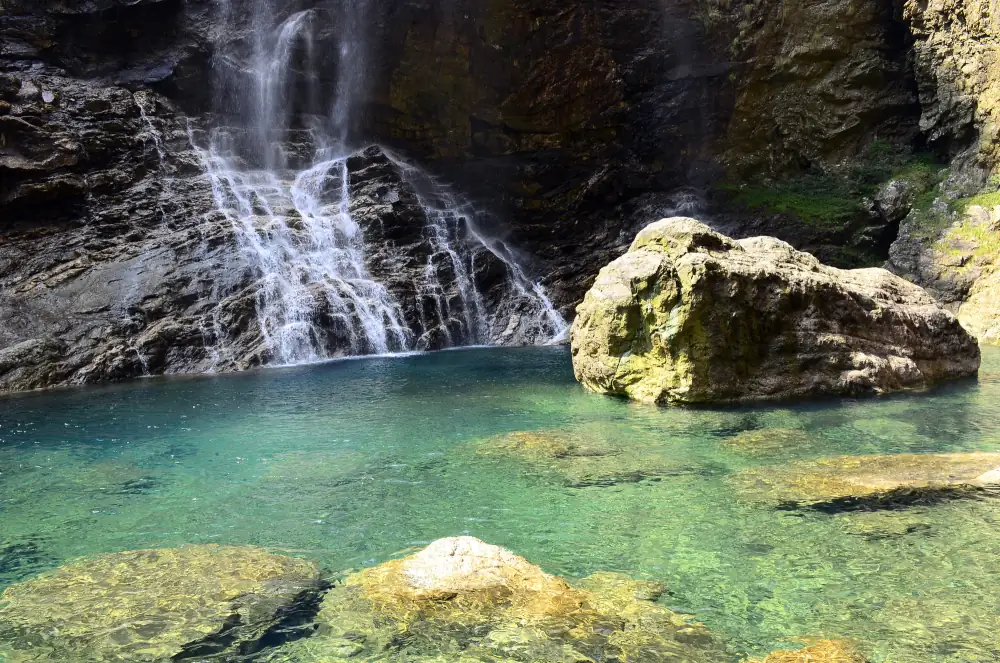
Lushan is most easily accessed from Jiujiang (九江), a city on the southern bank of the Yangtze River in northern Jiangxi. Jiujiang is served by high-speed trains from Nanchang (40 minutes, ¥60-100) and from Wuhan (1.5 hours, ¥100-180). From Jiujiang station, buses run regularly to the Lushan scenic area gate (40 minutes, ¥20).
The alternative approach from Nanchang by bus takes about 3 hours and is less convenient than the train-bus combination via Jiujiang.
Entrance fee: ¥180, which includes access to all main scenic areas. The ticket also includes bus transport up the mountain road.
Guling Town
The summit area of Lushan centres on Guling Town (牯岭镇), a genuinely surprising settlement at 1,167 metres that looks like a piece of 1930s European resort architecture has been transplanted onto a Chinese mountain peak. During the Republican era (1912-1949), Lushan became the favoured summer retreat of the Nationalist government — Chiang Kai-shek’s residence here is now the Meilu Villa (美庐别墅), open for tours.
The town’s stone buildings, European-style churches, and tree-lined main street create an atmosphere unlike anywhere else in Chinese mountain tourism. In summer it’s noticeably cooler than the Yangtze plain below (often 8-10°C cooler), which explains both its popularity as a resort and the extraordinary literary output it inspired — poets and scholars retreating here to escape the summer heat had nothing to do but write.
The Lushan Museum in Guling covers both the natural history and the remarkably dense political and cultural history of the mountain. It’s well worth an hour. The Republican architecture scattered through the surrounding streets — over 600 villas from the 1920s-1940s — is best explored on foot with no particular agenda.
The Sandie Waterfall
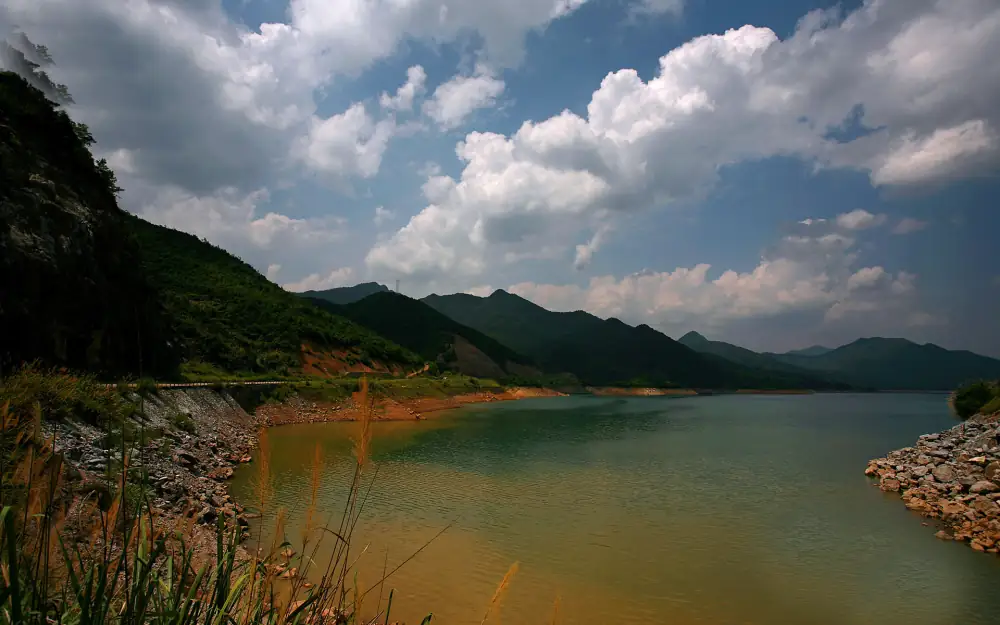
Li Bai’s poem — “flying water dropping three thousand feet, surely the Milky Way falling from the Ninth Heaven” — describes the Sandie Waterfall (三叠泉, Three-Step Falls). The waterfall plunges in three distinct steps over a total drop of 155 metres, making it one of the most dramatic cascades in eastern China.
The trail to Sandie begins at the eastern end of the scenic area and descends 2.8km (about 1,200 stone steps down) to the waterfall base. The descent is easy; the return is a genuine workout. Many visitors take the cable car down (¥80 one way) and either hike back up or take the cable car both ways (¥150 return). The spray from the falls is considerable — bring a light waterproof layer or accept getting wet.
The walk to the falls passes through forest and alongside streams. Morning visits avoid the worst of the tour group traffic; the falls themselves look best when the water volume is high, which means visiting during or just after the rainy season (June-August produces the highest flow).
The Flower Path & Other Scenic Areas
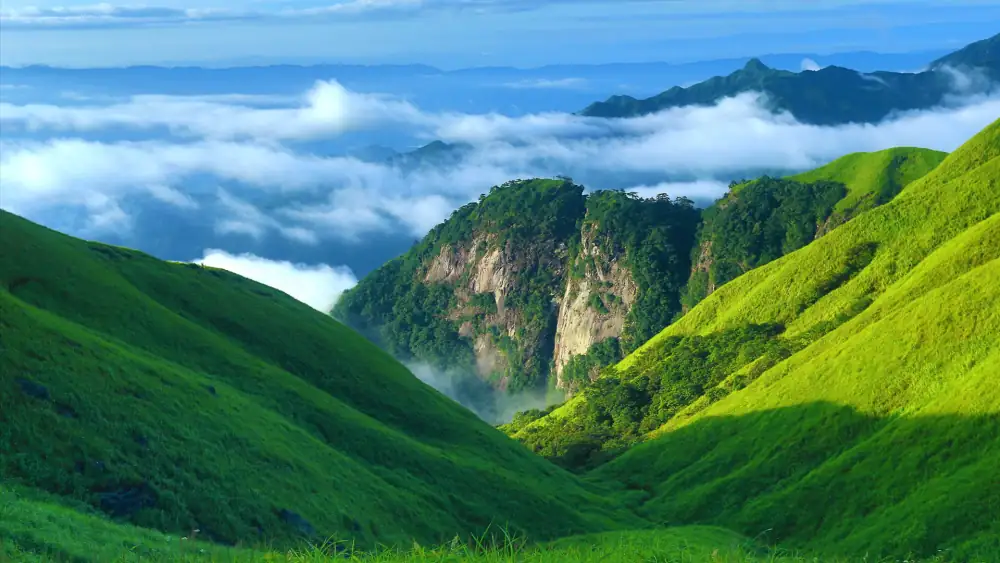
The Flower Path (花径) area near Guling contains Brocade Valley (锦绣谷) — a ravine with extraordinary geological formations where erosion has exposed the underlying rock in layers of red, orange, and grey. The valley’s viewing platform provides dramatic views down into the gorge and, in clear weather, out over the blue sheet of Poyang Lake visible in the distance.
The Immortals Cave (仙人洞) nearby is a natural cave in the cliff face associated with Taoist hermits and featuring a stone spring that local believers consider to have healing properties. The combination of the cave, the cliff-edge pavilion above it, and the views from here is one of Lushan’s most photographed compositions.
The Lulin Lake and Lulin Villa area (庐林湖, 庐林别墅) is where Mao Zedong stayed during the 1959 and 1961 Lushan Conferences — sessions that had enormous consequences for Chinese political history. The villa is preserved as a museum. The furniture, meeting rooms, and gardens feel frozen in the 1950s. For visitors interested in 20th-century Chinese political history, this is essential.
The Famous View Problem
Su Dongpo’s famous poem about Lushan contains the line: “I cannot see the true face of Mount Lushan because I myself am inside the mountain.” The observation is both philosophical and practical — Lushan is frequently wrapped in cloud and mist, so thick that visibility can drop to a few metres. This is actually part of the mountain’s charm (the mist effects are beautiful and create the atmosphere that made it famous for poets), but it means planning around the weather.
Clear days are most likely in autumn (September-October) and winter. The mist is heaviest in summer — which is also when the waterfalls are at their most dramatic. Many visitors deliberately come in misty conditions for the atmospheric photography.
Where to Stay
Guling Town has hotels ranging from budget guesthouses (¥150-250) to moderately comfortable mid-range options (¥400-700). Staying on the mountain overnight is recommended — the evening light as the mist fills the valleys below, visible from Guling, is one of those views that justifies the effort of getting here.
Budget-conscious visitors can stay at the base of the mountain in Jiujiang (¥200-400 for comfortable hotels) and make the mountain a day trip. Two days on the mountain — arriving by afternoon on day one, full hiking day on day two — is the minimum to properly explore all the key sites.
Lushan is one of those mountains where the literary and historical layers are as rewarding as the natural scenery. Coming prepared with some knowledge of Li Bai’s waterfall poem, Su Dongpo’s philosophical verse, and the extraordinary political conferences that happened here transforms the experience from scenic tourism into something considerably richer.