
Nanchang (南昌) is not on most international visitors’ China itineraries, which makes it both underrated and genuinely surprising. The capital of Jiangxi province sits on the Gan River south of Poyang Lake and carries a weight of historical significance that is hard to ignore: this is the city where the Chinese Communist Party launched the military uprising on August 1, 1927 that is considered the founding moment of the People’s Liberation Army. Every year on August 1st, the date is celebrated across China as Army Day. In Nanchang, the date is woven into the urban fabric — the city’s main thoroughfare is called August 1st Avenue.
Table of contents
Open Table of contents
The Nanchang Uprising & Revolutionary Sites
The Nanchang Uprising Museum (八一起义纪念馆) is built around the former Jiangxi Hotel where Zhou Enlai, Zhu De, He Long, and other Communist leaders planned and launched the uprising against the Nationalist forces. The museum is well-designed, with good English labelling, and covers both the specific events of August 1927 and the broader context of the Northern Expedition and the collapse of the First United Front between the Communists and Nationalists.
The immediate circumstances are dramatic: around 30,000 Communist-aligned troops seized the city overnight in response to Chiang Kai-shek’s bloody purge of Communists from the Nationalist Party. The uprising failed to hold Nanchang for more than a few days before Nationalist forces retook it, but the military organisation it created — Zhu De’s forces eventually becoming the backbone of the Red Army — was the foundation of everything that followed.
Adjacent to the museum, the former General Front Committee site (总前委旧址) preserves the meeting rooms where the night’s strategy was finalised. Both sites are free. Allow 2-3 hours.
The Bayi Square (八一广场) in the city centre is a vast public space anchored by the August 1st Uprising Memorial Tower. In the evenings, it fills with families, kite flyers, and the ordinary life of a mid-sized Chinese city. The contrast between the revolutionary symbolism of the monuments and the cheerful normalcy of evening recreation is quintessentially Chinese.
Tengwang Pavilion
Tengwang Pavilion (滕王阁) is one of China’s Three Great Towers, alongside the Yellow Crane Tower in Wuhan and the Yueyang Tower on Dongting Lake. The current structure is a reconstruction (the original was built in 653 AD and burned down dozens of times over the centuries — the current version dates from 1989) but the site and the views it provides over the Gan River make it essential.
The pavilion became famous primarily because of a single piece of writing: Wang Bo’s “Preface to the Prince Teng Pavilion” (滕王阁序), written in 675 AD when Wang Bo was 25 years old and paused here on his way to visit his father. The essay is one of the most celebrated pieces of classical Chinese prose, its final lines containing some of the most quoted poetry in Chinese literary history. Every educated Chinese person knows at least a few lines. Visiting the pavilion without knowing the essay is like visiting the Parthenon without knowing Greek mythology — technically possible but diminished.
The six-storey structure (plus two basement floors) contains galleries covering the cultural history of Jiangxi and the literary legacy of the pavilion, with reproductions of Wang Bo’s preface in various calligraphic styles. The roof terrace on the highest floor provides the river and city views. Admission is ¥90.
Evening visits (the pavilion is lit until 10pm) are particularly atmospheric, with the river traffic below and the city lights spreading toward the horizon.
Food in Nanchang
Jiangxi cuisine (赣菜) is less famous than neighbouring Hunan or Sichuan cooking but has a distinct character — bold, slightly spiced, heavy on pork and freshwater fish. Nanchang’s specific street food culture includes:
Nanchang Rice Noodles (南昌拌粉): A breakfast staple, served cold with chilli oil, vinegar, sesame paste, and various toppings. The noodles are wider and chewier than Guilin rice noodles. Every neighbourhood has at least one shop. ¥8-15 per bowl.
Rice Cake Soup (米粉肉): Pork pieces coated in rice flour and steamed — a traditional preparation that appears in homes and restaurants alike.
Laoganma Fish (老干妈鱼): Whole fish cooked with Laoganma chilli sauce and doubanjiang, a Nanchang take on the national condiment beloved everywhere.
The old food street near Shengjiing Pavilion in the old city has concentrated traditional eateries. A proper multi-dish dinner in a local restaurant costs ¥60-120 per person.
Nanchang as a Circuit Hub
Nanchang’s real value for visitors lies in its position as the hub for exploring Jiangxi’s remarkable heritage circuit. Within manageable day-trip or overnight-trip distance:
Jingdezhen (景德镇, 2.5 hours by high-speed train): China’s porcelain capital, where imperial ceramics have been made for 1,700 years. Active workshops, world-class ceramic museum, and a bohemian arts scene that has grown around the ceramics tradition.
Lushan Mountain (1.5-2 hours via Jiujiang): The UNESCO-listed mountain famous for waterfalls, Republican-era villas, and Mao’s political conferences. High-speed train to Jiujiang (40 minutes), then bus to Lushan (40 minutes).
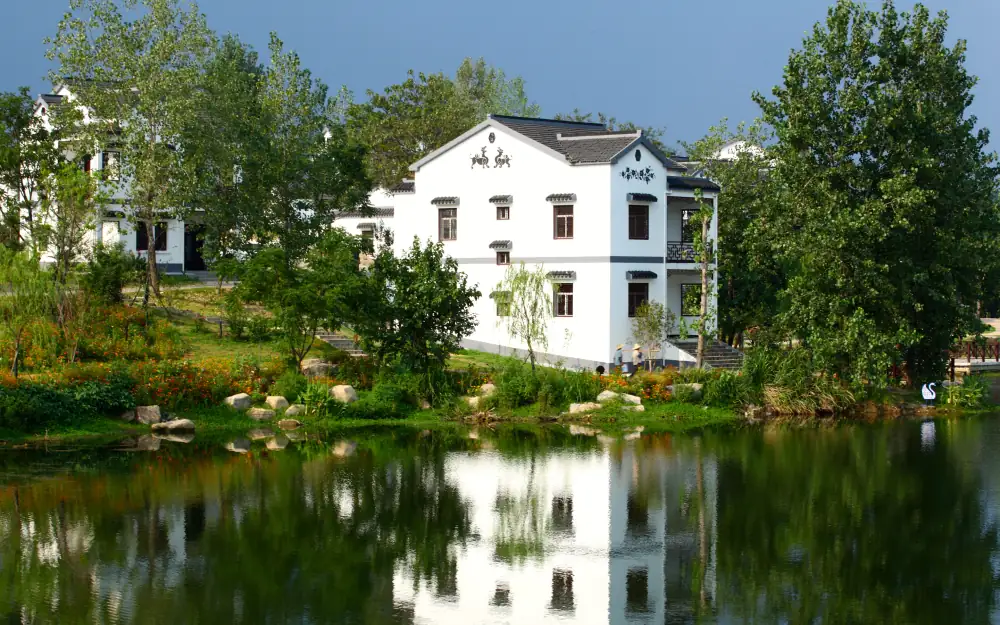
Wuyuan (婺源, 2 hours by bus): The famous village area of whitewashed Huizhou buildings surrounded by rapeseed fields in spring. Best from mid-March to mid-April.
Poyang Lake (鄱阳湖, 1 hour): China’s largest freshwater lake, famous as a winter bird sanctuary for Siberian cranes and other migratory species. Best November-January.
A well-planned Jiangxi circuit of 5-7 days based in Nanchang can cover all of these while giving the city itself the 2 days it deserves.
Getting to Nanchang
Nanchang Changbei International Airport has direct flights from most major Chinese cities (30 minutes from Beijing, 1.5 hours from Shanghai). High-speed trains connect to Shanghai (3.5-4 hours, ¥200-350), Beijing (5-6 hours, ¥400-600), and Hangzhou (2.5 hours, ¥150-200).
Accommodation: Nanchang has all the standard Chinese hotel chains plus several boutique options near the old Tengwang Pavilion waterfront area. Mid-range hotels ¥300-600, budget options ¥150-250.
Nanchang doesn’t pretend to be Beijing or Shanghai and benefits from not trying to be either. It’s a real, functioning Chinese provincial capital with deep historical layers, good food, and the kind of unhurried atmosphere that makes travel feel rewarding rather than managed.