
Macau has a reputation problem. Internationally, it’s known as “Asia’s Las Vegas” — a gambling city, full of outsized casinos and little else. That’s accurate for the Cotai Strip, but it’s completely wrong about Macau as a whole.
The historic peninsula is a genuinely extraordinary place: the only location on earth where Chinese and Portuguese colonial architecture exists side by side, preserved and still lived in, across 30 UNESCO World Heritage Sites clustered in a walkable area. The food — Macanese cuisine, a genuine fusion of Portuguese and Chinese culinary traditions developed over 450 years — is excellent and unique. The whole peninsula takes 1–2 days to see well, and the proximity to Hong Kong (1 hour by ferry) makes it a natural addition to any Hong Kong visit.
Table of contents
Open Table of contents
Getting to Macau
From Hong Kong — The Most Common Route
High-speed ferry (TurboJET or Cotai Water Jet):
- Departures from Hong Kong Macau Ferry Terminal (SheungWan) or Kowloon China Ferry Terminal
- Journey time: 55–75 minutes
- Frequency: Hourly or more during peak hours
- Cost: HKD 170–270 depending on class and time
- Book on TurboJET’s website or at ferry terminals
New Hong Kong–Macau–Zhuhai Bridge:
- The Hong Kong–Zhuhai–Macau Bridge (HZMB), opened 2018, connects via bus from the Hong Kong side border crossing to Macau’s Taipa Terminal.
- Journey time: approximately 40–50 minutes
- Cost: Shuttle bus HKD 70 (to Macau Immigration building, then local transport to city)
- Practical consideration: Good for those connecting onward to Zhuhai and mainland China; slightly less convenient for those staying in Macau city
From mainland China — Zhuhai Border Crossing
Macau shares a land border with Zhuhai, Guangdong Province (Gongbei Border Gate, 拱北口岸). This is the busiest land border crossing in the world by volume.
How to cross:
- Take high-speed train or bus to Zhuhai
- Walk through immigration at Gongbei Port
- Walk into Macau (Inner Harbour or NAPE area is immediately accessible)
From Guangzhou: 1 hour by HSR to Zhuhai, then cross the border. Total: 1.5–2 hours. From Shenzhen: 1 hour by bus/metro to Zhuhai border area, then cross. Total: 1.5–2 hours.
Macau International Airport
Direct flights from major Chinese cities and some regional Asian cities. Useful if flying directly rather than transiting through Hong Kong.
Visas and Entry
Visa-free entry for most nationalities: Citizens of the UK, EU, US, Australia, Canada, and most Asian countries can enter Macau visa-free for 30–90 days (depending on nationality). Check your country’s specific allowance.
Note on China vs. Macau vs. Hong Kong entry: These three are separate immigration jurisdictions. A China visa does NOT cover Macau or Hong Kong entry. Crossing from Macau to mainland China at the Zhuhai border requires either a China visa or qualification for China’s visa-free policies. This matters if you’re combining Macau with a China itinerary.
The Historic Peninsula: UNESCO World Heritage
The Historic Centre of Macau was listed as a UNESCO World Heritage Site in 2005. 30 monuments and public spaces within the historic peninsula collectively form the listing.
Senado Square and the Core Historic Area
Senado Square (塞那度廣場 / 議事亭前地) — the wave-patterned Portuguese mosaic pavement leads north from the ferry terminal area to the Leal Senado Building (the senate house, with a portrait gallery) and the pedestrian commercial zone beyond.
This square is the visual heart of Macau’s Portuguese-Chinese character: the Chinese shop signs, the Art Deco buildings, the Leal Senado’s yellow neoclassical facade, and Chinese grandmothers shopping for groceries in front of Portuguese baroque churches.
Ruins of St. Paul’s Cathedral (大三巴牌坊)
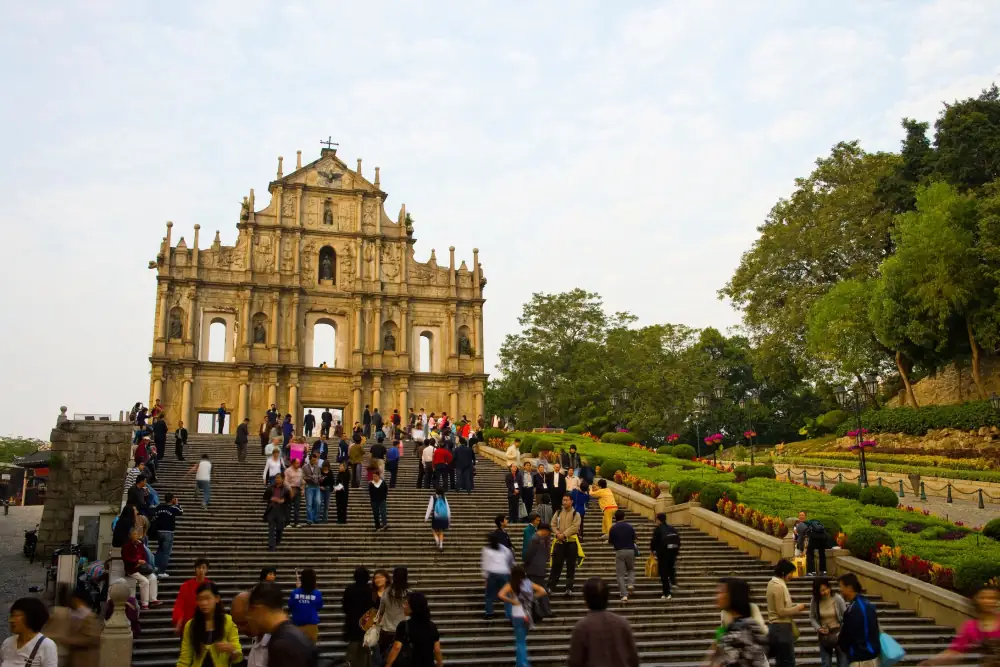
The iconic image of Macau: the remaining stone facade of the 17th-century Cathedral of the Assumption (destroyed by fire in 1835). The baroque stone facade survives intact, with elaborate carvings of saints, Portuguese ships, and Asian mythological creatures — a fusion of European and Asian artistic motifs that defines Macau’s character.
Walk up the stepped approach from Rua de São Paulo in the early morning for empty photos. By 10am it fills with tour groups.
Monte Fort (大炮台)
The fort immediately adjacent to St. Paul’s Ruins has a terrace with panoramic views over the peninsula. The Macau Museum occupies the interior — a concise history of Macau’s 500 years of Portuguese administration.
St. Dominic’s Church (板樟堂) and Dom Pedro V Theatre
Two more extraordinary colonial buildings within 5 minutes’ walk of Senado Square. St. Dominic’s, with its yellow baroque facade, is the oldest church in South China (1587). Dom Pedro V Theatre (1873) was the first Western theatre in East Asia.
Guia Fortress and Lighthouse
On the highest hill in Macau, the Guia Fortress was built by the Portuguese in 1638 and contains the only lighthouse in China during the colonial period, and a small chapel with rare frescoes blending European and Chinese Buddhist imagery.
Taipa Village — The Most Charming Area
Taipa (氹仔) is the island immediately south of the Macau Peninsula, connected by bridge. While the Cotai Strip (the reclaimed land between Taipa and Coloane) hosts the mega-casinos, Taipa Village itself (near the southern coast of the island) has been preserved as a heritage area.
Rua do Cunha (官也街) — the pedestrian street through Taipa Village, lined with Portuguese-era townhouses now converted into restaurants, cake shops, and boutiques. The street is famous for Macanese egg tarts and almond cakes.
The Taipa Houses Museum — five Portuguese colonial villas preserved as they were in the early 20th century, displaying Macanese domestic life, furniture, and the specific culture of Macanese families (the Macanese people, of mixed Portuguese and Chinese heritage, developed a distinct identity over centuries).
Coloane — The Beach Escape
Coloane (路環) is the southernmost island, less developed and more residential. The village has a small square with a Portuguese chapel (Chapel of St. Francis Xavier), the famous Lord Stow’s Bakery (where the Macau egg tart was invented in 1989 by Andrew Stow), and beaches including Hac Sa Beach (black sand beach).
Lord Stow’s original bakery in Coloane Village makes a pilgrimage worth doing for anyone who has encountered “Portuguese egg tarts” outside Macau — the original is distinct from all derivatives.
Macanese Food: A Unique Cuisine
Macanese cuisine — the food developed by Macau’s Portuguese and mixed-heritage families over four centuries — is genuinely unique: a fusion of Portuguese, Chinese, African, and Indian culinary influences developed along Portugal’s trade routes.
Must try dishes:
African Chicken (非洲雞) — roasted chicken with a sauce combining coconut, chilli, peanuts, and spices via Africa’s Portuguese colonial connections. One of the most complex and surprising dishes in Chinese-territory food.
Minchi (木須肉) — stir-fried minced beef or pork with potatoes, onion, and dark soy sauce, served with a fried egg on top. Pure comfort food, found everywhere, and better than it sounds.
Bacalhau (鹹魚) — salt cod, cooked in many variations (bacalhau à Bras with egg and potato; bacalhau com natas in cream sauce). Portuguese via Macau; extraordinary.
Caldo Verde — Portuguese kale soup with chorizo. Served at older Portuguese-style restaurants.
Macanese Egg Tarts — distinctly different from the Cantonese version (and the British custard tart prototype): the pastry is flaky and rich, the egg custard slightly caramelised on top, with a more complex flavour. Lord Stow’s bakery and Margaret’s Café e Nata are the two most famous sources.
Pork chop bun (豬扒包) — a thick-cut pork chop in a fresh bread roll. The version at Tai Lei Loi Kei in Taipa Village is considered the benchmark.
The Casinos: What Foreign Visitors Should Know
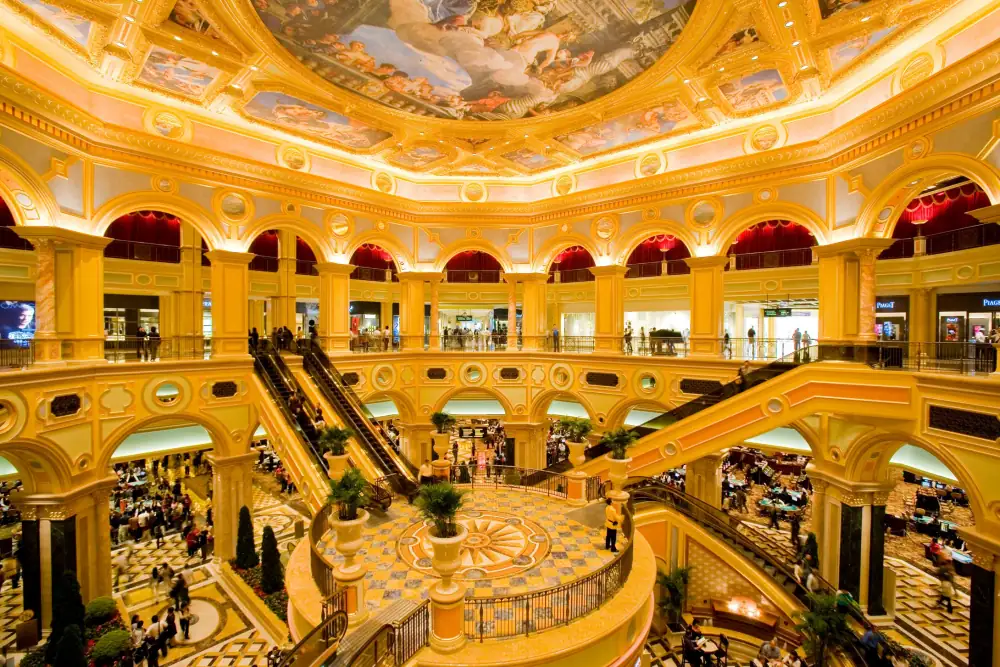
Macau surpassed Las Vegas as the world’s largest gambling revenue market in 2006. The Venetian Macao (on the Cotai Strip) is one of the world’s largest buildings by floor space.
Practical notes:
- Most casinos: minimum betting age 21 (not 18)
- Free entry to any casino floor; no dress code at most
- Chips are in Macau Patacas (MOP) or Hong Kong Dollars (HKD) — both accepted at face value
- Restaurants, shows, and spectacle within casino hotels are accessible without gambling
The casinos are architecturally interesting in their own way — the Paris Macao with a half-scale Eiffel Tower, the Venetian with an indoor canal and gondolas — and form part of the visual experience of contemporary Macau.
How Long to Stay
1 day (from Hong Kong): Just adequate. Arrive morning, walk the historic peninsula, eat lunch in Taipa Village, visit one or two churches, return afternoon. Rushed but possible.
2 days: Better. First day: historic peninsula in full. Second day: Taipa Village, Coloane Lord Stow’s, one casino spectacle. Comfortable pace.
3 days: Ideal. Allows deeper exploration, a beach afternoon, dining experimentation, and the Guia Fortress at sunrise.
Practical Information
Currency: Macau Pataca (MOP). HKD is accepted at par value throughout Macau. CNY is accepted at many retailers. Alipay and WeChat Pay work.
Language: Cantonese and Portuguese are official languages. English is widely spoken in tourist contexts.
Transport within Macau: Free shuttle buses run from major hotels to ferry terminals — available even if you’re not a hotel guest (just board and ask). Taxis are cheap (MOP 19 flag-fall). Walking covers the historic peninsula comfortably.
Internet: No Great Firewall in Macau — your regular apps and internet access work normally here.
Also see: Hong Kong Travel Guide | Guangdong Pearl River Delta Guide | China Payment Guide