
The reservoir spreads west from Chun’an in flat silver sheets, and the hills that used to rise above two river valleys now end abruptly at the waterline as a thousand wooded humps. From the deck of a slow boat the effect is disorientating: ridgelines that clearly continue underwater, bays that turn out to be drowned side valleys, and pine-covered summits reduced to islets you could walk around in ten minutes. Qiandao Lake (千岛湖) is barely older than the grandparents who remember the towns beneath it, and that recency is exactly what makes it strange and worth the journey.
Table of contents
Open Table of contents
What Qiandao Lake actually is
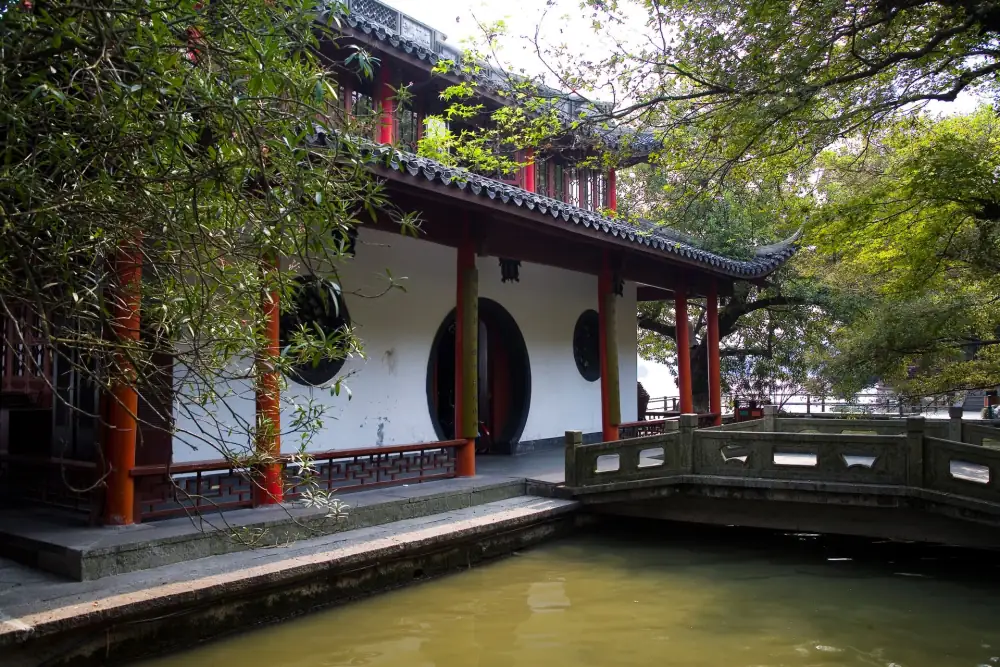
This is not a natural lake. It was created when the Xin’an River (新安江) was dammed for hydroelectricity, flooding a basin of farmland, two county seats and hundreds of hilltops. What emerged was a body of water studded with over a thousand islands — the name means “thousand-island lake” — held inside steep, densely forested shores in the far west of Zhejiang, close to the Anhui border.
The consequences are more interesting than the statistics. Because the catchment is heavily forested and settlement around it is limited, the water is famously clean, clean enough that the country’s best-known bottled water brand comes from here and that the lake is a serious commercial fishery. Because the islands are drowned hilltops rather than sandbars, they are steep, green and oddly uniform in shape. And because the whole landscape is fifty-odd years old, there is very little that is ancient on the water itself. The old temples, ancestral halls and Ming-dynasty lanes are inland, in valleys the water never reached.
Understanding that division is the key to planning a good trip. The lake gives you views, boats, swimming and cycling. The hinterland gives you villages, waterfalls, tea terraces and bamboo. A visit that only does the first half feels thinner than it should.
The lake districts and how boats work
The scenic area is carved into districts — central, south-east, south-west, north-west, north-east — plus an outlying karst stone forest. In practice most visitors deal with two of them, and each has its own pier with scheduled sightseeing boats that run more like a bus network than a cruise: fixed loops calling at a set of islands, with a morning and an afternoon pattern.
Central district
The busiest and the best introduction. Boats from the central pier work a loop through the headline islands.
Meifeng (梅峰) is the one everybody photographs. Five linked hills form the island, and a stepped path — or a short lift — climbs to a platform from which several hundred islands are visible at once, layered into the haze in receding shades of grey-green. There is a local saying to the effect that you haven’t seen Qiandao Lake until you’ve stood on Meifeng, and for once the boast is fair. Give it a couple of hours, mostly because you will want to wait for the light to shift.
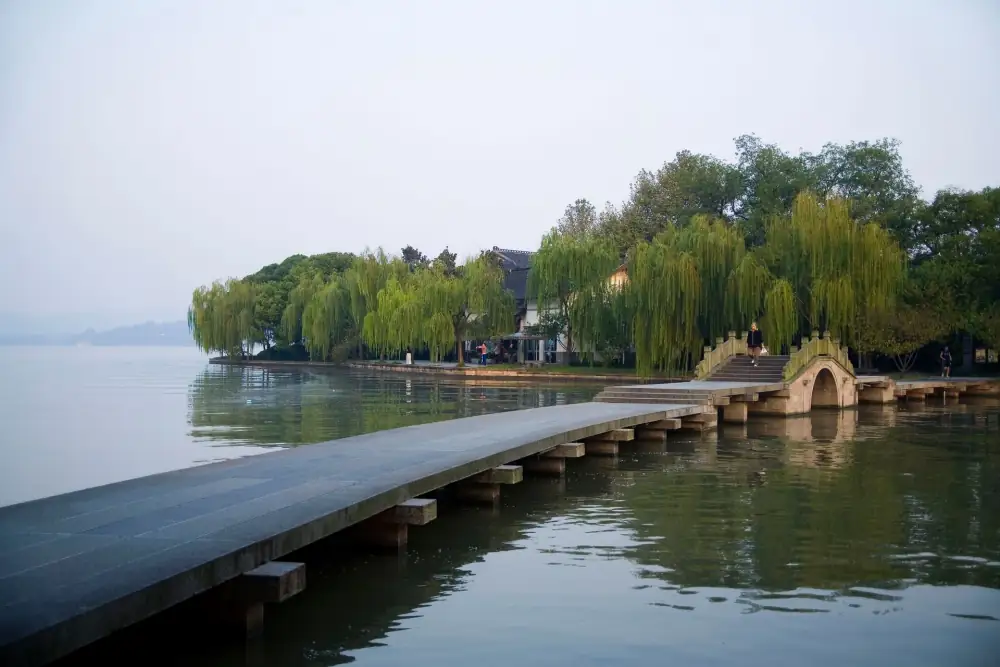
Yueguang Island (月光岛), sometimes called Moonlight Island, is a cluster of four islets joined by floating pontoon bridges, so you explore on foot rather than by boat. One bridge crosses water thick with enormous carp that surge for food in a churning mass; another is a long, low, slightly unnerving span that flexes underfoot. It is a good stop for anyone travelling with children.
Longshan Island (龙山岛) carries the lake’s cultural weight. A shrine here honours Hai Rui, the famously incorruptible Ming official who served as county magistrate in Chun’an, and the grounds include a rebuilt academy and a walled pond. The calligraphy stele inside — a single character constructed from four others, readable upside down as well — is the sort of detail that rewards anyone with an interest in Chinese history.
The central loop also takes in a monkey island with two resident macaque troops and an activity island with jet skis, parasailing and pedal boats.
South-east district
Developed earliest, quieter now, and arguably the purer landscape. Its boats run from a separate pier towards a tighter cluster of islands.
Huangshanjian (黄山尖) is the south-east’s answer to Meifeng: the highest point in a chain called the Pearl Islands, with a view over ninety-odd islets scattered like beads, a deep channel cutting away to one side and open water fading out to the south-west. Some people prefer it to Meifeng precisely because fewer people are on the platform.
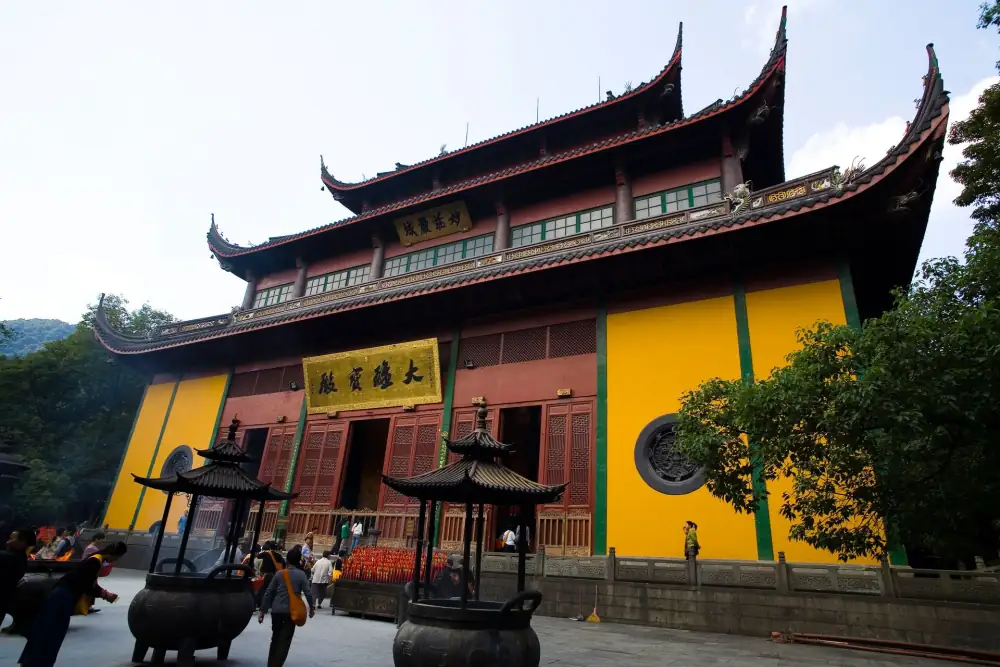
Mishan (蜜山岛) is a small, wooded island with a Chan Buddhist temple, incense drifting over the water and the atmosphere of a place that was a pilgrimage site long before the valley was flooded. Tianchi (天池岛) is pitted with stone basins quarried centuries ago to supply building stone to the Southern Song capital at Hangzhou. Guihua (桂花岛) is limestone, riddled with fissures out of which wild osmanthus grows; in early autumn the scent is heavy enough to notice from the jetty.
South-west district and the hinterland
Further out, less visited, and where the trip gets textured. Longchuanwan (龙川湾) is the lake’s only wetland, a maze of low islands and looping channels explored by electric boat and shoreline path, with a cluster of rural activities attached: tofu-making, a tea house, fishing.
Better still is Qinchuan (芹川村), a village of some seven centuries in a fold of hills to the south-west, where the great majority of the buildings are Ming and Qing houses in the Huizhou manner — white walls, black tiled ridges, carved beams and, unusually for the style, waterside pavilions. A shallow, glass-clear stream runs the length of the settlement, houses lined along both banks, small fish visible against the stones, stone bridges every few dozen metres. Almost everyone shares a single surname, and the ancestral halls are the oldest buildings in it. If you only leave the water once, leave it for this.
Beyond that, the stone forest on the lake’s outskirts is a genuinely large karst field of pinnacles, cliffs and caves, and Jiupaojie (九咆界), an hour’s drive out, strings together nine waterfalls in a valley whose isolated village retains an unpolished, working-agricultural character.
Cycling the lake
The shoreline circuit has become the reason a lot of Chinese travellers now come, and it is the single best way to understand the geography. The full loop runs roughly 185 kilometres of engineered lakeside road, crossing two long bridges and threading through hill villages, tea slopes and quiet inlets. It is not flat. Long, sustained climbs between bays are the defining feature.
Serious riders do it in two hard days or three comfortable ones, sleeping in the small towns strung along the route. Everyone else should treat it as a menu: rent a bike in town, ride one segment out along the northern or south-western shore, and turn back when the climbing stops being fun. Mornings are best — the water is often mirror-flat before the wind gets up, and the light comes across the islands at a low angle.
Rafting and the summer water
From late spring into autumn, the streams that drop off the surrounding peaks into the lake are run as rafting routes, and there are enough of them that they differ meaningfully in character. Some are steep and fast, with narrow beds, sharp drops and deep plunge pools; one runs partly through a tunnel; another is gentle enough for children and grandparents, more a float with swimming than a descent. Bring a change of clothes and shoes you don’t mind soaking, expect to be issued a lifejacket, and accept that valuables should stay in the car.
Elsewhere on the lake there are swimming coves, a forest reserve of tall trees and small waterfalls that stays cool through August, and enough motorised water sport on the activity islands to occupy a teenager for a day.
Getting there and moving around
Qiandao Lake sits on the old Hangzhou–Huangshan travel corridor, roughly 130 kilometres from Hangzhou and a similar distance from the Huangshan area, which makes it easy to slot into a wider eastern China itinerary.
- From Hangzhou. Coaches run all day from the city’s west bus station to Chun’an and take about two hours. Driving on the expressway is faster and the final stretch is a scenic route in its own right, though it is comprehensively speed-camera’d.
- By rail. A high-speed line running south-west from Hangzhou towards Huangshan calls at a station in the district; note that the nearest railway station is not in the lakeside town itself, so plan on a shuttle or taxi transfer at the end.
- By air. There is no airport at the lake. Fly into Hangzhou and continue by coach, train or a pre-arranged car.
- Towards Anhui by boat. A passenger ferry crosses the lake to a landing on the Anhui side, from where onward buses reach the Huizhou towns and Huangshan. It takes most of a day, you don’t stop at any islands, and it is by far the most atmospheric way to leave.
Locally, taxis in the lakeside town are abundant and shared as a matter of course — drivers stop for additional passengers heading the same way — and a handful of bus routes connect the town centre with the piers. For the hinterland villages, local buses leave from the town’s second bus station, but a hired car buys you a great deal of time.
Season by season
Autumn is the best of it. September to November brings high skies, thin cloud and the long visibility that makes the island panoramas work, along with fruit on the hillside orchards and fish at their fattest.
Spring is soft and green, with rape flowers around Qinchuan, tea picking on the slopes and bamboo shoots being dug in the northern hills. It is also the wettest stretch of the year, so bring proper rain gear rather than hoping.
Summer is hot and humid, and it is when the lake is used rather than looked at: rafting, swimming, water sports, and the forest reserves as escapes from the heat. Expect company, especially on weekends and around public holidays.
Winter is the connoisseur’s season. The water is at its most transparent, the boats are close to empty, the light is clean and cold, and rooms are easy to come by. The trade-off is reduced sailings and a genuinely chilly wind on open water.
Where to stay
Three broad choices, and the right one depends on what you came for.
The lakeside town is the practical base: most rooms, all the transport connections, restaurants within walking distance and a decent number of places with a water view. Anyone doing one boat day plus one inland day should stay here.
Island and peninsula resorts occupy their own headlands and small islands, with peacocks on the lawns and boats at the bottom of the garden. They are quiet and self-contained, which is lovely for a couple of nights and inconvenient if you want to move around.
Village guesthouses, especially at Qinchuan and in the outlying valleys, are simple, family-run and the most memorable option — you eat what the household is cooking, which is generally the best food of the trip. Book ahead in peak season and in autumn.
One practical note: older buildings around the lake can be damp, an inevitable consequence of the humidity. It is worth asking for an upper floor.
What to eat
The lake’s cuisine is fish first and hill produce second, and the dish everyone comes for is the fish head — a whole head from one of the big reservoir fish, simmered into a broth that turns milky and rich, sometimes plain, sometimes with dried wild bamboo shoots, occasionally under a lid of chillies. It arrives in a vessel the size of a washbasin and feeds a table. The bamboo-shoot version, using shoots steamed and dried in the northern highlands, is the one to order if you only eat it once.
Around it: steamed mandarin fish, clear fish-ball soup, silver-fish broth, wild boar ribs with pepper-salt, free-range chicken stewed into a dark soup, and a locally made pressed tofu that is springy enough to roll. Look out for a green tea grown in the mist on the surrounding peaks, flat-leafed and downy, and for hickory nuts, a hard-shelled local speciality that people work through by the handful over conversation. Dried fish, salted and air-cured in strips up to a metre long, hangs in every produce shop and travels well.
Eat in town rather than on the boats. The open-air food streets near the piers are lively and good, though it pays to be clear about what you are ordering before it arrives. For more on regional cooking across this part of the country, see our writing on food.
Honest advice, including what to skip
Pick two districts at most. The boat loops are timetabled and the islands are spread over a large area; trying to see the central and south-east highlights plus the south-west in one day means a great deal of sitting on decks and very little walking on land.
The viewpoints are the point. Meifeng and Huangshanjian justify the trip. If a day is going badly, sacrifice everything else and get up one of those hills in clear weather.
Skip the manufactured islands. Several of the smaller stops are recent constructions with a theme and an animal enclosure attached — snakes, peacocks, performing macaques. If your interest is landscape or nature rather than attractions, they are dispensable, and the ferry across to Anhui gives you hours of the same water without any of them.
Ignore anyone offering a cheap boat on the quayside. Unofficial operators tend to visit whatever is convenient rather than what you thought you were paying for.
Protect yourself from the sun. The summits are exposed, the water reflects, and the haze that softens the view does nothing to soften the ultraviolet. A hat, sunglasses and long sleeves make the difference between a good day on the water and a red one.
Give the hinterland a full day. The single most common mistake here is treating Qiandao Lake as a boat trip. The reservoir is remarkable, but the villages in the valleys behind it are where the region’s culture survived the flood, and they are what most people remember afterwards.