
Somewhere around a hundred million years ago this stretch of the Zhejiang coast was an active volcano. What survives is the rhyolite skeleton of it — the plugs, the walls, the cooled throats of vents — weathered into a forest of pinnacles and columns standing above valleys that run down towards the East China Sea. Yandangshan (雁荡山) is what a geology textbook looks like when someone has spent a thousand years hanging temples off it and giving every rock a name.
Table of contents
Open Table of contents
What Kind of Mountain This Is
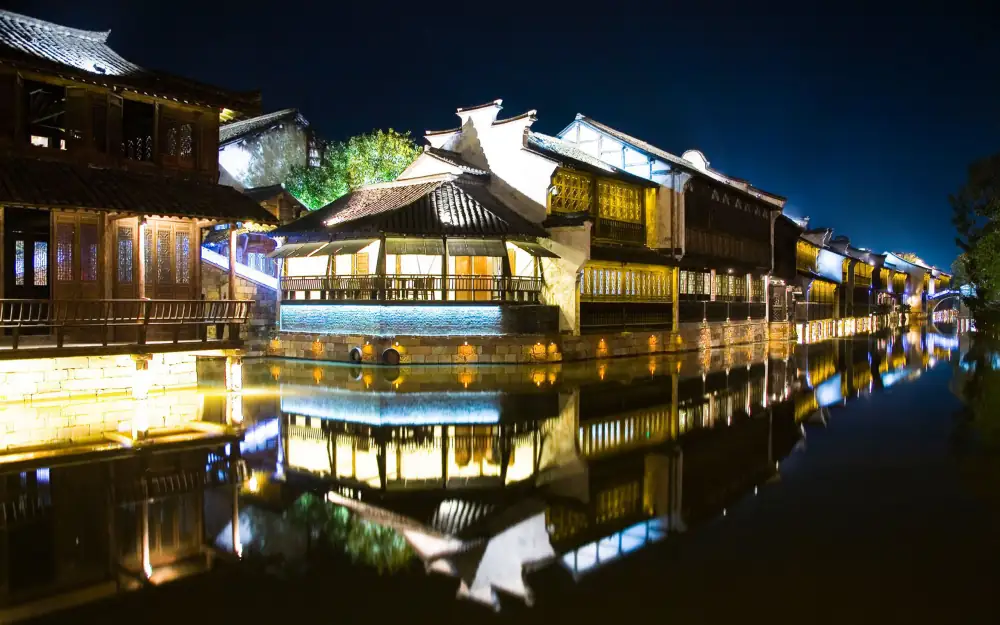
Yandangshan is not one summit. It’s a range spread over a wide area of Yueqing, a city administered from Wenzhou, and the name gets applied loosely — there is a northern Yandang, a central one, a southern one, and outliers east and west. When people say Yandangshan they almost always mean the northern block, which holds the developed scenic areas and everything worth planning a trip around.
Roughly five hundred named viewpoints are scattered across eight areas. That number is not useful as a target; it’s an indication of how densely the mountain has been read and re-read. Peaks, columns, plinths, caves, walls: the range functions as a museum of volcanic landforms, and the local habit of naming each one after a figure or an animal is not decoration but a way of navigating.
Three areas are picked out as the trio worth prioritising — Lingfeng, Lingyan and Dalongqiu. They are close together, they are different from one another, and between them they contain most of what makes the mountain distinctive. The name Yandang itself comes from the reeds on the high plateau, where southbound geese once stopped over.
What you should expect is a landscape that rewards moving. The single most-repeated observation about Yandangshan is that the rock shapes change as you walk — a peak that reads as a pair of scissors from one bend in the path becomes something else entirely twenty paces on. Approached passively from a viewing platform, the mountain underdelivers. Walked, it’s constantly rearranging itself.
Lingfeng, and the Reason to Stay the Night
Lingfeng is the eastern gateway and the first area most people enter. A stream runs up the middle of it with peaks stacked and leaning on both sides, and it is the part of the mountain photographers keep returning to.
By day it’s a pleasant valley walk with two significant caves and one of the range’s signature formations: a pair of cliffs that meet overhead like joined palms. Inside that formation sits Guanyin Cave, reached by a staircase that climbs through nine tiers of building wedged into the fissure — the architecture and the rock are inseparable, and the effect from the top looking down the stairwell is better than the view out. Sunlight reaches the main hall at the bottom for only a few minutes a day. A second cave nearby is quieter and less visited.
The real event is after dark. Once the light goes, the peaks flatten into silhouettes and the naming game begins in earnest: an eagle folding its wings, a rhinoceros looking at the moon, a couple leaning together, a woman waiting. It sounds like a gimmick and it isn’t. The daytime versions of these rocks are cluttered with texture and vegetation; reduced to outline against a dim sky, they resolve into shapes that are genuinely, sometimes startlingly, legible. Move a few metres and they change again.
Tickets for day and night entry are handled separately, so you can choose one or both. Do the night one. It’s the strongest single hour on the mountain, and it dictates where you sleep — you want to be within walking distance, not driving back down a mountain road at eleven at night.
Lingyan: The Sober One
There’s an old formulation that sets the two against each other neatly — Lingfeng is sharp and ornamental, Lingyan is massive and heavy — and the distinction still holds. Lingfeng sends your imagination running; Lingyan quiets you down.
The area is arranged around an old monastery with a vast cloud-coloured cliff screen behind it and two thousand-foot walls facing off to either side, named for a pillar of heaven and an unfurled banner. Standing between them the scale is oppressive in the way cathedrals are meant to be. The complex hides its subtler features: a cave with a natural skylight, a dragon-nose spring, a small waterfall, a jade maiden peak, a valley called the sleeping dragon. Concealment is the mountain’s specialty here, which is why Lingyan repays a slower walk than most people give it.
Lingyan is also where the acrobatic performance happens — climbers crossing between the facing cliffs on ropes strung high above the monastery. It runs at set times through the day, with more slots at weekends than midweek, and it draws a crowd. Whether it’s your thing depends entirely on your tolerance for spectacle, but it’s undeniably a display of nerve, and the setting does the heavy lifting.
Dalongqiu and the Waterfalls
Dalongqiu is a broad-mouthed valley ending in the longest single-drop waterfall in the country — a couple of hundred metres of water off a cliff lip into a pool. It’s also the least dependable thing on the mountain, because its character depends entirely on how much rain has fallen.
After a summer thunderstorm it’s a white torrent, loud enough to be felt from a hundred metres away, throwing spray far enough to soak spectators. In a dry spell it becomes a thread that disperses into mist before it lands, which is beautiful in a completely different register — on a winter day with the sun at the right angle, the falling water can throw rainbows that appear and vanish. Neither version is wrong. But if you have come specifically for a wall of water, time your visit to the wet months and go the day after rain.
The walk into the valley is easy and the light is good. There’s a well-known piece of local advice about the route: enter along the right-hand side and leave along the left, because the peaks read differently in each direction. The scissors formation on this approach is the mountain’s best demonstration of the shape-shifting effect.
Sanzhepu, between Lingfeng and Lingyan, is the other water feature and a strong contender for the finest single sight on the mountain. A stream drops over three successive cliffs; the middle fall is the one people come for, pouring from the roof of a huge semicircular hollow with the wall curving inward behind it. What that hollow probably is, is a cooled volcanic vent — fire and water occupying the same space, a few million years apart. A narrow side canyon nearby folds around one of the range’s most imposing cliff walls, and it demonstrates the other thing this mountain does well: keeping things out of sight until you’re on top of them.
The Quieter Corners
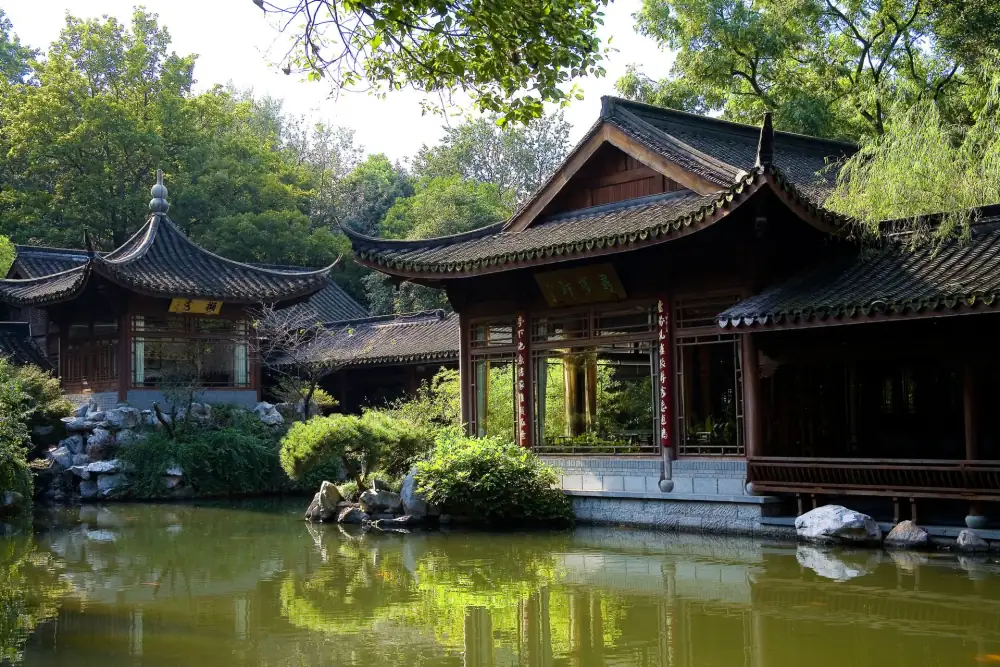
Xianshengmen is a gate rather than a peak: two cliffs rising a couple of hundred metres with only a few metres between them. Yandangshan has more than a dozen features called gates and this is the most extreme. The proportions do something odd to the inner ear — some visitors find they can’t stand under it for long. A cluster of Ming-era memorial arches in the western part of the area is one of the range’s few substantial pieces of built heritage.
Fangdong sits west of Lingyan and is the one to choose if you want cliff exposure without crowds. A boardwalk more than a hundred metres long is pinned into a vertical rock face, with terraced fields cut into the slope below and a scatter of caves and pinnacles above. A cable car handles the ascent, short and gentle enough that people who dislike heights generally cope. Signage is sparse and the paths are often nearly empty, which some visitors find eerie and others find is exactly the point.
Yanhu, the plateau the mountain is named for, sits high above everything else. It was once a genuine lake ringed with reeds; silting has reduced it to a pond. What survives is the position — a viewpoint over the East China Sea with no foreground, good for sunrise and for the cloud sea that forms below it. This is the one part of the range that requires real walking.
Xianqiao, in the north, is built around legends of an immortal arriving on a crane. The feature itself is a natural rock span arching over the valley, best seen from below. Quiet, modest, and pleasant if you already have three days. Yangjiaodong is a Taoist site in a cliff face, backed by a ravine and fronted by a drop, with a temple built into the cave mouth — worth it for the setting rather than the building.
Getting There and Getting Around
The coastal high-speed line has a station named for the mountain, and it’s the obvious way in — from the station a short local ride reaches the main village, which is the hub for everything. Trains from Shanghai take a few hours, from Hangzhou and Wenzhou much less. Two airports lie within an hour or two by road, one to the north and one to the south.
Long-distance coaches also run from Hangzhou, Ningbo and Shanghai, with the Shanghai services including an overnight sleeper that deposits you on the highway junction before dawn. That’s an unappealing arrival; take the train.
Locally, small green shuttle buses connect the central areas in season and leave when they fill. They cover the axis from the highway junction west to Dalongqiu. Outside peak season they run erratically or effectively convert into taxis.
For anything beyond the central corridor — the plateau, the gate, the northern areas — you will want a car and driver for the day. Some of these places involve long approaches on foot from the nearest drop-off, so carry water and something to eat; the outlying areas have very little in the way of shops. See /tags/itinerary for how a mountain like this fits into a longer coastal route.
Where to Stay
Xiangling Tou, the village at the centre of the range, is where to base yourself. Everything is within reach of it, the shuttle buses stop there, and its pedestrian street is where the mountain’s food and evening life concentrate. Several properties are a short walk from the Lingfeng entrance, which matters if you’re doing the night visit.
Options run from small guesthouses to a handful of larger hotels with more comfort and less character. Many will collect you from the train or coach station if you ask when booking. Rooms facing the hills are worth requesting.
Rates in the village move with the season and with demand, so book ahead for holidays and summer weekends. Camping on the mountain is possible and Lingfeng in particular is a popular spot for it, which is one way to catch both the night silhouettes and sunrise from the same place.
Eating
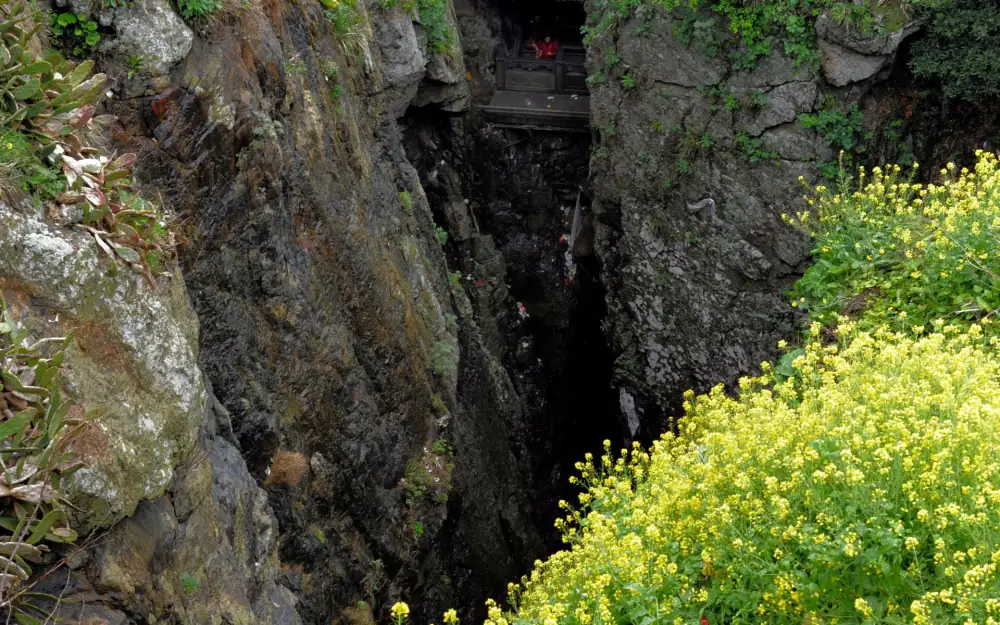
The mountain sits close enough to the sea that its cooking pulls from both directions, mountain and coast, which is unusual and makes for a more interesting table than most inland ranges offer.
Sweetfish is the local emblem — small, golden, fine-scaled, without any muddiness, and traditionally counted among the range’s handful of prized products. It’s a fish that grows fast, spawns and dies inside a year, which is why it has an old name meaning month-marking fish. Order it grilled or steamed and eat it with something to drink.
Rock frog appears in summer and autumn, usually as a clear soup: firm delicate meat, clean broth, no heavy seasoning. It sits alongside sweetfish among the dishes the area is known for, a list that also runs to eel arranged around potato and radish and a stew of game with potatoes cooked slowly to a deep red-brown.
Mung bean noodles, thick as chopsticks and faintly green, are the local staple and are meant to be stir fried. The rule is that watery vegetables ruin them; the right accompaniments are celery, oyster meat, razor clams and shredded omelette. There’s also a sweet potato vermicelli soup, cooked with pork bones and finished at the table with vinegar, seaweed, dried shrimp and egg.
Seafood generally is good and fresh. The restaurants inside the scenic areas are convenient and expensive for what they are; eating down in the town instead is both better value and better cooking. Busy places with a lot of local custom are the ones to pick. For more on regional cooking along this coast, /tags/food is the place to start.
Seasons
Spring brings green and mist and moderate crowds, with rising water through May and June.
Summer is hot and humid but has the fullest waterfalls, and afternoon thunderstorms are common. This is when Dalongqiu is at its most dramatic. Bring repellent — the valleys have mosquitoes.
Autumn is the best all-round choice: clear air, comfortable temperatures, still enough water in the streams through September, and the best odds of a clean sea view from the plateau.
Winter is quiet and cold with thin waterfalls, but the rock formations are at their most exposed with the vegetation down.
Honest Advice
Two days, three areas, one night on the mountain. That’s the shape of a good Yandangshan trip: Dalongqiu and Lingfeng night on day one, Lingfeng day and Sanzhepu on day two, Lingyan on the morning you leave. Add the gate and the plateau if you have a third day.
Don’t hire a guide. Almost everything here is natural scenery, the group commentary is audible everywhere anyway, and being marched between viewpoints on someone else’s schedule works directly against the one thing this mountain asks of you — walking slowly and looking from different angles. The scissors peak is the proof of concept.
Wear comfortable flat shoes or trainers; there’s more staircase than trail. Carry water for the outlying areas. Be firm about declining offers of free incense at temple entrances, which have a way of becoming expensive. And if it has rained heavily, drop everything and go to Dalongqiu — you can see caves and cliffs any day, but the big waterfall in full flow is a matter of timing. More on ranges like this at /tags/nature.