
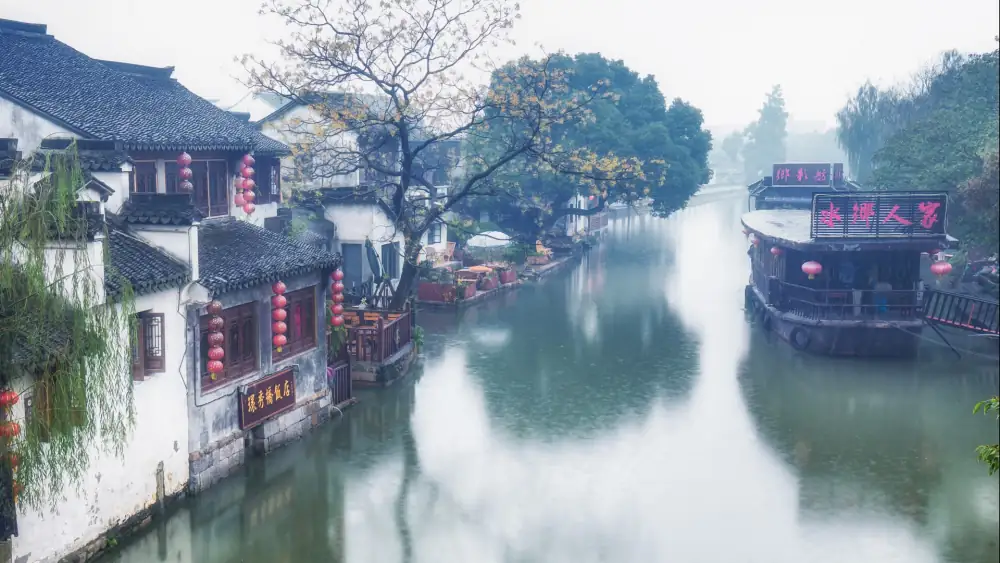
Mist sits low over the canal at Bazi Bridge (八字桥) while a woman rinses vegetables on the stone steps and a black-awning boat slides past with a load of building sand. Shaoxing (绍兴) is a canal city that never stopped being one: the waterways still carry cargo, and the laundry above the paving belongs to somebody. Zhejiang’s showier water towns have been polished into stage sets; this one kept its working edges, along with rice-wine cellars, a literary quarter that shaped modern Chinese fiction, and the pavilion where Chinese calligraphy found its founding text.
Table of contents
Open Table of contents
Why Shaoxing earns the detour
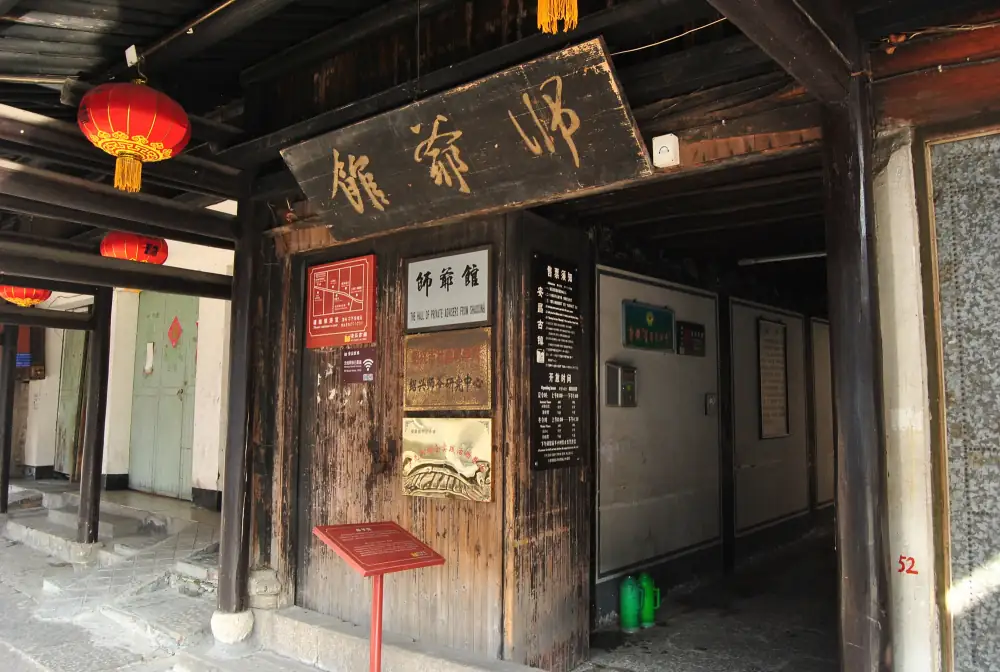
Most visitors to eastern China route themselves between Shanghai, Suzhou and Hangzhou and never look south of the Qiantang, which leaves Shaoxing under-trafficked for a city with this much stacked history. It was capital of the ancient Yue state, whose king Goujian schemed his way back to power from here. It gave China Wang Xizhi, whose “Preface to the Orchid Pavilion Collection” is the most copied calligraphy in the language, and Lu Xun (鲁迅), whose stories mapped a provincial town’s small cruelties so precisely that readers still walk the streets. It also gave the country its defining rice wine.
Water holds all of this together. Canals thread the old quarters, stone-arch bridges cross every few hundred paces, and a low grid of whitewashed walls under black tile runs between. The pleasure is not ticking off monuments but walking slowly and eating things salted, dried or fermented into something pungent and excellent. If your travel leans towards culture and food rather than spectacle, this city rewards patience.
A walking route through the old city
Give the old centre a full day on foot. The route runs roughly north to south and can be joined anywhere.
Lu Xun’s quarter
Start at the Lu Xun Native Place (鲁迅故里), a preserved block along one street: the ancestral compound, the house where the writer grew up, the walled kitchen garden he called Baicaoyuan (百草园), and the Sanwei Study (三味书屋) across the lane where he was drilled in the classics. Read a story or two first — “Kong Yiji” and “Hometown” take twenty minutes between them — and the block turns from architecture into geography. Ceremonial gates, ancestral hall, raised timber thresholds: a comfortable provincial family’s world a century ago, which Lu Xun spent his career dismantling. Arrive when the site opens; by late morning school groups fill the courtyards.
Shen Garden and the canal to the south
A short walk east brings you to Shen Garden (沈园), a compact Song-era pleasure garden attached to a private house, remembered for a broken romance between the poet Lu You and his cousin Tang Wan. Its Song-period pond, well and rockwork are the genuine survivals; the rest is reconstruction, and fifteen quiet minutes by day is plenty. In warm months the garden runs a costumed evening programme with Yue opera excerpts, lanterns and wine — unashamedly theatrical, and better than it sounds.
Cangqiao Straight Street
Cangqiao Straight Street (仓桥直街) is the best stretch of old Shaoxing and the reason to stay overnight. Three things run in parallel: a canal, a row of houses whose back doors open onto the water, and a flagstone lane. Old stone bridges cross at intervals, and residents actually live here, drying radishes on windowsills and playing cards in doorways. Walk it slowly, then again after dark, when the water goes black and the lit windows do the work.
Bazi Bridge and the northern lanes
Northeast of the centre, Bazi Bridge crosses two channels at once in a splayed figure that reads like an early flyover, and it is among the oldest surviving city bridges in China. The lanes around it see few visitors and hold the most intact ordinary housing in Shaoxing. Nothing is presented for you, which is the appeal. Nearby sit the Qingteng Study (青藤书屋), courtyard of the Ming eccentric painter Xu Wei, and Zhou Enlai’s ancestral home (周恩来祖居).
Getting on the water
Black-awning boats (乌篷船) are the local signature: narrow craft under a low arched canopy of black-lacquered bamboo, foot-rowed by a boatman who steers with an oar under one leg. Jetties operate at several points in the old city and at the outlying scenic areas, boats are small, and the boatmen work the canals from early morning. Take a short circuit through the city channels; the interest lies in the back walls, the bridges and the mooring steps.
Beyond the old city
The Orchid Pavilion
The Orchid Pavilion (兰亭) sits among bamboo and running water southwest of the city, a pilgrimage site rather than a sight. At a spring gathering here, scholars floated wine cups down a stream, wrote poems, and Wang Xizhi drafted the preface in a state of inspiration he could never afterwards reproduce. The grounds hold the goose pond, the winding stream, an octagonal stele pavilion carrying an emperor’s copy of the text, and shallow basins where visitors practise characters with oversized brushes. Half a morning, longer if you are drawn in.
East Lake
East Lake (东湖) is a flooded quarry east of town — sheer cut cliffs, caves at the waterline, causeways and stone bridges. Go in by boat and walk out along the embankment, which gives you the cliffs from below and then above. Village opera runs in the grounds in season.
Keyan and the stone country
Keyan (柯岩) preserves the ancient quarries on a larger scale: freestanding rock pillars left by a thousand years of stone-cutting, gardens laid over the workings, and a reconstructed “Lu Town” staged as the setting of Lu Xun’s fiction. The quarry landscape is genuinely strange; the town is a film set. Neighbouring Jian Lake (鉴湖) supplies the water traditionally used for the city’s wine.
Anchang
Anchang (安昌) is the water town to choose if you want one. A single canal runs its length under humpback bridges, with covered walkways along the banks, and its trade is food rather than souvenirs: sausages and cured duck hung in curtains from the eaves, soy-braised meats, wine shops, and a dense market before Chinese New Year.
Kuaiji Mountain and further out
South of the city, the Mausoleum of Yu the Great (大禹陵) climbs the lower slopes of Kuaiji Mountain (会稽山): a stepped processional way, spirit beasts, halls and an ancient cypress, honouring the flood-tamer of Chinese myth. Further out, in Zhuji, the Wuxie waterfalls (五泄) drop through a bamboo gorge in five stages — a decent day for hiking legs.
Getting there and getting around
Shaoxing sits between Hangzhou and Ningbo on a busy rail corridor. Frequent high-speed trains reach Hangzhou in little more time than it takes to find your seat, and services from Shanghai run through the day. Hangzhou’s airport is the practical air gateway, closer than most visitors expect, with coaches into the city.
The old centre is compact and best covered on foot. A metro line and a dense bus network handle the rest, and ride-hailing apps make the language problem disappear. Group the out-of-town sites by direction — Orchid Pavilion southwest, East Lake and Kuaiji Mountain east and south, Keyan and Anchang west — and do one cluster per half-day rather than zigzagging.
The four seasons
Four distinct ones, and they alter this city more than most destinations.
| Season | What it feels like |
|---|---|
| Spring | The strongest season: canals run high, bamboo is bright at the Orchid Pavilion, peach and orchid festivals fall here, and the common grey drizzle suits the place. |
| Summer | Hot, humid and heavy, with cicadas and mosquitoes. Walk early and late; the water sites are the relief. Bring repellent. |
| Autumn | The connoisseur’s choice. Osmanthus scents the gardens, and wine-making arrives with the cooler air. Book rooms early around the October holiday. |
| Winter | Damp, chilly and largely visitor-free, with old buildings unheated, so layer up. The compensation is Anchang before New Year, cured meat hanging from every eave. |
Where to stay
Base yourself in the old city. Two areas work:
- Around Lu Xun Middle Road. The most convenient base: walking distance to the literary block, Shen Garden and the boat jetties, with plenty of eating options. Hotels and small guesthouses both cluster here.
- Cangqiao Straight Street and the canal lanes. Converted courtyard houses and small hostels, some with windows over the water. Atmosphere is the draw, soundproofing the trade-off, and rooms are few — lock this in first over holiday weekends.
Skip the Keqiao district unless business takes you there; it is a modern textile centre outside the historic core.
What to eat and drink
Shaoxing cooking is salty rather than sweet, built on river fish and shrimp, poultry, beans and preserved vegetables, and it leans hard on fermentation. Not a subtle regional cuisine but a pungent one, and among the more distinctive entries on eastern China’s food map.
Yellow rice wine, properly
Huangjiu (黄酒) — literally yellow wine — is brewed from glutinous rice with a fermentation starter, not distilled. Shaoxing is its capital, and locals call the aged stuff lao jiu, old wine. Body and colour deepen with age, from pale straw to burnt amber; the flavour runs to caramel, toasted grain, walnut and dried fruit, finishing savoury. Two names to know: huadiao (花雕), aged wine in ornamented earthenware jars, and nu’er hong (女儿红), traditionally buried at a daughter’s birth and dug up for her wedding.
Drink it warmed in a small bowl or a blue-and-white cup, in short sips, with food. Cellars around the old city pour samples across a range of ages, and the gap between young cooking-grade wine and a properly aged one is obvious to a first-timer.
The fermented and the drunken
- Stinky tofu (臭豆腐). Steeped in amaranth-stalk brine, then deep-fried into dark cubes with a molten interior, or steamed for a homelier version. The smell arrives well before the plate. Order it fried, from a busy stall, with chilli sauce.
- Preserved mustard greens (梅干菜). Salted, sun-dried and almost black, deeply smoky-savoury. The classic is meigancai kourou, dried greens steamed with belly pork until the fat collapses — order this if you order nothing else.
- Fermented bean curd (腐乳). Tofu ripened into a soft, salty paste, eaten in tiny amounts with rice porridge or used to braise meat.
- Drunken dishes. Chicken, crab and river fish steeped in yellow wine and served cold. Drunken chicken is tender, faintly sweet and excellent in hot weather.
- Fennel beans (茴香豆). Broad beans simmered with aniseed and salt, the immortal bar snack of Lu Xun’s fiction and still the thing to pick at over a bowl of wine.
- Sweet things. Shaoxing xianggao, a baked rice-flour cake spiced with aromatics — buy the osmanthus version — and naiyou xiaopan, a small pastry with a whipped-egg-white cap like a snowy hat.
The old taverns near the Lu Xun quarter trade on literary associations and serve the standards competently; kitchens along Cangqiao Straight Street tend to cook better with fewer coach parties. Many places allow half portions, which is how two people get through six dishes.
Honest practical advice, including what to skip
- Two nights, not one. The old city changes character at dawn and dusk; a single afternoon gives you neither.
- Go early. Tour groups arrive mid-morning and leave by late afternoon, so everything here is better at either end of the day.
- Buy specialities in a supermarket, not at a scenic site. Preserved greens, wine and rice cakes are sold in ordinary shops, more reliably.
- Skip the reconstructed “old” attractions. Lu Town at Keyan and similar themed builds add nothing once you have walked the real lanes at Bazi Bridge.
- Skip the long lake boat rides. A short canal circuit gives you more.
- Don’t over-programme. Two of the outlying sites in a day is comfortable; three is a scramble.
- Language. English is thin outside hotels. Carry destination names in Chinese; bus announcements come in a dialect other Chinese speakers struggle with.
- Bring rain gear in any season. This is a wet corner of Zhejiang, and a canal city in drizzle is a feature rather than a problem.
Shaoxing does not perform for visitors, which is exactly why it stays with people. Pair it with Hangzhou or a longer swing through east China, and give it two days.