
Dawn at Hengdian, and a man in the full court dress of a Qing official is buying breakfast noodles from a cart, phone tucked under a jade-buttoned collar. Two streets away a crew is rigging lights against the wall of a replica Forbidden City while a minibus of extras waits with the engine running. This is a working town where the industry is film, and the sets are not exhibits but places of business that happen to sell tickets.
Table of contents
Open Table of contents
What Hengdian actually is
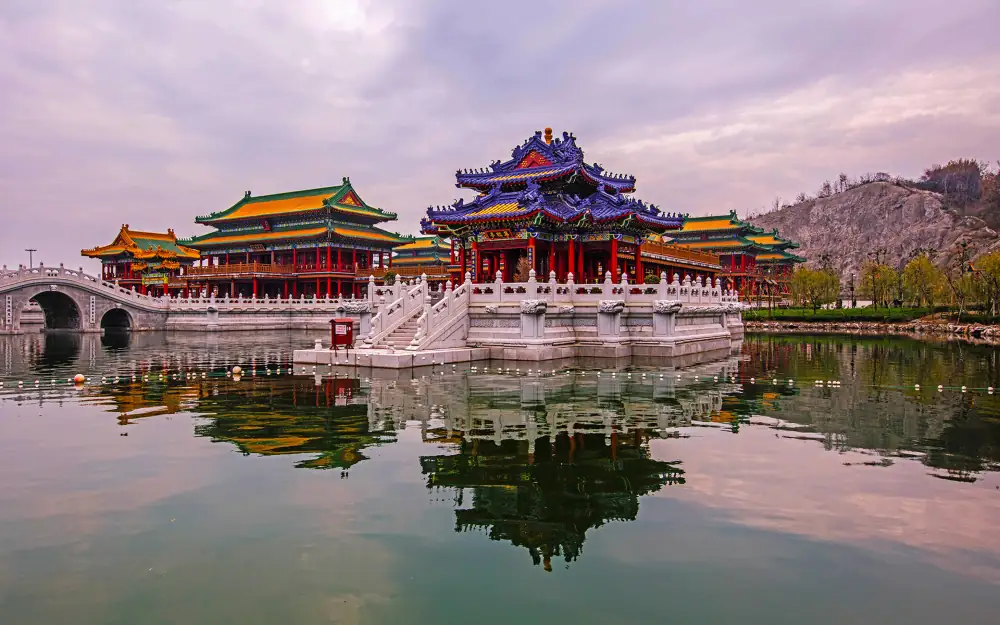
Hengdian (横店) is a town inside the city of Dongyang, in central Zhejiang, and it is the largest film and television production base in Asia. The comparison to Hollywood gets made constantly and it is misleading in one important way: there is no single studio compound here. What exists instead is a scatter of separate walled backlots, each one a different historical era built at full architectural scale, distributed across several kilometres of ordinary small-city Zhejiang. You buy into them individually. Between them run shuttle buses, taxis, restaurants, karaoke bars, hardware shops selling armour fittings, and thousands of aspiring bit-part actors.
None of it is old. Every temple gate and palace hall was built in the last few decades for the camera, and anyone who arrives hoping for authenticity has misunderstood the trip. What Hengdian offers is scale and craft. The replica of Beijing’s imperial palace complex is not a scale model; it is a full-size stand-in that has carried the visual weight of an entire generation of Chinese period drama. Standing in an empty throne hall at nine in the morning, before the crowds and the costumed selfie queues arrive, the effect is genuinely disorienting.
The other thing on offer is the industry itself. Hengdian has bred a floating population of extras known as 横漂, the “Hengdian drifters” — people who moved here from across the country to queue for background work. Their presence is why the town has the atmosphere it does. The sets are the stage; the street is the interesting part.
The backlots worth your time
There are more than a dozen ticketed bases. Attempting all of them would be tedious and expensive of time. Four carry the experience.
Qin Palace (秦王宫)
The most impressive single build. Warring States and Qin dynasty architecture on a scale designed to make human figures look small: broad stone ramps, tiered ramparts, a throne hall reached by a processional stair, and an adjoining terrace representing the rival state of Yan. It is where the great sword-and-empire films were shot, and the sightlines were composed for a camera rather than for a visitor, which is exactly why they work. Two staged shows run here — a duelling spectacle and a larger costumed set-piece — and both are better than their descriptions suggest. Allow a couple of hours minimum, and understand that this base involves a lot of climbing on stone.
Ming and Qing Palace (明清宫苑)
The full-scale imperial palace replica, and the engine room of Chinese television. Courtyard after courtyard of vermilion walls, an imperial garden, princely mansions, and a reconstructed old-Beijing lane of grey brick housing. This is the base where costume rental makes the most sense, because the grounds are built for exactly the kind of slow processional walking that a robe demands. Two performances anchor the schedule: a mounted cavalry battle in an arena, and a court ceremony in the main forecourt. Get the day’s timings from the leaflet at the gate and build the visit around them rather than wandering and hoping.
Guangzhou Street and Hong Kong Street (广州街·香港街)
The original set, built for a historical epic about the opium trade, and the reason the whole enterprise exists. One half is nineteenth-century Canton: godowns, waterfront, shophouses. The other is colonial Hong Kong, with a governor’s residence, a church, a tramline street and a harbourfront. It photographs beautifully in late afternoon and it is the smallest of the major bases, which makes it a good pairing with something larger.
Dream Valley (梦幻谷)
An evening-only park, and the sequencing hinge of any Hengdian itinerary. The daytime backlots shut in the late afternoon; Dream Valley opens as they close. Inside is a water-town street, a food lane, some rides, and two large outdoor spectacles — a staged rainstorm and flash flood that soaks the front rows, and a music-and-dance production built around volcanic effects that is among the more ambitious pieces of live tourism theatre in the country. It is loud, unsubtle and thoroughly enjoyable.
The rest
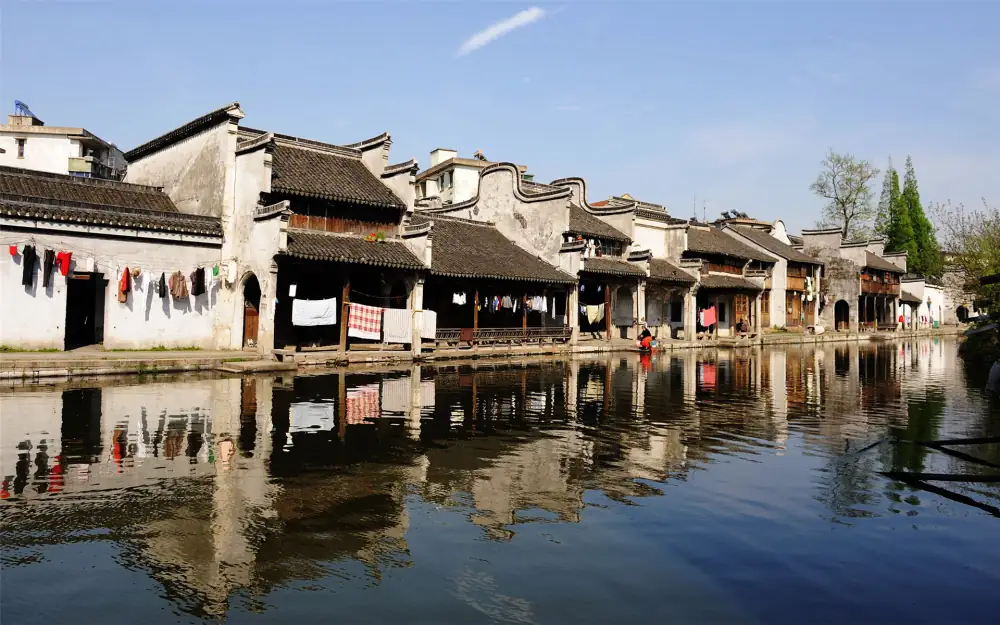
Qingming Riverside (清明上河图) recreates a Northern Song city from the famous scroll painting, complete with a winding canal, arched bridges and wharves, plus two shows. It is good, though it repeats notes you will have hit elsewhere. The Ming and Qing Residences Museum City gathers relocated Jiangnan vernacular houses — whitewashed walls, carved beams, ancestral halls — and rewards anyone with a real interest in domestic architecture. Huaxia Culture Park is a themed tour of Chinese civilisation and can be skipped without regret. Pingyan Grotto, a karst and Daoist cave site with a cable car, is the one place in Hengdian that is actual landscape rather than construction; it works well as a decompression stop when set fatigue arrives, which it will.
Getting there and getting around
Hengdian has no railway station of its own, which trips up first-time visitors. The practical routes in:
- Via Yiwu. The nearest useful rail hub and a small airport. From Yiwu’s long-distance coach station, buses to Hengdian run frequently and take well under an hour. This is the default.
- Via Hangzhou. Coaches run from the airport and from the city’s main bus terminals directly to the studio area, taking around three hours. Sensible if you are already in the provincial capital.
- Via Dongyang. Trains and coaches to Dongyang, then very frequent local shuttles for the last short leg.
- By road. Expressway exits are signposted for both Hengdian and Dongyang, and the town is within a comfortable day’s drive of Shanghai, Nanjing and most of Jiangsu.
Once you are there, use the dedicated tourist shuttle. It runs a loop in both directions linking the visitor reception centre, every ticketed base and the main hotel strip, and it is the only sane way to cover ground. Taxis are plentiful and the distances short. Motor tricycles are quicker and much louder. Do not try to walk between bases — the individual parks are large enough that you will already be covering serious distance inside them, and the roads between are ordinary traffic corridors with nothing to look at.
Seasons and crowds
Central Zhejiang has a humid subtropical climate with four genuinely distinct seasons. Spring and autumn are the obvious windows: mild, bright, and long enough in the day to fit a full backlot plus an evening park. Summer is hot, sticky and punishingly sunny on open stone plazas — bring a hat and treat midday as a break rather than a viewing slot. Late summer into early autumn carries some typhoon risk, which in practice means a washed-out day rather than a ruined trip. Winter is the low season: cool, quiet, sets nearly empty, and the earliest sunsets of the year, which compresses what you can see.
Crowd management matters more than weather. Public holidays and weekends fill the parks and push room rates up sharply, and the costume rental queues become their own attraction. A midweek visit outside holiday periods is a materially different experience.
Where to stay
Everything clusters in the town itself, and because the shuttle radiates from there, almost any central address works.
- Wansheng Street area. The commercial core: supermarkets, banks, the main food street, and walking access to two of the major bases. Business hotels dominate. The most convenient choice for a short visit.
- Near Qingming Riverside. Hotels here are popular with production crews for the same reason they are convenient for you — proximity. If star-spotting is part of the appeal, this is where the odds improve.
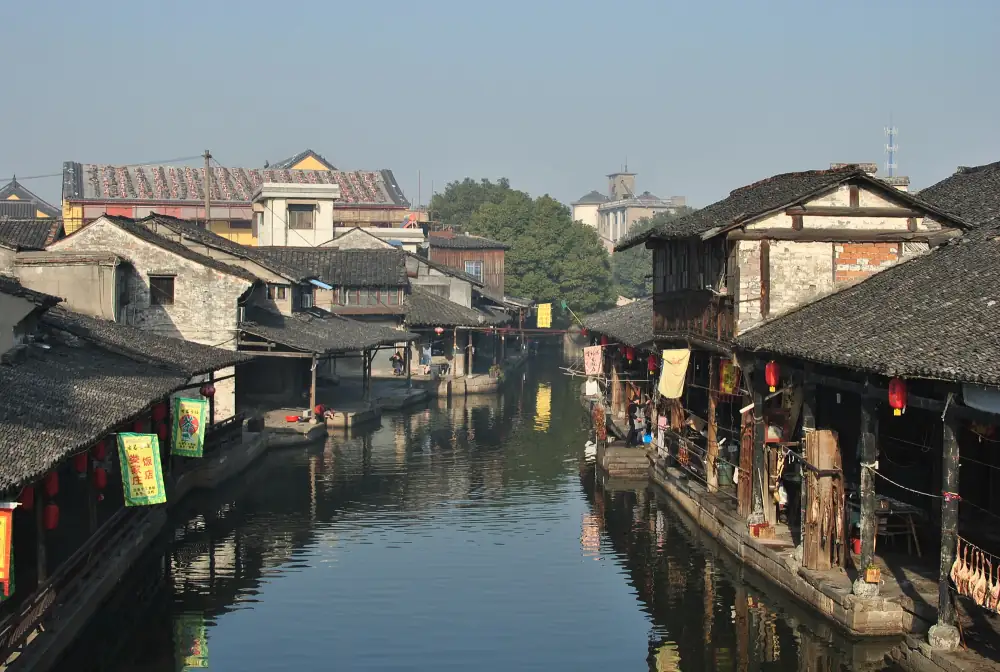
- The old residences zone. Quieter, lanes and courtyards, a short walk from the evening park. Better for anyone who wants the town rather than the strip.
- The resort road. Larger properties with banquet halls and Zhejiang cooking, aimed at groups.
Independent guesthouses are abundant at the cheaper end, and rates are negotiable outside peak weekends.
What to eat
The regional cooking here belongs to Dongyang and Jinhua, and it is heartier and saltier than Hangzhou’s refined Jiangnan repertoire.
- Steamed buns with braised pork belly (馒头扣肉). The obligatory banquet dish: flat-bottomed white buns paired with thick triangular slabs of twice-cooked pork. Rich, and meant to be shared.
- Glutinous rice sausage (糯米肠). Intestine casing packed with sticky rice, simmered, then sliced and crisped on the griddle.
- Griddle-baked tofu (烤豆腐). Pressed against the hot pan wall until browned, then stewed with greens or pork.
- Acorn jelly (橡子豆腐). A cool, coffee-coloured jelly eaten with sugar and rice vinegar — a summer dish, and better than it sounds.
- Jinhua ham (金华火腿) and Jinhua flaky pastry (金华酥饼). The two regional exports worth carrying home, the pastry a small, dark, salty-filled crab-shell biscuit.
Wansheng Food Street is the main eating strip, and its lineup is deliberately pan-Chinese rather than local — Chongqing hotpot, northwestern noodles, northeastern pancakes, Jinhua clay-pot casseroles, Dongyang hand-pulled noodles. That reflects who lives here. For a deeper dive into regional cooking, our food coverage goes further.
Sequencing one or two days
One day, tightly run. Ming and Qing Palace at opening, in costume if you want the full experience. Guangzhou and Hong Kong Street before lunch. Qin Palace through the afternoon, timed to catch at least one show. Dream Valley from dusk. That is a long day on your feet and you will skip things.
Two days, properly. Day one: Qin Palace in the morning light, Qingming Riverside after lunch with its two performances, then the evening at Dream Valley. Day two: Ming and Qing Palace timed around the cavalry battle and the court ceremony, Guangzhou and Hong Kong Street in the golden hour, and Pingyan Grotto’s cable car if you want a view over the whole strange landscape of it before you leave.
The single rule that governs everything: the daytime bases close before the evening park opens, so Dream Valley always takes the last slot of the day. Plan backwards from that. For more on structuring multi-stop trips in the region, see our itinerary guides.
Honest advice
Buy tickets for specific bases rather than a blanket pass unless you genuinely intend to visit five or more; most people overestimate their appetite for replica architecture by about two parks. Wear real shoes, because the stone is uneven and the distances inside each base are longer than the maps imply. Collect the performance leaflet at every gate — the shows are the best value in Hengdian and are easy to miss entirely by arriving at the wrong hour.
If you are choosing what to drop: Huaxia Culture Park first, then the large temple complex, then Qingming Riverside if you have already done Qin Palace and the imperial replica. Keep Dream Valley. Keep costume rental, even if you feel foolish about it, because watching hundreds of other people commit to the same idea is a large part of the fun.
And on filming: it is fair game to watch and to photograph the street, but never a take in progress. Crews here are working to a schedule and the goodwill that lets visitors stand this close to a live production is worth protecting. Read more about the traditions behind these sets in our culture archive.