
Water does the talking at Yuntai Mountain (云台山). Cliffs of oxidised sandstone squeeze together until the sky is a ribbon overhead, streams slide over slabs polished the colour of raw liver, and somewhere above you a cascade drops out of a hanging valley with a noise like distant traffic. This corner of the Taihang range, on Henan’s northern rim near Jiaozuo, has been turned into one of the most efficiently run scenic areas in China, and that efficiency is both its gift and its irritation.
Table of contents
Open Table of contents
What Yuntai Mountain actually is
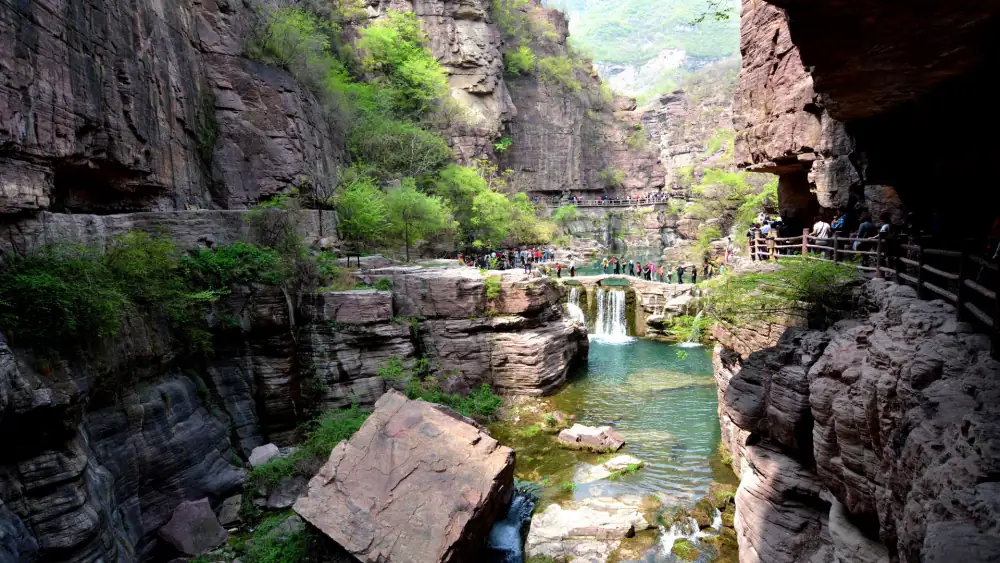
Think of it less as a single peak than as a fan of separate valleys cut into the southern edge of the Taihang escarpment, where the plateau of Shanxi breaks off and falls towards the flat, farmed plain of the Yellow River. Each valley has its own character and its own entrance. You visit them in sequence, carried between them by a fleet of green shuttle buses, because private cars are kept out of the interior entirely.
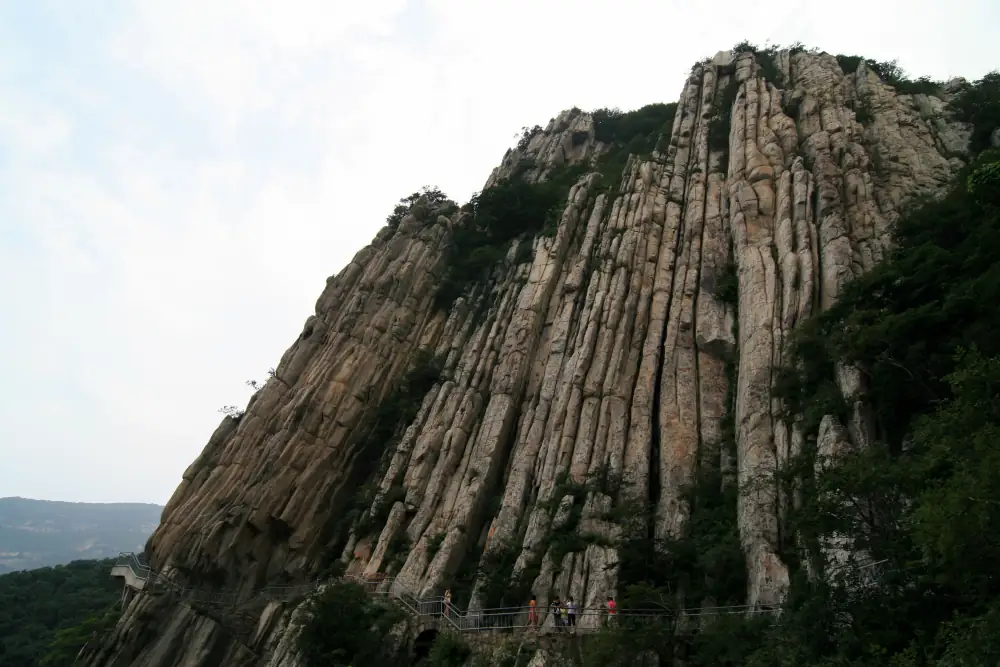
Geologists rate the place highly enough that it carries global geopark status, and you can see why without knowing a word of stratigraphy: horizontal beds of red and grey rock stacked like masonry, undercut caves where softer layers dissolved out, and vertical joints that streams have exploited into slots barely wide enough to walk. Nature lovers will find plenty here to slow them down, and the landscape holds its own against China’s more famous mountains.
Culturally it is older than the ticket barriers suggest. Taoist hermits built shrines on the high ground. A deposed Han emperor summered on these slopes. Most famously, a circle of third-century poets and drinkers known as the Seven Sages of the Bamboo Grove retreated to the cliffs at Baijiayan (百家岩) to write, argue and dodge court politics, and their reputation still colours how Chinese visitors talk about the mountain. That thread of literary escapism runs through a lot of Chinese landscape travel, as anyone following /tags/culture will recognise.
The valleys, one by one
Red Stone Gorge (红石峡)
Start here if you can, because nothing else on the mountain matches it and everything else feels gentler afterwards. A staircase drops you into a slot canyon where the walls glow rust-red, ferns grip every ledge, and a boardwalk runs at water level past pools, chutes and a curtain of spray. It is a one-way route, which keeps the flow moving, but the gorge is narrow and mid-morning can turn it into a shuffling queue. Allow the best part of two hours if you want to stop and look rather than being pushed along.
The rock warms and cools slowly in such a confined space, so the gorge stays cool in July and holds green moss through the coldest weeks — hence its older name, the Warm Basin Valley.
Tanpu Gorge (潭瀑峡)
Also called Xiaozhaigou, this is the family favourite: a broad, shallow valley where a stream steps down through a chain of jade pools, small falls and rock slides. Children paddle. Photographers crouch. A cave of dripping water hangs above the path, and a Y-shaped fall splits neatly around a boulder. Walking to the head of the valley and back takes a couple of gentle hours, and the surface is easy underfoot the whole way.
Quanpu Gorge (泉瀑峡)
Longer, wilder and steeper-sided, Quanpu Gorge climbs between towering walls to the mountain’s single greatest set piece: the Yuntai Waterfall, a thread of white falling from a notch in the cliff top into a stone amphitheatre. In full summer flow it is genuinely thunderous. In a dry autumn it can shrink to a wisp, and in deep winter it freezes into a vertical column of grey-green ice. Springs seep straight out of the gorge walls along the way, which explains the name.
This is the longest of the three water walks. Budget half a day if you intend to reach the fall on foot and linger.
Zhuyu Peak (茱萸峰)
The high point of the range and a different kind of day. A stone stairway climbs relentlessly through pine, maple and old yew to a Taoist temple on the summit, where the view splits in two: crumpled ridges of Taihang to the north, and southwards the whole Huaichuan plain, gridded with fields, with the Yellow River drawn across it like a strip of foil. Tang poets came up here to mark the autumn festival by wearing sprigs of dogwood, and the peak still carries that faintly melancholy, homesick literary association.
Take your time on the steps. There is shade most of the way, a stone bench roughly whenever you need one, and no prize for arriving out of breath.
The tunnel road and Zifang Lake (子房湖)
Getting to Zhuyu Peak means riding the Diecai Tunnels (叠彩洞), a corkscrew of hand-cut galleries drilled through the cliff by local work crews over a decade in the late twentieth century. Buses swing through hairpins inside the rock and pop out onto ledges with sudden drops to the valley floor. It is a sightseeing attraction in its own right, best appreciated from a window seat on the left going up.
Zifang Lake sits on the eastern side, a long green reservoir pinched between steep hills, named for a Han dynasty strategist said to have hidden out nearby. Ten minutes at the viewpoint is enough unless you want a speedboat ride.
The smaller stops
Wanshan Temple (万善寺), a working Ming-era monastery in a wooded side valley, is pleasant but modest. Macaque Valley (猕猴谷) shelters a genuinely wild population of Taihang macaques — stocky, long-haired, adapted to the coldest latitude any macaque manages — though the staged monkey shows are not everyone’s idea of a good afternoon. Both are the first things to drop if your schedule tightens. Qinglongxia (青龙峡) and Fenglinxia (峰林峡), further out, and Qingtianhe (青天河) with its river gorges, need a separate day each and are best saved for a return trip.
How the shuttle system works
Understanding this is the difference between a good day and a frustrating one. Cars stay at the enormous car park by the main gate. Inside, everything moves by shuttle bus, with stops at every valley entrance and a network of loops linking them. You hop on and off with your pass as often as you like, and a guide on board narrates the route.
Two consequences follow. First, you are not walking between valleys, so distances stop mattering and you can plan by attraction rather than by map. Second, every visitor funnels through the same small number of boarding points at the same times, which is precisely where the crush happens.
Getting there and moving around
Yuntai Mountain sits in Xiuwu county, north of Jiaozuo and roughly two hours from Zhengzhou by road. Options in rough order of convenience:
| Approach | How it works | Best for |
|---|---|---|
| Rail to Jiaozuo or Xiuwu | Frequent trains from Zhengzhou; longer-distance services from Beijing, Xi’an, Wuhan and beyond | Most independent travellers |
| Direct coach | Seasonal services from Zhengzhou, Xinxiang and Luoyang bus stations to the mountain gate | Travellers without a car who want one connection |
| Fly to Zhengzhou | Xinzheng airport, then rail or road north | Arrivals from abroad |
| Self-drive | Expressway to the Xiuwu exit, then a signposted run east to the gate | Families and anyone combining Henan sights |
From Jiaozuo, buses and taxis run out to the gate through the day. Local taxis in Jiaozuo often negotiate rather than meter, so agree the trip before you get in. If you are stitching Yuntai Mountain into a wider loop with Luoyang, Kaifeng or the Shaolin Temple, the rail links make it straightforward — see /tags/itinerary for route-building ideas.
The four seasons
- Spring. Snowmelt fills the streams, wild flowers speckle the slopes, and the temperature suits long days of walking. Early spring can still be bare and brown at altitude.
- Summer. Peak water, peak green, peak noise from the falls — and peak everything else. Afternoon storms arrive without much warning, paths turn slick, and the gorges are cool while the plain below bakes. Bring waterproofs and expect company.
- Autumn. The connoisseur’s season. Maples turn scarlet across the ridges, the air is dry and clear, and views from Zhuyu Peak stretch for miles. Water levels drop, so the great waterfall is less dramatic.
- Winter. Ice takes over. Cascades freeze mid-fall into ribbed columns, the gorges empty of people, and the red rock looks even redder against snow. Some high paths close after storms, but if solitude appeals, this is the moment.
Avoid the national holiday weeks in early May and early October unless you have no alternative.
Where to stay
Three broad choices, each with a trade-off.
- The service villages inside and beside the scenic area. Clusters of family guesthouses sit within easy reach of the gate, the largest and most useful being Anshang village, which has shops, banking and a ticket point. Rooms are simple and the food is home-cooked. Staying here buys you the single greatest advantage on the mountain: being at the barrier before the coaches arrive.
- Xiuwu town or Fangzhuang. A short drive out, noticeably better rooms and a proper choice of restaurants, at the cost of an early start.
- Jiaozuo city. Full range of hotels, real urban dining, easy rail connections, and about an hour each way. Sensible if you are only giving the mountain one day or arriving late.
Book ahead for weekends, holidays and midsummer. Power cuts are not unknown in the villages, so a charged battery pack earns its place in your bag.
What to eat
Henan food is wheat country cooking: hearty, savoury, unfussy. The dish to try first is huimian (烩面), thick hand-pulled noodles in a long-simmered mutton broth, ladled up with coriander and chilli oil — a proper meal after a day of stairs. Wuzhi youcha (武陟油茶), a thick roasted-grain drink, makes a warming breakfast that tastes like nothing else.
In the mountain villages the register shifts to farmhouse cooking. Look for free-range chicken stewed slowly with medicinal roots, wild wood-ear mushrooms picked from the slopes, mountain chives scrambled with small deep-yolked eggs, and steamed wild yam eaten with honey. Braised donkey meat is a genuine regional speciality of the Jiaozuo area, served in a rich, peppery broth. Come autumn, stalls sell frost-dusted persimmon cakes, dense and toffee-sweet. The four local tonic herbs — yam, rehmannia, achyranthes and chrysanthemum — turn up in dishes and gift boxes alike. More on regional cooking at /tags/food.
Inside the scenic area, order simply. Ordinary noodle and dumpling dishes are far better value than elaborate meat plates, and the same souvenirs sell for less in the village shops than at the attraction kiosks.
Honest practical advice
Start absurdly early. Almost every complaint about Yuntai Mountain traces back to arriving at the same time as the tour coaches. Reach the gate at opening, ride straight to Red Stone Gorge, and you will walk the best gorge in near silence. Do it the other way round and you queue twice.
Reverse the standard order. Coach groups tend to be fed into the valleys in a set sequence. Working against the grain — the far valleys first, Red Stone Gorge late in the afternoon as the day trippers leave — can hand you empty boardwalks.
Use the shuttle loops strategically. When a boarding point looks hopeless, walk to the next stop up the line or wait fifteen minutes for the surge to clear. Buses come round constantly; the queues are peaks, not a permanent state.
What to skip. With only one day, drop Wanshan Temple and the monkey shows, and treat Zifang Lake as a photo stop. Do not attempt the outlying gorges and Qingtianhe on the same trip — they will hollow out everything else.
Practical kit. Grippy shoes with a decent sole; the gorge boardwalks are wet year round. A light waterproof, even in August. A thin extra layer, because the mountain runs several degrees cooler than the plain and evenings bite. Skirts and smooth-soled fashion trainers are a mistake on the stairs.
On the paths. Don’t swim in the pools. Keep your bag zipped near the macaques, who are quick and unsentimental. Look where you are putting your feet, then stop and look at the view — trying to do both at once is how people turn ankles. Biting insects here have a reputation, so cover up at dusk.
Give the mountain two unhurried days and it repays you properly: one morning deep in a red slot canyon with water at your elbow, one afternoon on a summit with half of Henan laid out below. Walkers planning more of the same will find kindred routes under /tags/hiking.