
At four in the morning the path above the South Heaven Gate is busier than the town below it. Torch beams swing across granite, someone’s thermos rattles, and the whole moving column is heading for the same slab of rock on Zhurong Peak. Hengshan (衡山) has been receiving people like this for a very long time — pilgrims, emperors’ envoys, generals, and now anyone who wants to watch the Xiang River appear out of the dark as five separate loops of pale light.
Table of contents
Open Table of contents
Why This Mountain, Among Five
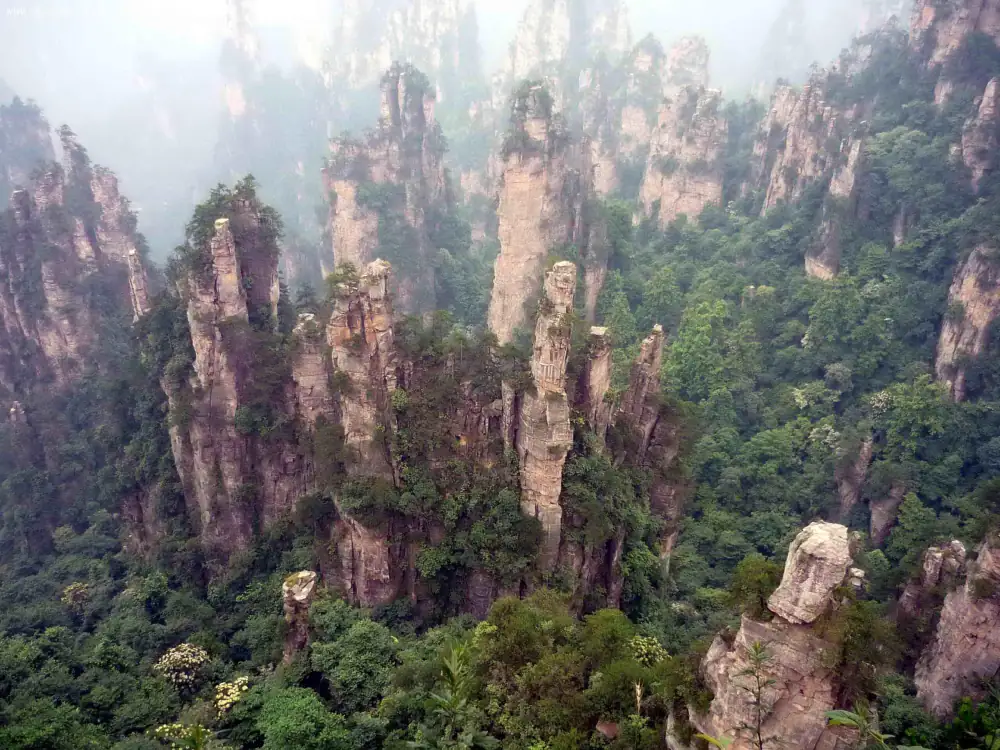
China’s five sacred mountains were fixed by imperial ritual, one for each direction, and Hengshan drew the south. It rises behind Nanyue (南岳), a temple town in the Hengyang district of Hunan, and its high point — Zhurong Peak (祝融峰), named for the god of fire — tops out just under 1,300 metres. That is modest against the northern peaks, and Hengshan’s reputation was never built on altitude.
It was built on two other things. The first is vegetation. Where the other four sacred mountains are rock and pine, Hengshan is dense subtropical forest almost to the top: broadleaf evergreens, bamboo in the gullies, camellias, and enough leaf litter that the paths smell of humus rather than dust. A Qing poet compared the five mountains to postures — one walking, one sitting, one standing, one lying down — and said only the southern peak seemed to fly. What he meant, standing among that greenery, is legible when you get there.
The second is longevity. Hengshan has been identified for centuries with the star that governs human lifespan, and the epithet stuck: the Longevity Mountain. Emperors carved the two characters into its rock. Today the theme is everywhere — in the name of a colossal bronze vessel on one of the outlying peaks, cast with ten thousand different renderings of the character for long life; in the shops selling longevity cakes; in the reason most Chinese visitors give for coming at all. People climb Hengshan to ask for something, usually on behalf of a parent.
Two Religions, One Ridge
The thing that will strike you first is not scenery but arrangement. At the foot of the mountain stands the Nanyue Grand Temple (南岳大庙), the largest palace-style complex in southern China, laid out on nine successive courtyards behind a gate and an old theatre stage. Its main hall imitates the throne hall of the Forbidden City, right down to the marble dragon set into the stairway, and it carries seventy-two stone pillars for the seventy-two peaks of the range.
What is unusual is what flanks it. Eight Taoist abbeys stand along one side of the temple axis; eight Buddhist monasteries stand along the other. Confucian elements sit in the middle. That arrangement is not an accident of building history — it is the local settlement, and it holds all the way up the mountain. Monks and Taoist priests have lived on the same slope here for well over a thousand years, and the mountain’s own list of local oddities begins with exactly that fact.
For visitors this means you never get a clean religious narrative. A Chan monastery of enormous historical importance sits twenty minutes’ walk from a Taoist terrace. Incense burns at both. Pilgrims bow at both, without evident difficulty. If you have any interest in how Chinese religion actually works on the ground rather than in textbooks, this is one of the most instructive mountains in the country — more so than the tidier pilgrimage sites. Our culture archive has more on the subject.
The Route Up the Front
The classic sequence starts in town and works upwards.
The Grand Temple deserves a slow hour before you climb. Go early; the incense haze in the first courtyards is thickest in the morning and the hall interiors are dark.
Zhonglie Shrine (忠烈祠), a few kilometres up the road, is the one stop nobody should skip and the one that most tour groups hurry. It is a memorial cemetery for Chinese soldiers killed fighting the Japanese, built into the hillside on a long axis of stone steps that climbs past an archway, a memorial tower and a hall to a terrace of tombs at the top. Granite, pines, silence. It is the only large-scale war cemetery of its kind on the mainland, and the atmosphere is entirely different from the temples — keep your voice down and put the camera away for a bit. Read more in our history coverage.
The halfway pavilion is the practical hinge of the mountain. Buses stop here, guesthouses cluster here, and the ancient pines around it lean uniformly southward from generations of north wind. From this point you can walk, take the cable car, or continue by road.
South Heaven Gate is the watershed. A stone archway straddles the ridge, with the sunny front slope behind you and the shaded back slope dropping away ahead. Four named peaks close in from four directions, and a long boat-shaped rock below the gate looks convincingly like a hull in cloud. Above here you walk.
Zhurong Peak is bare granite after the forest below — black rock, stacked boulders, a small stone temple on the summit weighted down against the wind. Two things to find while you are up there. One is the terrace where a narrow slab bridges the gap between two boulders; the drop is real and the crossing is short, and a good number of people decline it, which is how it acquired the name Trial-of-the-Heart Bridge. The other is the view down: on a clear morning the Xiang River shows as five distinct curves of light on the plain, which local usage reads as five dragons bowing to the peak.
The Quieter Way Down
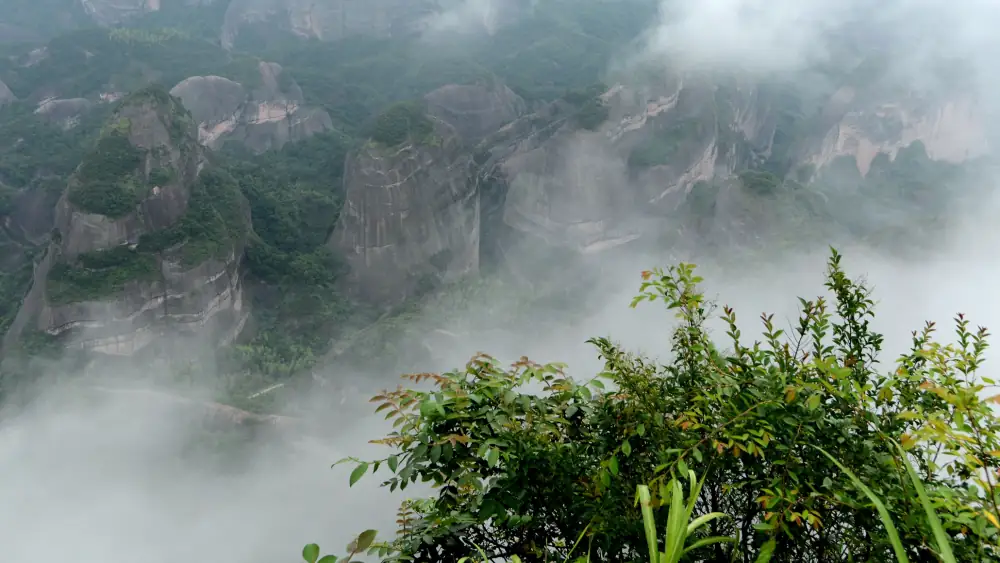
Most day visitors return the way they came. Do not. The back slope holds the mountain’s best walking and its most interesting buildings, and it is often nearly empty.
The sutra hall below the summit sits in a pocket of primary forest that has never been cleared — the genuine article, with rare broadleaf species, huge magnolias, and a tangle of undergrowth quite unlike the managed woodland lower down. Botanists come here specifically. The building itself is a modest single-eaved hall with red walls, and its restraint is the point.
The mirror-polishing terrace is one of the source sites of the southern school of Chan Buddhism, named for a teaching parable between two Tang monks. A master’s tomb pagoda stands behind it and an old stone staircase drops away down the slope. During the war against Japan the terrace complex was requisitioned as a training school for guerrilla officers, and senior figures on both sides of China’s own conflict held meetings here — a strange overlay on a Buddhist site, and one the interpretive panels handle with some care.
Below that, two monasteries in quick succession: one styled the source of the dharma in the whole realm, whose gate couplets tell you plainly how highly it rates itself; the other, further down, treated as an ancestral temple by a Japanese Zen lineage, with a story about a visiting abbot who arrived with a gift of sutras and left a permanent connection. A large nine-storey stupa stands on a nearby summit; you can climb to the eighth floor and look out over the farmland below.
The last stop before the road is the water-curtain cave — not really a cave but a waterfall, dropping in a single sheet from a rock lip into a pool, with centuries of carved inscriptions on the surrounding stone from four dynasties. In sunshine there is usually a rainbow in the spray. In dry months it is a trickle and honestly not worth the detour.
One more, for the determined: a temple deep in a fold of the hills where eight peaks close around a valley like petals. The saying is that you do not know the depth of Hengshan until you have been there. It involves a proper walk on a road with maples and firs, and in late autumn, when the maples turn, it is the best hour on the mountain.
Getting There and Around
Hengyang has no airport of its own. Most international travellers fly into Changsha and take a coach or train south; the journey is short and frequent.
By rail you have a choice, and here is the trap: there are two separate stations with confusingly similar names, one in Hengyang city and one much closer to the mountain. They are not the same place, and turning up at the wrong one costs an hour or more. Whichever you use, local buses connect the station forecourt with Nanyue town at the foot of the mountain, running through the day and stopping in the evening — plan to arrive in daylight.
Coaches also run from Changsha’s southern bus station and from Hengyang’s west bus station directly to Nanyue. Once you are in town, free and cheap shuttles circulate to the visitor centre and the mountain gate, and the scenic-area buses handle the climb. Walking the entire mountain from town to summit and back down the far side is a long, hard day; almost everyone rides part of it, and there is no shame in that. Our hiking archive covers similar staged ascents elsewhere.
Seasons on the Mountain
Hengshan is famously in cloud. For much of the year the upper slopes spend their days inside it, and the temperature drops noticeably in stages as you climb — locals divide the mountain into three separate skies for exactly this reason. Pack a layer more than the town temperature suggests.
Late summer and early autumn are the best window: cool air, foliage still full, reliable visibility on some mornings. Spring is wet and lush, with camellias and mountain flowers, and the paths can be slippery for days at a time. Winter, from about December to early February, brings the mountain’s speciality — rime ice coating every branch and railing in white, a genuine rarity at this latitude, which draws crowds of southern Chinese who have never otherwise seen frost. Overcast days, counter-intuitively, are often the best for atmosphere: mist among the temple roofs beats a hazy clear sky.
Time your visit against the religious calendar. The pilgrimage season runs through the later summer and autumn months, peaking on a single day when the crowds climbing to burn incense number in the tens of thousands. It is remarkable to witness and miserable to navigate. New Year’s Day brings a scramble for the first stick of incense of the year.
Sleeping and Eating
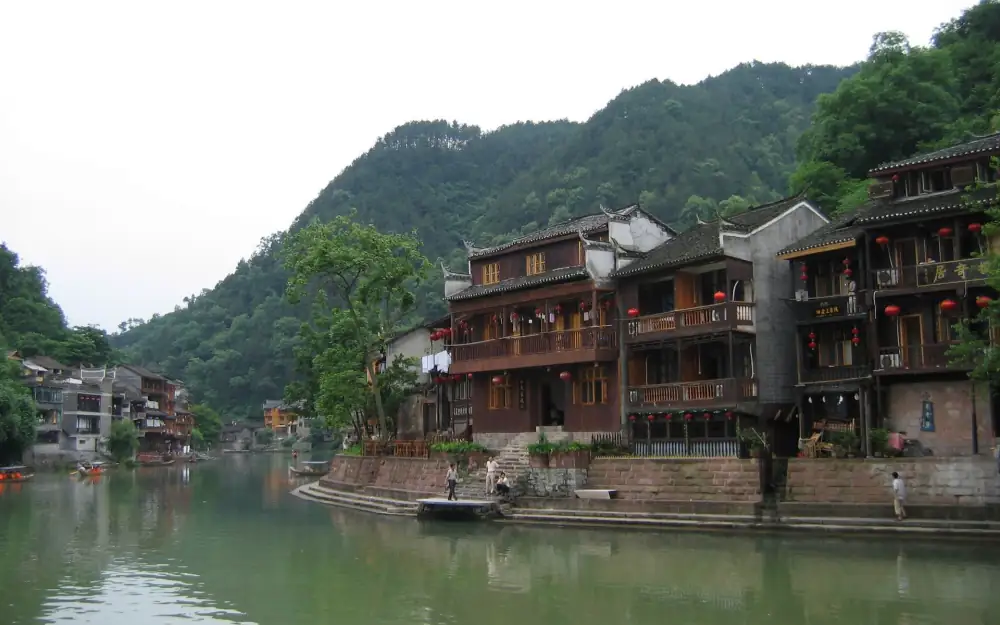
Nanyue town is the sensible base — walking distance to the Grand Temple, the bus station and most restaurants, with everything from hostels to comfortable business hotels. The halfway pavilion has a cluster of family guesthouses, useful if you want to split the climb. Near the summit, temple lodgings and small guesthouses put you within minutes of the sunrise viewpoint; expect cold rooms and very basic facilities in exchange. Hengyang city works if you are passing through and only want a half day on the mountain.
Because this is a Buddhist and Taoist centre, the local cooking tradition is vegetarian, and it has had a long time to get good. Tofu is the backbone: home-style braised, in clay pots, formed into balls, stuffed and deep-fried, stewed with mushrooms, pressed and smoked with five spices. Ask for a temple-style meal rather than ordering dish by dish.
Beyond the monastery kitchens you are in Hunan, and Hunan means chilli. Three things to look for. Fish-head steamed or stewed with tofu is the regional showpiece, rich and unsubtle. River snails stir-fried in tea oil with wine and spices are eaten by sucking the meat straight from the shell — messy, faintly absurd, excellent with beer. And the savoury rice balls sold as street food here are nothing like the sweet ones elsewhere: sliced rice paste rolled by hand, served in clear broth with spring onion and a heavy dose of white pepper.
For breakfast, find soft bean curd in the old town before mid-morning, made with spring water and served warm and barely set. Wild umbrella-shaped mushrooms appear in season and are worth ordering on sight. Local souvenirs run to longevity cakes, cloud-mist tea grown on the slopes, and a medicinal wine that is exactly the sort of thing you buy for a relative. More Hunanese cooking in our food guides.
Honest Advice
Skip the rafting and the various add-on attractions in the surrounding valleys unless you have a spare day. They are unrelated to what makes Hengshan interesting.
Expect to be offered incense repeatedly, at the gate, in the car park and outside the temples. A polite, firm refusal is enough, and you can buy inside the temples if you want to make an offering.
Sunrise is a lottery. Cloud wins more mornings than it loses. Stay two nights if it matters, or accept that mist among the summit rocks is its own reward.
Dress for a different mountain than the one you can see from town. The gap between the base and the peak is larger than the map’s contour lines suggest, and wind at the top is constant.
Go up the front, down the back. It is the single best structural decision you can make here, and most visitors get it wrong.