
China’s northwest is a land of extremes—where scorching deserts meet snow-capped peaks, and ancient Silk Road cities rise from the sand. This guide takes you beyond the familiar Gobi to three of the region’s most extraordinary destinations: the alien-like “Saturn Rings” of Mangya, the flower-carpeted Nalati Grassland in the Tianshan Mountains, and the timeless grottoes of Dunhuang. Whether you’re a photographer chasing otherworldly geology, a nature lover seeking high-altitude pastures, or a history buff tracing Buddhist art, this corner of China delivers an unforgettable journey.
Table of contents
Open Table of contents
Mangya: China’s Martian Landscape
Deep in the Qaidam Basin of Qinghai Province, the town of Mangya (茫崖, Máng Yá) feels like a portal to another planet. Here, wind and time have sculpted a series of surreal desert landforms that rival the American Southwest or even Mars.
The Saturn Rings
The most famous feature is the “Saturn Ring” (土星环, Tǔxīng Huán)—a series of concentric, elliptical ridges stretching for kilometers. Formed over millions of years, alternating soft and hard sedimentary layers were tilted by tectonic uplift, then eroded by relentless winds. The harder rock became raised rings, while softer rock eroded into grooves. You can see these rings on both sides of National Highway G315 near Old Mangya.
Black and Rouge Mountains
Just west of Mangya, two striking mountain ranges offer a stark color contrast. Heidu Mountain (黑独山, Hēi Dú Shān) appears pitch-black due to a “desert varnish” of oxidized iron and manganese on its surface. Nearby, Yanzhi Mountain (胭脂山, Yānzhī Shān) glows in shades of rouge and pink from its crystalline limestone and marble. Together, they create a dramatic palette that changes with the light.
Yardangs and Gravel Waves
Mangya is also home to some of China’s most spectacular yardangs—wind-carved ridges that look like a fleet of ships or ruined castles. The Cold Lake (冷湖, Lěng Hú) area is particularly impressive. Look out for “gravel waves” (砾浪, Lì Làng), where black pebbles have been sculpted into rippling patterns by constant gales.
Practical Tips for Mangya
- Best time to visit: May to October, when temperatures are milder (summer highs ~30°C, but very dry). Avoid winter when roads may be icy.
- Getting there: Fly to Dunhuang or Golmud, then drive 4–6 hours. Many travelers combine Mangya with a Gansu-Qinghai road trip.
- Getting around: A 4WD vehicle is recommended for off-road exploration. Mobile reception is patchy—download offline maps.
- Tickets: Most landforms are free to view from the roadside. No official ticket offices.
- Where to stay: Basic hotels in Mangya town or Huatugou (花土沟). Book ahead in peak season.
- What to bring: Sunscreen, hat, plenty of water, and a dust mask. Drones are allowed but check local regulations.
Nalati: The Sky Grassland
From the stark deserts of Qinghai, fly north to Xinjiang’s Ili Valley, where the Nalati Grassland (那拉提草原, Nàlātí Cǎoyuán) offers a complete contrast. At an elevation of around 1,800 meters, this alpine meadow is known as the “Sky Grassland”—a sea of green surrounded by snow-capped Tianshan peaks.
What to See and Do
- Summer flowers: From June to August, the meadows explode with wildflowers—yellow potentilla, blue gentians, and purple irises. The air is thick with the scent of grass and blossoms.
- Kuerdening Grand Canyon: Hike along the rim of this forested gorge for panoramic views of the grassland and distant glaciers.
- Kazakh culture: Stay in a yurt (毡房, zhānfáng) and try fermented mare’s milk (kumis). Local families offer horseback rides and evening singing.
- Photography: Sunrise and sunset cast golden light on the undulating hills. A telephoto lens captures sheep and yurts against the mountains.
Practical Tips for Nalati
- Best time to visit: June to September. July is peak flower season. August can be crowded.
- Getting there: Fly to Yining (Yining Airport, YIN), then drive 3 hours. Alternatively, take a high-speed train to Yining from Urumqi (about 5 hours), then hire a car.
- Getting around: The scenic area has shuttle buses. Horseback riding is available for ¥80–120 per hour.
- Tickets: Entry to Nalati Scenic Area is around ¥95 (adult). Shuttle bus is extra (~¥40). Book via WeChat mini-programs or at the gate.
- Where to stay: Yurt stays inside the park (basic, shared facilities) or hotels in Nalati town. Prices range from ¥200–600 per night.
- Altitude: 1,800–2,500 m. Most visitors feel fine, but take it easy on arrival.
Dunhuang: Where Desert Meets Devotion
No trip to northwest China is complete without Dunhuang (敦煌, Dūnhuáng), the ancient oasis that guarded the Silk Road. Surrounded by the Gobi Desert and the Kumtag Sand Sea, Dunhuang is both a natural wonder and a cultural treasure.
The Mogao Caves
The Mogao Caves (莫高窟, Mò Gāo Kū), a UNESCO World Heritage site, house the world’s largest and richest collection of Buddhist art. Over 1,000 years, monks and pilgrims carved 492 caves into the cliff face, filling them with murals and statues. The dry desert climate preserved these masterpieces in vivid color.
- Must-see caves: Cave 96 (the giant Buddha), Cave 148 (Nirvana Buddha), and Cave 257 (Nine-Colored Deer mural).
- Tickets: Reserve well in advance (at least 2 weeks) via the official website or WeChat. Standard tickets (¥238) include 8 caves and a guided tour. Emergency tickets (¥100) cover 4 caves but sell out fast.
- Etiquette: No photography inside caves. Follow the guide’s flashlight. Silence your phone.
Mingsha Mountain and Crescent Moon Spring
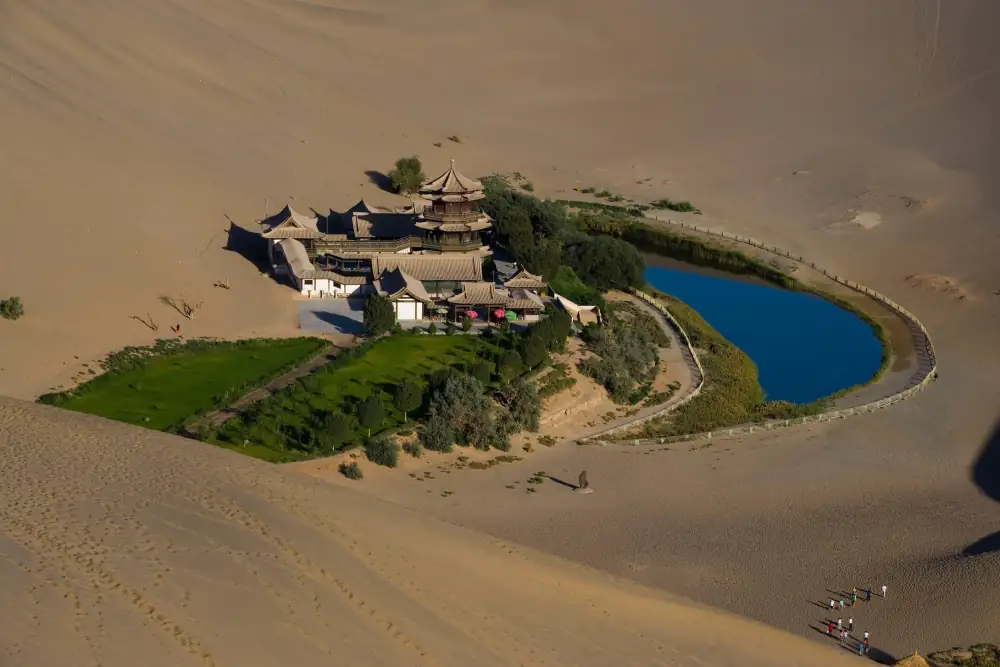
Just south of Dunhuang, Mingsha Mountain (鸣沙山, Míngshā Shān) is a dune field where sand “sings” when you slide down. At its foot lies Crescent Moon Spring (月牙泉, Yuèyá Quán), a crescent-shaped lake that has survived for millennia thanks to a delicate wind balance.
- Activities: Camel rides (~¥100), sandboarding, and hiking to the dune crest for sunset views.
- Best time: Early morning or late afternoon to avoid heat. Sunset is magical.
- Tickets: ¥110 (adult). Valid for 3 days.
The Great Wall and Yumen Pass
Dunhuang was the westernmost outpost of the Han Dynasty. Visit Yumen Pass (玉门关, Yùmén Guān) and Yang Pass (阳关, Yáng Guān) to imagine the caravans that once passed through. The surrounding Yardang National Geopark (Dunhuang Yardang) features wind-carved rock formations that resemble a ghost town.
Practical Tips for Dunhuang
- Best time to visit: April to October. May and September offer pleasant temperatures. July–August is hot (40°C) but manageable with early starts.
- Getting there: Fly to Dunhuang Airport (DNH) from Beijing, Xi’an, or Lanzhou. High-speed trains from Lanzhou take about 8 hours.
- Getting around: Taxis are cheap (¥10–20 within town). Rent a car for outlying sights.
- Where to stay: Hotels near Shazhou Night Market (e.g., Dunhuang Silk Road Hotel). Budget hostels also available.
- Food: Try Lanzhou beef noodles, apricot peel water (杏皮水, xìng pí shuǐ), and lamb skewers at the night market.
Suggested Itinerary: 10-Day Northwest Loop
This loop combines the best of Gansu and Qinghai, hitting Mangya, Dunhuang, and Nalati in a logical route.
| Day | Destination | Highlights |
|---|---|---|
| 1 | Arrive in Lanzhou | Explore the city, eat beef noodles |
| 2 | Lanzhou → Zhangye | Zhangye Danxia (rainbow mountains) |
| 3 | Zhangye → Jiayuguan | Jiayuguan Fort, Great Wall |
| 4 | Jiayuguan → Dunhuang | Mogao Caves, evening at Shazhou Market |
| 5 | Dunhuang | Mingsha Mountain, Crescent Moon Spring |
| 6 | Dunhuang → Mangya | Drive along G315, see Saturn Rings |
| 7 | Mangya → Golmud | Explore yardangs, Black Mountain |
| 8 | Golmud → Yining (fly) | Rest day, transfer |
| 9 | Yining → Nalati | Nalati Grassland, yurt stay |
| 10 | Nalati → Yining → Depart | Morning hike, fly out |
For more route ideas, browse our China itineraries.
Best Time to Visit
- April–May: Spring, mild temperatures, fewer crowds. Good for Dunhuang and Mangya.
- June–August: Peak season for Nalati (flowers) and Dunhuang (hot but lively). Book accommodation early.
- September–October: Golden autumn colors in Nalati; comfortable weather for desert exploration.
- November–March: Cold and dry. Some mountain roads may close. Not recommended for first-time visitors.
Practical Information for International Travelers
Visas
Most nationalities need a tourist visa (L visa) for mainland China. Apply at your nearest Chinese embassy or visa center. The 144-hour transit without a visa is available in some cities (e.g., Xi’an, Chengdu) but not for overland travel to Xinjiang. Check the latest rules before booking.
Money & Payments
- Mobile payment: Alipay and WeChat Pay are widely accepted. Link your international credit card (Visa/Mastercard) to Alipay before your trip.
- Cash: Always carry some RMB for small vendors and rural areas. ATMs are available in cities.
- Cards: Credit cards are accepted in hotels and large restaurants, but not everywhere.
Getting Around
- High-speed trains: Connect major cities like Lanzhou, Zhangye, and Jiayuguan. Book via Trip.com or 12306 (Chinese railway website).
- Flights: Domestic flights are efficient for long distances (e.g., Dunhuang to Yining).
- Car rental: Self-driving is possible but requires an International Driving Permit (IDP) and Chinese temporary license. Many travelers hire a private driver.
Health & Safety
- Altitude: Nalati (1,800 m) and Mangya (3,000 m). Stay hydrated, avoid alcohol on arrival.
- Sun protection: The sun is intense. Wear SPF 50+, a hat, and sunglasses.
- Water: Drink bottled or boiled water. Avoid tap water.
Food to Try
Northwest cuisine is hearty and lamb-heavy. Don’t miss:
- Lanzhou beef noodles (兰州牛肉面, Lánzhōu niúròu miàn) – clear broth, hand-pulled noodles.
- Yangrou paomo (羊肉泡馍, yángròu pàomó) – lamb soup with crumbled flatbread.
- Naan bread (馕, náng) – baked in a tandoor, perfect for the road.
- Apricot peel water (杏皮水, xìng pí shuǐ) – a sweet-sour drink from Dunhuang.
- Kumis (马奶子, mǎnǎizi) – fermented mare’s milk, an acquired taste.
For more culinary adventures, see our food guide.
Final Tips
- Pack layers: Desert days are hot, nights are cold. Mountain areas can be chilly even in summer.
- Learn a few Chinese phrases: “Hello” (你好, nǐ hǎo), “thank you” (谢谢, xièxiè), “how much?” (多少钱, duōshao qián).
- Respect local customs: In Xinjiang, avoid photographing people without permission. In Buddhist sites, dress modestly.
- Book ahead: Mogao Caves tickets and popular hotels sell out weeks in advance.
China’s northwest is a land of superlatives—the driest, the most colorful, the most surreal. Whether you’re standing on a Saturn ring in Mangya, breathing the crisp air of Nalati, or tracing a thousand-year-old mural in Dunhuang, you’ll understand why this region has captivated travelers for centuries. Start planning your journey today, and let the landscapes of the Silk Road rewrite your definition of beauty.
For more on the region’s history, explore our Silk Road culture and history articles.