
Quanzhou (泉州) is one of China’s most historically extraordinary cities and one of its least visited by international tourists — a combination that makes it genuinely special for travellers who value depth over convenience.
In the Song and Yuan dynasties (10th–14th centuries), Quanzhou was the largest port in the world. Merchants from the Arab world, Persia, India, East Africa, Southeast Asia, and Europe converged here. They left behind an astonishing physical legacy: a Qingjing Mosque built in 1009 that is still in active use, a Hindu temple with Dravidian-style stone carvings, Nestorian Christian grave markers, a Manichean temple (the only one surviving in China), and the architectural vocabulary of Minnan (Southern Fujian) culture that spread along trade routes to Southeast Asia.
The entire city was listed as a UNESCO World Heritage Site in 2021: “Quanzhou: Emporium of the World in Song-Yuan China.”
Getting There
Quanzhou has its own airport (Jinjiang Airport) with domestic connections. More commonly: Xiamen is 1 hour away by bus or HSR; Fuzhou is 2 hours north by HSR. Quanzhou fits naturally into an itinerary combining Xiamen (2 days) + Quanzhou (1–2 days) + Fuzhou or the Wuyi Mountains.
The Religious Heritage Circuit
Qingjing Mosque (清净寺)
Built in 1009 by Arab merchants — one of the oldest mosques in China, modelled on the Umayyad Mosque in Damascus. The main prayer hall is partially ruined (the roof collapsed in the 14th century), creating an unusual open-air courtyard surrounded by Arabic calligraphic inscriptions. Still in active use for Friday prayers.
Kaiyuan Temple (开元寺)
Founded in 686 AD, the most significant Buddhist temple in Fujian. Two 40-metre Song dynasty pagodas (East and West Towers, constructed 1228–1250) flank the main hall and are among the finest examples of stone pagoda architecture in China. The main Mahavira Hall retains original Song dynasty architecture.
Mazu Temple and Tianhou Palace (天后宫)
Mazu, the sea goddess, is the most widely worshipped deity in Fujian and coastal Southeast Asia. Quanzhou’s Tianhou Palace is one of the oldest and most significant Mazu temples in China. The temple was the departure point for sea voyages and is still an important pilgrimage destination.
Stone Carving Museum (泉州石雕博物馆)
The stone museum displays Hindu, Nestorian Christian, Islamic, and Chinese religious sculpture recovered from Quanzhou’s multicultural medieval layers — stone figures of Vishnu, Shiva, and Nandi stand alongside Nestorian cross fragments and Chinese Buddhist carvings from the same centuries. One of the most unusual museum collections in East Asia.
West Street (西街)
Quanzhou’s main historic commercial street — running from Kaiyuan Temple eastward through the old city. The street preserves Minnan-style Qilou (arcaded shophouse) architecture and some of the city’s oldest family businesses.
Eat on West Street: Oyster vermicelli (蚵仔煎, a Minnan staple shared with Taiwan), peanut soup (花生汤), mochi rice cakes, and soy milk tofu (豆花). Quanzhou street food reflects its multicultural past — Arab influence in the spiced meat buns, Minnan tradition in the seafood-based snacks.
Chongwu Ancient City and Huishan Stone Carving Village
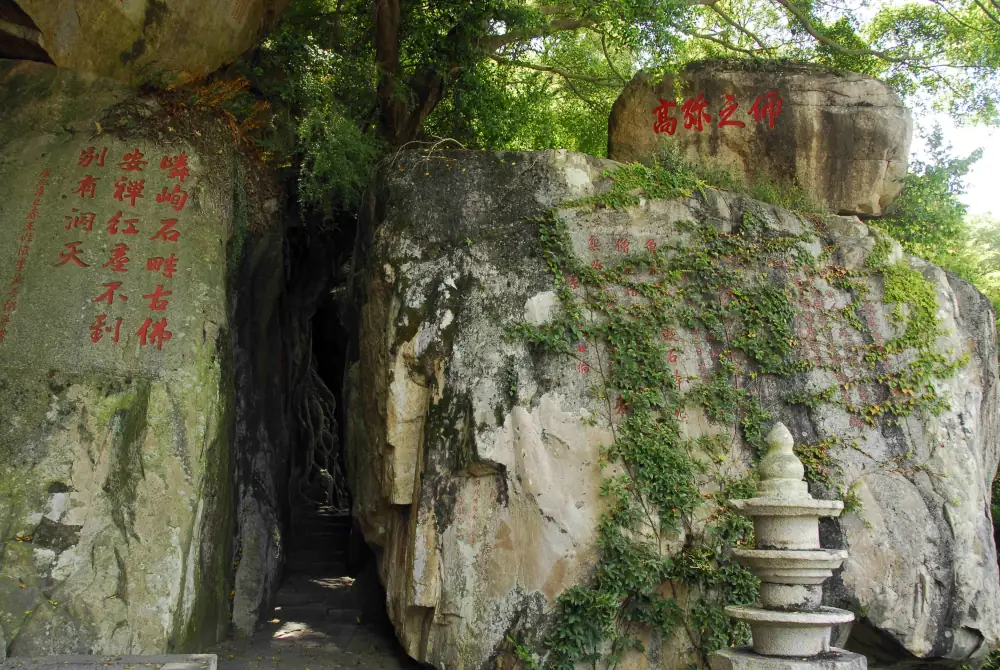
Chongwu (崇武) — 30km from Quanzhou — is a remarkably complete Ming dynasty stone city wall, still intact around a fishing village. The wall circuit (4km) is walkable.
Huishan village nearby is the centre of China’s stone carving industry — 3,000 craftspeople and 1,000+ workshops producing everything from garden ornaments to cemetery sculpture. The stone carving culture has been here for 1,000 years.
Practical Notes
Language: Minnan dialect (Hokkien/Taiwanese) is the local language. Mandarin is universally understood. Many older residents speak a variety of Minnan with strong Southeast Asian influence (reflecting Quanzhou’s overseas Chinese community connections to Malaysia, Singapore, Philippines, and Indonesia).
Best time: October–April (mild weather, dry). Summer is hot and occasionally affected by typhoons.
Combine with: Xiamen (Gulangyu Island) 1 hour by HSR, Fujian Tulou earthen buildings 2 hours by bus, Fuzhou 2 hours by HSR.
Also see: Fujian Xiamen Tulou Tea Guide | Gulangyu Island Guide | Fujian Tulou Hakka Guide