
Fujian Province faces Taiwan across the Taiwan Strait — a seafaring culture that sent emigrants across Southeast Asia and the world, creating the large overseas Chinese communities of Singapore, Malaysia, Philippines, and beyond. The province combines maritime heritage, extraordinary ethnic Hakka architecture, and the most prestigious tea terroir on Earth.
Table of contents
Open Table of contents
Xiamen (厦门) and Gulangyu Island
Xiamen is one of China’s most liveable and visually appealing cities — a subtropical coastal city with excellent seafood, walkable waterfront districts, and the extraordinary pedestrian island of Gulangyu.
Gulangyu Island (鼓浪屿) — UNESCO World Heritage
A car-free island of 1.88 km² accessible by ferry from Xiamen — Gulangyu was carved into nine foreign concessions in the 19th and early 20th centuries. The architecture is extraordinary: Italian Baroque, Spanish Colonial, British Victorian, and Chinese Minnan-style buildings crowded on narrow lanes above the sea.
Historical Nickname: The “Island of Pianos” — at its peak, Gulangyu had more pianos per capita than anywhere in China. The tradition of music education began with missionary schools and was adopted enthusiastically by local families. The Gulangyu Piano Museum houses 100+ antique pianos.
Best time: Early morning (before 9am) or evening (after 6pm) when day-trippers have left; the island is much more atmospheric with fewer crowds.
Key sites:
- Sunlight Rock (日光岩) — the highest point; panoramic views of the island, Xiamen, and on clear days, the Taiwanese island of Kinmen just 5km away
- Shuzhuang Garden (菽庄花园) — a 1913 private garden of extraordinary design; a bridge connects a classical garden to a coastal embankment
Entry: Ferry ¥35 (round trip from Xiamen); island entry free; inner scenic area ¥60.
Xiamen’s Zengcuoan Village (曾厝垵)
A gentrified fishing village that became Xiamen’s most vibrant and eclectic neighbourhood — independent cafes, hostels, galleries, and street food in a maze of alleyways between old stone fishing houses and new colourful murals.
Xiamen Food
Oyster omelette (海蛎煎) — a Minnan speciality; sweet potato starch-thickened omelette with fresh oysters, scallions, and chilli sauce. The definitive Xiamen street food.
Shacha sauce (沙茶) — a peanut-based sauce resembling satay; unique to Fujian. Used in noodles, hot pots, and dipping sauces.
Hakka Tulou (福建土楼)
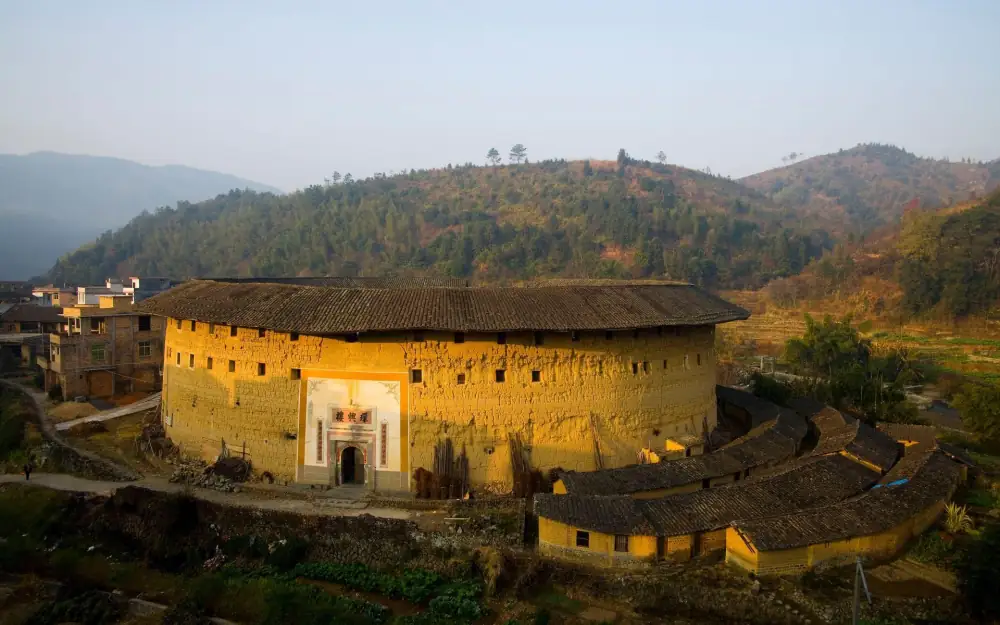
The extraordinary circular and square earthen fortress villages of the Hakka people (客家人) — a Han Chinese ethnic group that migrated from Central China southward over 1,000 years and built these remarkable communal fortresses for defence and community living.
UNESCO World Heritage status: 46 specific tulou designated in 2008.
What is a Tulou?
A multi-story circular or square earthen building housing an entire clan community — sometimes 200–800 people — in a single fortress structure. The outer walls are 3–5 storeys high, without windows on the lower floors (for defence). The interior courtyard contains a shared well, grain store, ancestral hall, and communal spaces. Each family has a floor section — ground floor kitchen, upper floors bedrooms.
Key Tulou Clusters
Tianluokeng cluster (田螺坑土楼群) — the most photographed; four circular and one square tulou arranged on a hillside, nicknamed “four dishes and one soup (四菜一汤)” for the arrangement. Best viewed from the hillside above at sunset.
Hongkeng cluster (洪坑土楼群) — includes the Zhencheng Lou (振成楼), the “Prince of Tulou” — a grand circular fortress with Art Deco interior design, built in 1912 by an overseas merchant. Entry ¥60 for the cluster.
Taxia Village (塔下村) — a Zhang family village in a steep river valley; stone ancestral halls, water mills, and family tulou along the stream. Quieter and more village-like than the main tourist clusters.
Nanjing Tulou Scenic Area
The main tourist hub for tulou visits — 2 hours by bus from Xiamen. Guided tours can be organised from Xiamen hotels.
Wuyi Mountain (武夷山) — Tea and UNESCO Scenery

UNESCO World Heritage (Nature and Culture)
Wuyi Mountain is double-listed — as a natural heritage site for its biodiversity (3,100+ plant species; rare animals including Wuyi mountain skins), and as a cultural site for its Neolithic remains and ancient Han Dynasty sites.
Jiuqu Stream (九曲溪) Bamboo Raft Ride
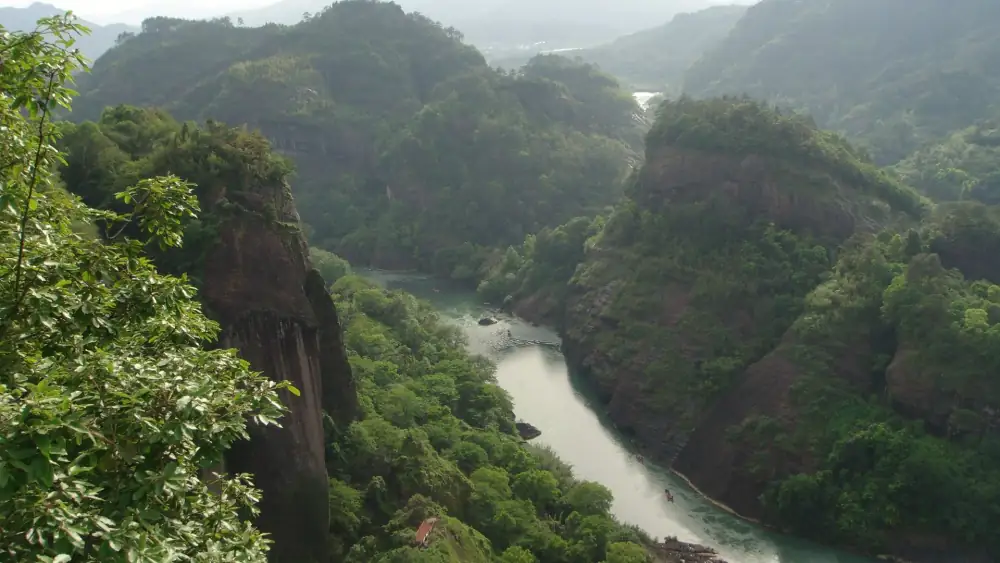
The most famous experience at Wuyi — a 9km bamboo raft ride down the Jiuqu (Nine-Bend) Stream through towering volcanic rock cliffs, passing Han Dynasty cliffside burial boats (hanging coffins) and Taoist temples built into rock faces. 2–2.5 hours. ¥210.
Rock Oolong Tea (岩茶)
Wuyi Rock Oolong is the world’s most prestigious oolong tea category — the “four famous bushes” (四大名丛) grow in specific cliff clefts where volcanic mineral-rich soil and moist cliff microclimate create an irreproducible “rock charm” (岩韵) flavour.
Da Hong Pao (大红袍) is the most famous variety — the six original plants are still living on a cliff face (photographed but not harvested; all Da Hong Pao sold commercially is from cuttings). Museum exhibition at the base of the original plants. Tasting sessions ¥50–¥200.
Practical Info
Xiamen Gaoqi International Airport — well-connected with all major Chinese cities; also regional Southeast Asian routes.
High-speed trains: Shanghai to Xiamen (3.5–4 hours); Beijing to Xiamen (8 hours). Xiamen to Wuyi Mountain (2 hours by high-speed from Xiamen North Station).