
The oarsman stops rowing where the channel narrows to the width of the boat, and for a moment there is nothing at all: no engine, no traffic, no city. Reeds close over both gunwales. A moorhen crosses ahead. Then he leans on the sweep again and the boat slides on between fish ponds that have been dug, banked and re-dug for the better part of a thousand years. Xixi Wetland (西溪湿地) sits a few kilometres from West Lake, on the western edge of a city of ten million, and it does not feel remotely like it.
Table of contents
Open Table of contents
What Xixi Is, and What It Is Not
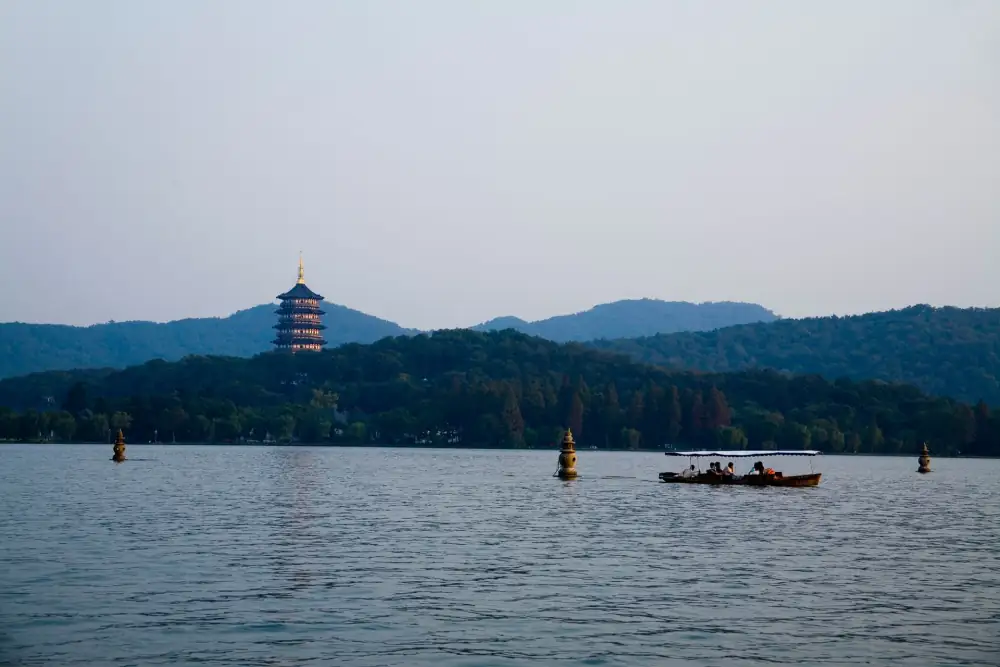
The old name for this ground was Hezhu — river islets — which describes it better than “wetland park” does. Xixi is not wilderness and never was. It is roughly ten square kilometres of engineered water: a dense mesh of channels, embankments, fish ponds, mulberry banks and small islands, worked for centuries for fish, silkworms, bamboo shoots, plums, persimmons and tea. What survives is a secondary wetland inside a metropolitan boundary, which is genuinely unusual, and the reason it carries formal protection.
The park is managed in three broad bands. The eastern section is given over to conservation and breeding and is largely closed to visitors. The middle section is where you go — the boat routes, the villas, the old street, the walking loops. The western band is a landscape zone with lighter access. Do not expect a hard boundary between them on the ground; expect signage, boardwalks and a lot of water.
One more thing to understand before you arrive: Xixi’s fame in China rests partly on a film. A Feng Xiaogang romantic comedy shot here in the late 2000s produced a line — roughly, Xixi, stay a while — that became the park’s unofficial motto and sent domestic visitor numbers through the roof. That popularity is why the gates get busy and why the boats queue. It has nothing to do with why the place is good.
Water: The Boats and the Channels
The rowed boats are the thing. Hand-poled and hand-swept wooden craft work the inner channels, and they go where nothing else can — under low bridges, down cuts barely wider than the hull, into reed beds that close behind you. The boatmen have been doing this for years and will point out, with some pride, which particular boat carried which particular actor.
Electric launches cover the longer routes between the main landings. They are faster, quieter than you expect, and much less atmospheric. If you have to choose, take the rowed boat.
A useful sequence: board at one of the main landings, work inward through the villa cluster, and get off partway to walk. Do not try to complete a circuit by water. Xixi rewards the interruption — you want time on the banks as well as on the channels.
Duck Bay is on most boat routes, a crooked inlet where waterfowl gather in numbers because the feeding is good. Whether the name comes from the shape of the channel or the ducks themselves depends on who you ask, and neither explanation makes the place less pleasant.
The deep pool in the northern part of the park is a broad basin with steep banks and no land approach, guarded by three enormous camphor trees. Every year at the Dragon Boat festival this becomes the stage for a local gathering that is not a speed race at all — the boats are heavily decorated and the competition is in handling and display. If your dates coincide, rearrange them to be here.
The Island of Autumn Snow
Somewhere near the centre of the park, on a small island in the core water area, stands a hermitage founded under the Song and rebuilt several times since. Its name translates as the Hermitage of Autumn Snow, and the snow in question is reeds.
In late autumn and through winter the reed beds around the island go over: plumes turn silver-white, the leaves bleach, and the whole surrounding water is fringed in something that from a distance looks exactly like drifted snow. Viewing the Xixi reeds was formally listed among the scenes of the West Lake region in Qing times, and this island is where it was done from. It is reachable only by small oar boat, which keeps the numbers down.
The buildings are modest — two courtyards, one Buddhist, one given over to poets associated with the place, a stone path to the water. Ducks come out of the reeds in groups as the boat approaches, cross the channel with visible irritation, and vanish into the next stand. Go here if you go nowhere else.
Villas, Libraries and a Very Flat Bridge
Xixi drew literati for the same reasons it drew fish farmers: it was quiet, cheap, wet and close to the city. Several of their retreats have been rebuilt and opened, and they are pleasant rather than spectacular. Visit two, not seven.
The best is a late-Ming scholar’s thatched retreat arranged around a fish pond, with the main hall on the south side, a study behind it, and a small grass pavilion across a bridge on the north bank. Its character — deliberately plain, deliberately remote — captures the four adjectives that Chinese writing on Xixi keeps returning to: cold, wild, plain, elegant. That is the aesthetic the whole park is trying to hold on to, and it explains why nothing here is grand.
A Qing official’s villa on the eastern side has a more entertaining story attached, involving a struggling calligrapher whose brushwork on a temple plaque caught the Kangxi emperor’s eye, a subsequent very rapid career, and an imperial visit by boat during which the emperor wrote two characters and dashed off a poem about bamboo windows and old plum banks. The villa is now one of the park’s main gates and a restaurant precinct.
Elsewhere, a lakeside reading pavilion with two book towers stands in for the local tradition of collecting and hiding books, and a plum-and-bamboo retreat, named for the two plants as emblems of integrity, sits near the plum walks. Those walks matter in February.
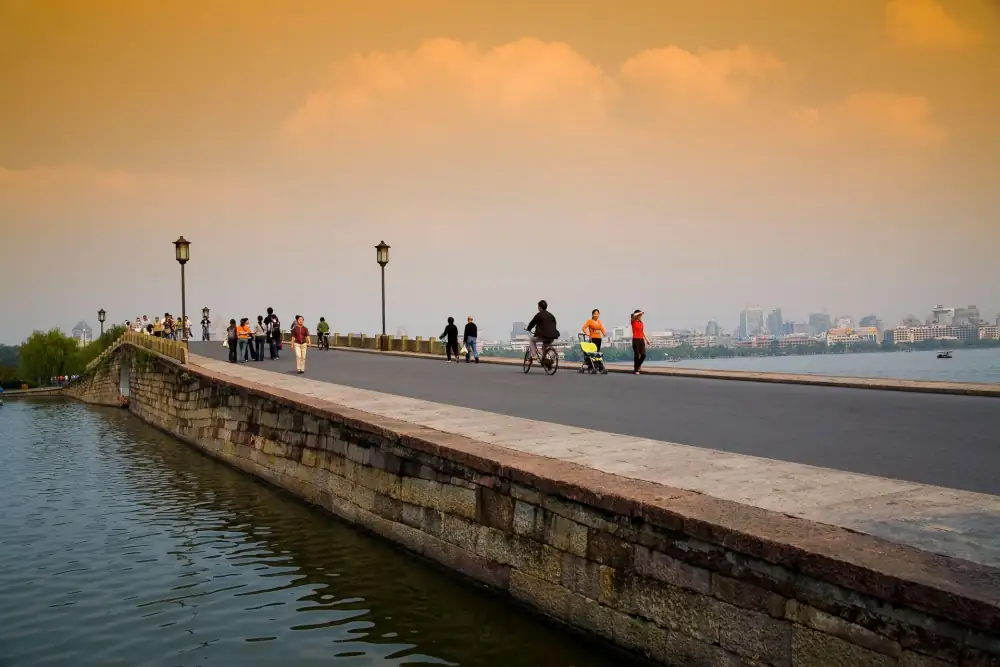
Then there are the bridges, and they are more interesting than they look. Xixi has hundreds, and the characteristic type is a low three-span slab of stone with a flat deck and no railings at all. The absence is the design: a flat, unobstructed deck let farmers cross with shoulder poles and full baskets without catching anything on a parapet. Many older named bridges have gone entirely, surviving only in local records. The plain ones that remain are the honest architecture of this landscape.
Birds, Reeds and the Botanical Side
The largest natural reserve inside the park is closed to general access, but a viewing platform on its edge overlooks the reed and pond mosaic where the birds actually are. Egrets and herons work the shallows; ducks raft on open water; in migration seasons the numbers rise sharply. Bring binoculars — the park’s own hides are functional but distant.
A wetland botanical garden occupies a large open section with several hundred plant species, aquatic and marginal, and it is the right place to sit down. Nobody hurries here, the banks are wide, and it is one of the few parts of Xixi with genuine long sightlines across water.
There is also a recreated farmstead showing the tools and rooms of Xixi’s working households before the park existed: fish traps, silk reeling equipment, mulberry baskets, kitchen gear. It sounds dutiful and is quietly excellent, mostly because everything in it explains something you have already seen outside. Our culture archive goes further into these rural trades.
Hezhu Street
The old street near the northern part of the park is the commercial heart of a visit: teahouses, workshops, snack stalls, a pagoda and a small square where folk performances run through the day — lion dance, dragon dance, and a local stick-fighting form once practised by boatmen.
Two crafts here are worth your attention. The first is a tradition of tiny woven baskets, made in a dozen forms and now protected as intangible heritage, with very few practitioners left. The second is maltose, pulled by hand on a hook until it goes pale and stiff; buying a piece and stretching it between two people is a small and slightly ridiculous pleasure that most visitors enjoy more than they expect to.
Sit down for tea while you are here. Xixi grew its own leaf long before it was a park, and it is served in plain white bowls rather than glasses — thick, sweet-edged, and not remotely like the Longjing everyone comes to Hangzhou for.
Getting There and Getting Around
Xixi has several gates, spread widely around the perimeter, and choosing the wrong one adds a long walk or a taxi ride. Decide your route first, then pick the gate that starts it — the main boat landings are not at every entrance.
The metro reaches the park’s eastern side, which is the simplest approach from central Hangzhou. City buses serve most gates. Taxis and ride-hailing from the West Lake district take well under half an hour when traffic behaves. Hangzhou’s public bicycle scheme has docking points across the city, and cycling out is entirely feasible if you know the route; note that the city runs licence-plate restrictions on driving, which occasionally catch out visitors with hire cars.
Inside, the choice is boat, foot, or both. There are no shuttle roads through the middle. Distances are longer than the map suggests because water forces detours, so allow more walking time than the printed figures.
If you are building a longer Hangzhou itinerary, Xixi pairs naturally with a West Lake day rather than competing with it; see our east China itineraries for how the pieces fit.
Seasons
Autumn is the best of it, and by some distance. Osmanthus scents the whole city in September and October, persimmons turn hard orange on bare branches, and the reeds go white. Come in the second half of autumn if you can choose.
Late winter is for plum blossom, which has a long history here and is concentrated along particular walks. Cold, damp, grey and nearly empty — an acquired taste, and a real one.
Spring brings green everything, a flower festival in the early part of the season, and the heaviest domestic crowds after autumn. Rain is frequent and improves the light on water.
Summer is hot and humid in the way that Hangzhou is famous for. Lotus and water chestnut are in, the vegetation is at maximum, and the sensible plan is to be on the water by early morning and out by lunchtime. Mosquitoes are a genuine consideration; bring repellent.
Eating and Sleeping
Do not stay inside the park. Xixi is close enough to central Hangzhou that there is no advantage in it, and the city gives you better food, better transport and West Lake on your doorstep. Base yourself near the lake or in the western business district and treat Xixi as an excursion.
For eating, the park restaurants occupy the restored villas, and their appeal is location rather than cooking — you are paying for a view over a fish pond, which on a still afternoon is a fair trade. The menus are Hangzhou-style with a wetland accent: freshwater fish and river shrimp, lotus root, bamboo shoots, greens, water plants you will not have met before.
Three local products are worth seeking out. Green plums grow here in quantity and turn up preserved and in drinks. Dried fish cured with wine is the strongest-flavoured thing on the local table. And the sweet fermented rice mash sold in jars — barely alcoholic, eaten grains and all, cooked with egg or sugar — is a Zhejiang staple and a good souvenir. More regional cooking in our food guides.
Snack as you go on Hezhu Street rather than committing to a long lunch. It suits the pace of the place better.
Honest Advice
Ignore the attraction list. Xixi publishes a long inventory of named sites, most of them small restored buildings, and the villas do blur. Pick the island hermitage, one villa, the old street and a stretch of open water, and let the rest go.
Go early, and go on a weekday. The boats queue badly by mid-morning at busy times of year, and the whole experience depends on quiet. National holiday weeks are best avoided entirely.
Pick up the free map at the gate and decline the people offering to guide you outside it. The park is easy to navigate once you have the sheet in hand.
Do not underestimate the water. Boardwalks run past genuine marsh, and the edges are not all fenced. Keep children in hand.
Skip the wedding-boat and fishing add-ons unless you have children to entertain or a full day to fill. The rowed boat and a long walk are the two things that make Xixi worth the trip; everything else is optional decoration.