
At six in the morning the pond at the centre of Hongcun (宏村) is a flat black mirror, and the whitewashed gable walls above it appear twice — once in stone and once in water, upside down and slightly trembling. A woman comes down the steps to rinse vegetables. Somewhere behind the lanes a door scrapes open. Then, at about half past nine, the first coach party arrives, and the village becomes a different place entirely. Understanding those two versions, and arranging to see the first one, is the whole art of visiting here.
Table of contents
Open Table of contents
What Hongcun is
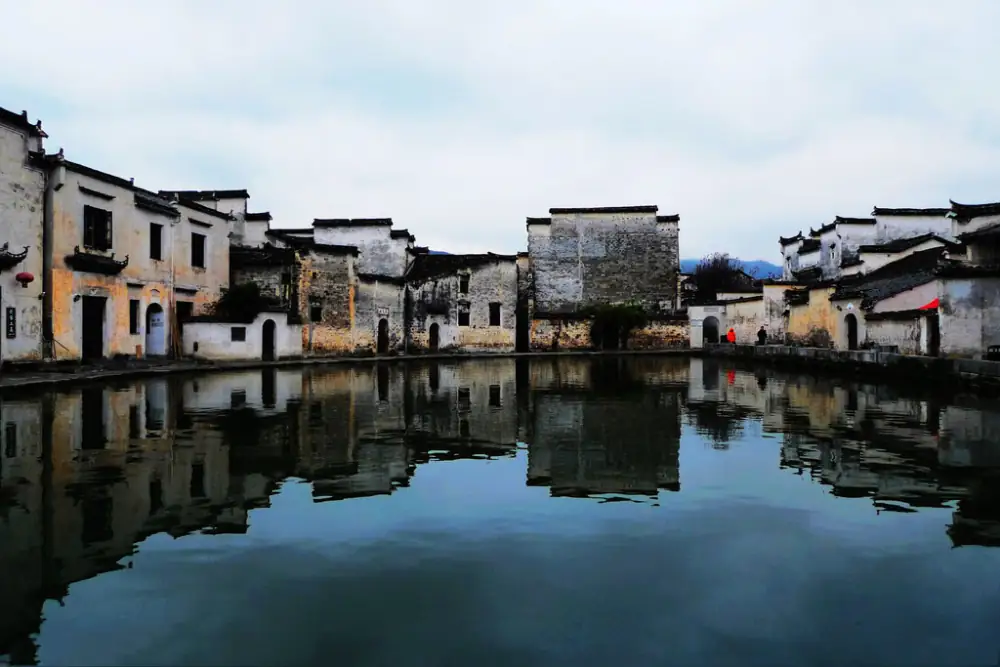
Hongcun sits in the north-east of Yi county (黟县) in southern Anhui, in a basin of hills at the foot of the Huangshan range. It was founded in the Northern Song and settled by a single clan, the Wang, whose descendants still live here, and something over a century’s worth of building through the Ming and Qing periods left more than a hundred and forty houses standing largely intact. Together with the neighbouring village of Xidi, it carries World Heritage status.
Two things make it exceptional rather than merely old.
The first is the architecture. This is the heartland of the Huizhou style: whitewashed walls, dark grey tiles, and the stepped “horse-head” gables that rise above the roofline in a series of blocks, originally as firebreaks between tightly packed houses. From outside the buildings are austere, almost blank, with high walls and small doors. Inside they open into narrow courtyards under a slot of sky, and everything that the exterior denies itself — brick carving over the doorframes, stone reliefs, and woodwork of extraordinary density on beams, brackets and window screens — is lavished on the interior. The style was paid for by the Huizhou merchants who dominated salt, timber and pawnbroking across the lower Yangtze, and it reflects exactly that combination of enormous wealth and Confucian discretion.
The second is the water. In the Southern Song the villagers built an engineered water system, drawing a stream from the hills into a channel that runs the length of every lane, passes the doorstep of every house, feeds a crescent pond at the village’s heart and finally spills into a large lake at the southern edge before irrigating the fields. It provided drinking and washing water, fire suppression, cooling and irrigation, and it still does most of that. The channel is knee-deep, clear, and edged in stone, and it makes the village audible as well as visible — you hear running water everywhere.
The ox
The layout follows the shape of an ox, deliberately. The wooded hill behind the village is the head; two ancient trees, a ginkgo and a red poplar, both around five centuries old, are the horns; the water channel winding through the lanes is the intestine; the crescent pond is the stomach; the lake at the south is the belly; the houses along the channel form the body; and four bridges over the encircling stream are the legs. Whether you find this charming or contrived, it is genuinely legible on the ground, and it explains why the village feels coherent rather than accidental.
What to see, in order
The natural route runs from south to north, which is how the coaches do it. Consider walking it in reverse, or at a different hour.
South Lake (南湖). The image everyone knows: a broad sheet of water with a causeway and arched bridge across it, and the village’s gable walls reflected in a single unbroken row. Modelled loosely on the causeways of West Lake, it changes completely with the hour and the season — mist at dawn, lotus and reflections in summer, lanterns doubled in the water on still evenings. This is where the art students set up their easels, in rows, from March onwards.
South Lake Academy (南湖書院). Six small private schools along the north bank were merged in the early nineteenth century into one large academy, and the result is a serious complex: a lecture hall, a shrine to Confucius, a reading room for the classics, a lake-view pavilion where the teachers rested, and an inner garden. It says something about this village that its most expensively built public institution was a school.
Moon Pond (月沼). A half-moon of water in the middle of the village, ringed by stone paving and by some of the finest houses in Hongcun. It is deliberately semicircular rather than round — a full moon must wane, and a flower in bloom must fade, so the design stops short of completion. Whatever the philosophy, the effect is that the buildings on the far side reflect perfectly. Come at first light, and again at dusk. On the north side stands the Wang ancestral hall, built in the early fifteenth century, its beams, brackets and struts carved to a standard that repays close attention.
Chengzhi Hall (承志堂). The single most impressive house, built in the 1850s for a salt merchant, and effectively a self-contained compound: nine light wells, sixty-odd rooms, more than a hundred wooden columns, inner and outer courtyards, front and rear halls, a study, a fish-pond hall, stables, servants’ quarters, guards’ rooms, a pavilion for mahjong and a room for opium. The front hall is the point. Above the central door, a gilded wood carving depicts a hundred boys at the lantern festival — dragon dancers, boat mimes, individually characterised faces — and around it are scenes from historical romance, god-of-wealth figures, and four columns representing the fisherman, woodcutter, farmer and scholar. Give it twenty minutes rather than three.
The other halls. Dexi Hall is a courtyard house with a pond fed by a hidden culvert from the main channel, sixteen lotus-carved folding doors, two gardens and a kiwi vine over the east wall — the best surviving example of a private Huizhou garden here. Shuren Hall was built on a hexagonal plan for good fortune. Jingxiu Hall and Jingde Hall are more typical of an ordinary prosperous family, which makes them useful correctives after the merchant palace.
Leigang hill (雷岗山). Five minutes’ walk uphill from the back lanes, wooded with trees two and three hundred years old, with a clearing that gives the classic elevated view over the whole village — tile roofs, gable ends, the lake beyond. Almost nobody bothers. Go at sunset.
Xidi and the villages beyond
Xidi (西递) lies a short bus ride away and is the necessary companion to Hongcun. Where Hongcun is about water, Xidi is about street and stone: a long spine of lane with a famous ornamental archway at its entrance, houses set behind deep sequential courtyards, and carved doorframes and lattice windows in unusual concentration. It is quieter than Hongcun and, for many visitors, the more architecturally satisfying of the two. See both if you can; if you cannot, choose Hongcun for the setting and Xidi for the buildings.
Tachuan (塔川), a couple of kilometres from Hongcun, is a hamlet stacked on a slope with terraced fields below. It is celebrated for autumn colour — in November the trees around the houses turn every shade from yellow to deep red — and in spring the same slopes are yellow with rape blossom, seen from above with grey roofs in the middle distance.
Mukeng bamboo forest (木坑竹海), a little further on, is a valley entirely filled with tall bamboo, with paths through leaf litter that rustles as you walk and a good chance of cloud sitting in the valley in the early morning. It has appeared in at least one very famous film. Avoid late spring, when the bamboo changes its leaves and looks patchy.
Further afield, towards Shexian, are two things worth a day: a cluster of memorial archways standing in open fields, raised over several dynasties to honour one family’s officials and widows, and an old weir on the river below a stone-built merchant quarter, where flat-bottomed boats still work the water. Both explain how the Huizhou trading economy actually functioned.
Seasons
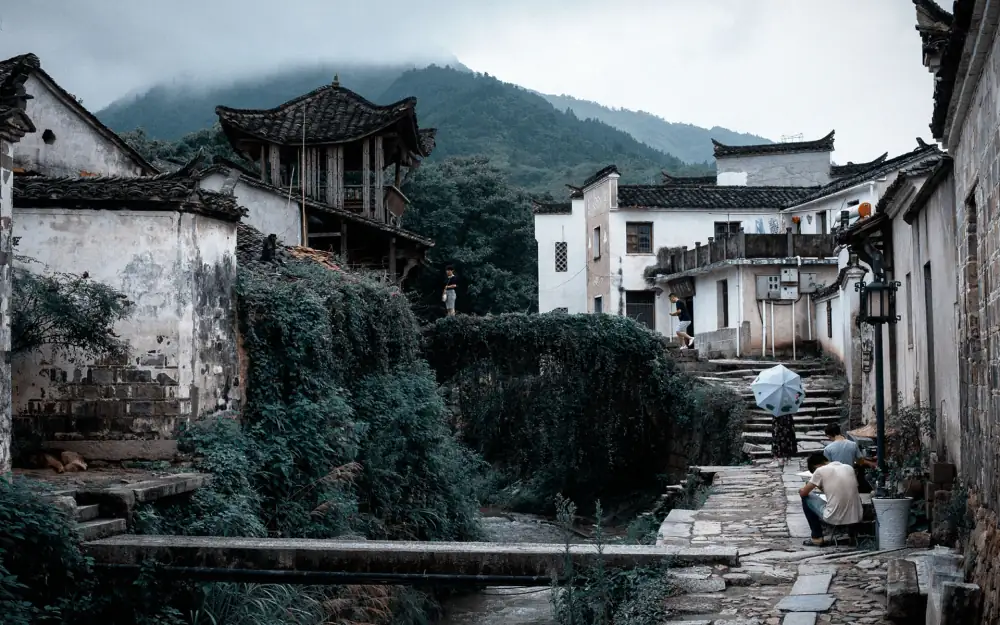
The climate here is humid subtropical, with long summers and winters and short springs and autumns. Nothing is extreme: the hottest month averages in the high twenties, the coldest a few degrees above freezing.
Spring is the headline season. From late March into April the rape flowers open across the valley floor and the terraces at Tachuan, peach and willow come out along the lake, and the reflections are at their best. It is also when the art schools descend and when a large amateur mountain-bike race is held in the county. Expect company.
Autumn, particularly November, brings the red leaves at Tachuan, clear light, cool mornings and the county’s annual photography festival. Arguably the best all-round time to come.
Summer is hot, humid and green, with lotus on the ponds and afternoon downpours. The water system keeps the lanes noticeably cooler than the open fields, which was part of the point.
Winter is quiet and underrated. Snow falls occasionally and settles on the grey tiles, which is the version of this village that painters have always wanted; on a still, cold morning with a little mist you may have Moon Pond entirely to yourself. Bring warm layers, as old houses are heated lightly if at all.
Getting there and around
There is no railway station or airport in Yi county. The gateway is Huangshan City, which everyone locally calls Tunxi — and which is emphatically not the same place as the Huangshan mountain scenic area, a confusion that catches out a great many visitors.
- By rail. High-speed trains from Hangzhou, Shanghai, Nanjing and Hefei reach Huangshan, from where tourist coaches and taxis run out to Hongcun in roughly an hour, some of them calling at Xidi on the way.
- By air. Huangshan’s airport has domestic connections; continue by road.
- From the mountain. If you are coming down off Huangshan itself, buses run to Hongcun from the gate towns at the foot of the mountain.
- From Hefei. Coaches make the trip in most of a day, which is worth knowing if you are approaching from the north or west.
- Locally. Buses shuttle between the county town, Xidi and Hongcun through the day, and the village to Tachuan or the bamboo forest is a very short taxi ride. Within Hongcun everything is on foot; the lanes are too narrow for anything else.
Where to stay and what to eat
Sleep inside the village. This is the most important practical decision of the trip. A large number of the old houses now take guests — carved wooden beds, courtyards, breakfast in the hall — and the difference between staying in and staying out is the difference between seeing Hongcun and seeing a coach stop. Guesthouses range from restored merchant residences to sociable hostels with dormitory beds and a garden. Book well ahead in spring, autumn and around any public holiday, and be aware that some of the older houses do not take cards.
The food is Huizhou cooking, one of the older regional traditions and quite unlike its neighbours: heavier, saltier, fond of preservation and fermentation, built on hill produce rather than seafood. What to order:
- Stinky mandarin fish, the region’s signature and its most confronting dish. Freshwater fish lightly fermented before cooking, so that it smells alarming and tastes clean, firm and faintly cheesy. Almost every kitchen in the village does a version, and it is genuinely good.
- Hairy tofu, pan-fried, another controlled fermentation, crisp outside and molten within.
- Sun-dried tofu, made in every household in the county in the depths of the twelfth lunar month and sold year-round.
- Flatbreads stuffed with dried preserved greens, baked and sold from stalls throughout the village. The best single cheap thing to eat here.
- Dried bamboo shoots braised with cured pork, mushroom and free-range chicken soup, pickled greens stewed with tofu, wild river shrimp flash-fried whole, wild spring greens from the hills, and a fiery local fermented bean curd sold in jars.
Local shops sell shiitake from the county, sugar-roasted chestnuts, beaded embroidery — an old Huizhou craft — and the region’s famous pointed green tea from the mountains to the north. For more on regional food and on this part of the country, see our east China writing.
An evening spectacle staged on a reservoir nearby dramatises the life of Huizhou women with acrobatics, water effects and projection — large, loud and thoroughly modern, and best judged by your tolerance for that after a day among carved beams.
Honest advice, including what to skip
Beat the coaches, twice. Groups arrive mid-morning and leave in the late afternoon. Be at Moon Pond and South Lake before eight and again after five. If you are visiting as a day trip, arriving as the tour buses depart is far better than arriving early with them.
Do not come during national holiday weeks. The village is small, the lanes are narrow, rooms are scarce and the experience is genuinely unpleasant. A wet Tuesday in November is worth ten of a holiday Saturday.
Walk the lanes with no destination. The set-piece halls are only part of it. What makes this place is the incidental stuff — water running past doorsteps, a woman washing greens, an elderly man painting in a doorway, drying vegetables, chickens, a tea house at the pond where you can sit for an hour. Some of the best culture here has no signage.
Take the carving seriously. It is easy to walk through four houses without properly looking at anything. Pick two — Chengzhi Hall and one smaller residence — and spend real time on the brick, stone and wood work. This is where the region’s history is actually recorded.
Wear grippy shoes. Stone paving, constant water, moss.
Ignore anyone offering to bring you in around the entrance. It wastes time, the arrangements are policed, and time is the one resource you cannot recover on a short trip.
What to skip: the souvenir stalls selling identical bamboo trinkets, the more heavily reconstructed halls on the standard guided circuit if your time is short, and any plan that tries to combine Hongcun, Xidi, Tachuan and the bamboo forest in a single day. Two villages in two days, with one dawn and one dusk in each, will leave you with far more than four sights in one.