
Changzhou announces itself quietly. Step out of the station and you get wide boulevards, glassy office towers and the bustle of a mid-sized Chinese city — then, a few streets east, a gilded pagoda rises above the rooftops and the Grand Canal slides past low grey houses where families still hang laundry over the water. This is a city most travellers skip on their way between Nanjing and Suzhou, and that is precisely what makes an afternoon here feel unhurried.
Table of contents
Open Table of contents
- What Changzhou actually is
- Walking the old city
- Yancheng (淹城): earthworks from the Spring and Autumn period
- The theme parks: be honest with yourself
- South to Tianmu Lake and the Nanshan Bamboo Sea
- Getting there and getting around
- What each season feels like
- Where to stay
- What to eat
- Practical advice, and what to skip
What Changzhou actually is
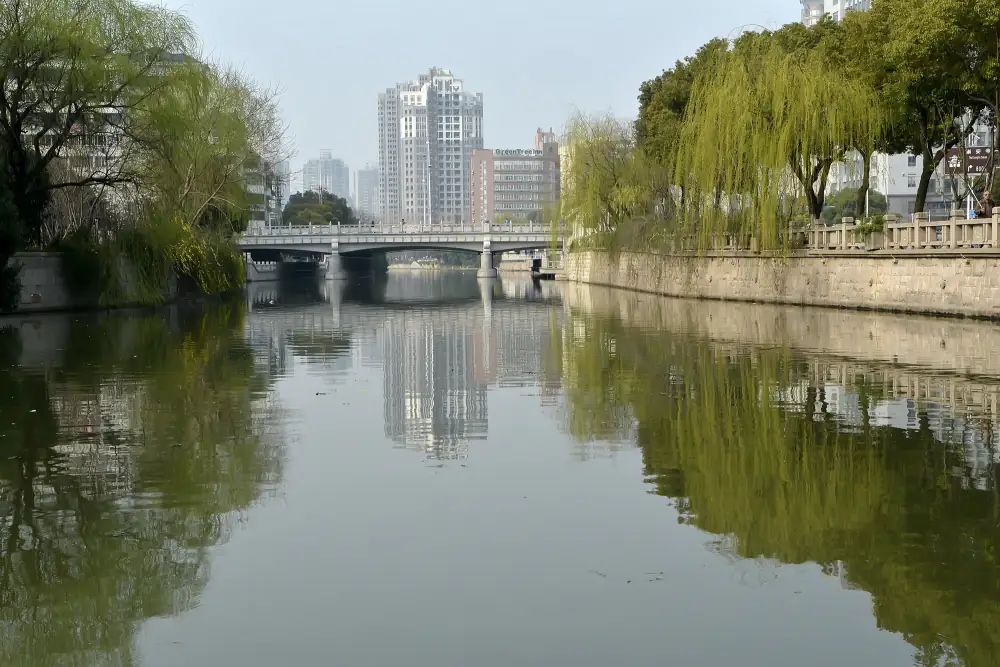
Changzhou (常州) sits in southern Jiangsu, roughly equidistant from Nanjing, Suzhou and Shanghai, wedged into the dense industrial belt of the Yangtze delta. It is an old place — a walled settlement stood here well over two thousand years ago — but it wears that history lightly, because the modern city has grown over most of it. What survives is concentrated: a stretch of the Beijing–Hangzhou Grand Canal, one great temple complex, a couple of restored lanes, and an earthwork ruin on the southern fringe.
Set against its neighbours, Changzhou loses on paper. Suzhou has the gardens, Nanjing the imperial weight, Yangzhou the literary glamour. Changzhou’s appeal is more practical: a genuine slice of delta life without the coach parks, plus two things its rivals lack — a huge family theme-park cluster on the northern edge of town, and a lovely stretch of lake and bamboo hill country an hour south.
Walking the old city
Everything worth seeing in the centre falls inside a compact eastern arc, and makes a natural half-day on foot. Start early, work east to west, and you finish near the shopping streets in time for lunch.
Tianning Temple (天宁寺) and its pagoda
Tianning Temple has stood in some form since the Tang dynasty, and remains the largest working monastery in the city. The halls are tall, dim and heavily used — incense smoke, chanting from a side hall, monks crossing the courtyards on errands. It feels like a functioning institution rather than a museum piece, which is more than can be said for many restored temples in the region.
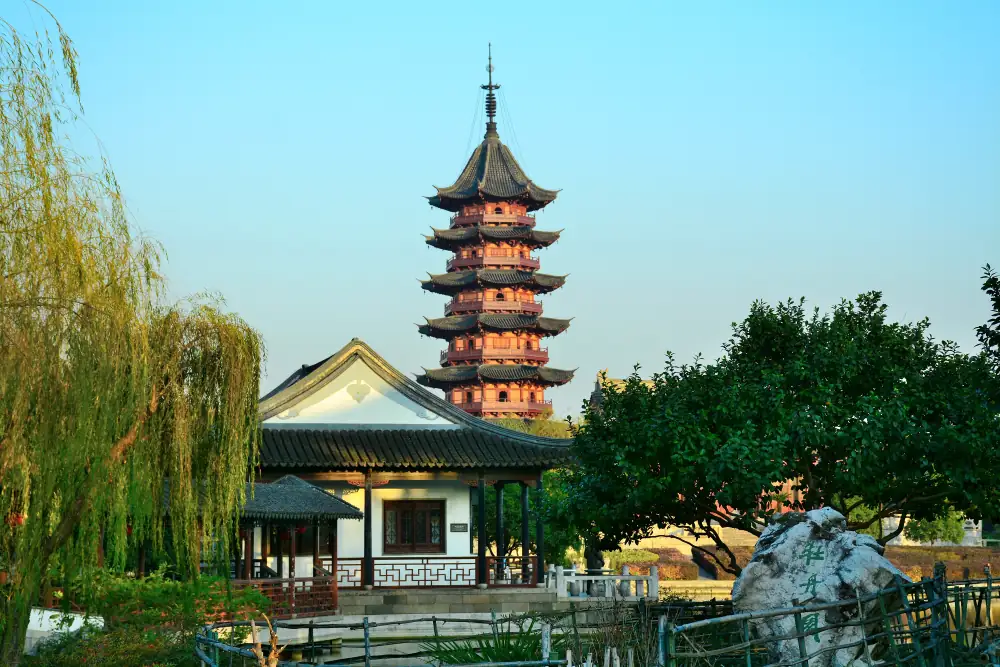
Behind the halls rises the reason most people come: a soaring thirteen-storey pagoda, one of the tallest of its kind anywhere in China. The climb is a long spiral past floor after floor of carved panels, lacquerwork and stone relief, each level illustrating some part of Buddhist teaching in a different regional craft tradition. Pace yourself; there is no lift and the stairs get narrow. The reward is a wide view over the city — the canal threading west, the parks below, tower blocks fading into delta haze. Come in the last hour of afternoon light, and again after dark from street level, when the whole structure is lit.
Hongmei Park (红梅公园)
Immediately north of the temple, Hongmei Park is the city’s largest and best-loved green space, and locals treat it as an extension of their living rooms. Retired men play cards under the willows, someone practises a bamboo flute badly but happily, and grandmothers push prams around the lake. The park takes its name from the Red Plum Pavilion, a heavy two-storey timber hall with squat, solid proportions that predate the fussier late-imperial style.
Two other structures anchor the grounds: a slender brick pagoda known as the Wenbi Tower, best photographed from across the lotus pond in late afternoon, and a cluster of pavilions arranged around the water. In the last weeks of winter the plum trees flower and the park fills with photographers; the rest of the year it is simply a pleasant, thoroughly local place to walk off lunch.
Qingguo Alley (青果巷)
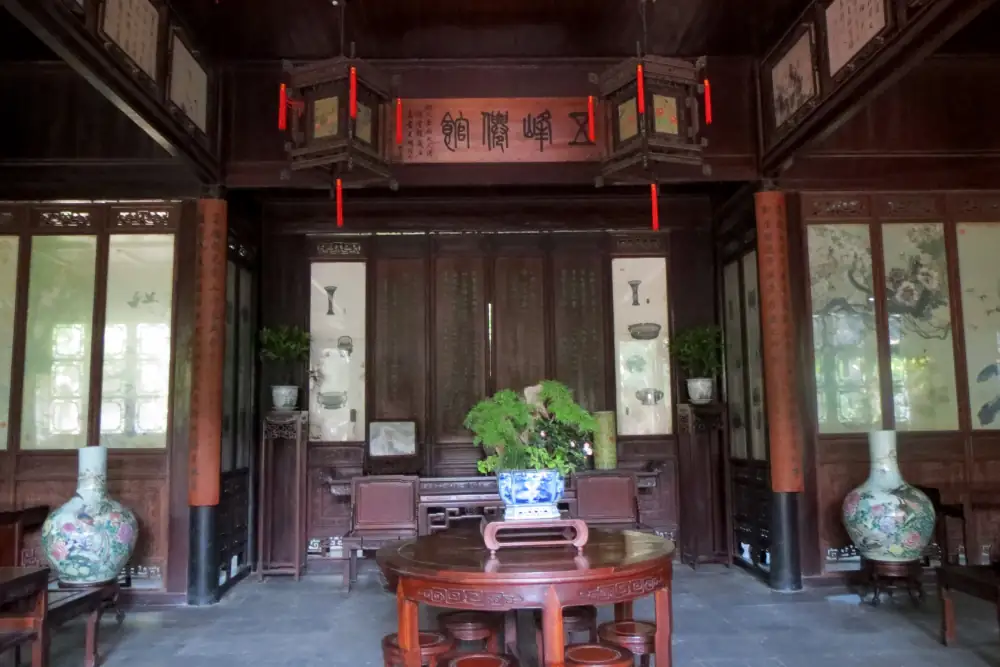
Qingguo Alley is Changzhou’s showpiece restoration, a long lane of whitewashed walls, black-tiled roofs and stone door frames running near the canal. Its name comes from the fruit trade that once operated along it, and the courtyard houses behind those walls produced a remarkable run of scholars, reformers and painters. Several compounds are now open as small exhibition houses, and one or two reward stepping into for the timber joinery alone.
Be realistic about what this is. The lane has been comprehensively rebuilt, and now holds cafés, craft shops and photogenic corners for weekend visitors. If you have already seen Pingjiang Road in Suzhou or the water towns west of Shanghai, you will recognise the formula. Give it an hour, go early, and treat the quiet side lanes running off it as the real attraction.
The canal and Comb Alley (篦箕巷)
Comb Alley made combs — fine-toothed bamboo combs and wooden hair combs — for something like fifteen centuries, and a few workshops still sell them, stacked in trays by tooth width. Stand on the arched bridge at dusk and you get barge lights on the water, a working waterway rather than a scenic one: low cargo boats pushing coal and sand through the city as they have for a thousand years. For anyone interested in the canal as an engineering and trade story rather than a photo backdrop, this half-kilometre is the best thing in Changzhou.
A short walk east brings you to a small riverside garden built around a pavilion commemorating the poet Su Dongpo, who moored here repeatedly and eventually died in the city. It takes twenty minutes — worth it if you are already on the canal, not worth a detour.
Yancheng (淹城): earthworks from the Spring and Autumn period
South-west of the centre lie the Yancheng ruins, the remains of a small fortified settlement from the Spring and Autumn period, unusual for its three concentric rings of wall and moat. Very little stands above ground — grassy embankments, water channels, woodland — so the site rewards imagination rather than sightseeing. Walking the outer ring on a weekday morning, mist on the moats and nobody else about, is genuinely atmospheric.
Adjacent sits a large theme park recreating the same era with costumed streets, philosophy pavilions and rides. The two are different propositions. Families with young children will get more out of the park; anyone travelling for culture should stick to the earthworks and the small museum. A wildlife park in the same cluster is skippable.
The theme parks: be honest with yourself
Changzhou’s northern district holds one of eastern China’s largest concentrations of built attractions, led by China Dinosaur Park (中华恐龙园) — a serious fossil museum wrapped inside a big-ticket amusement park with coasters, water rides and evening shows. A second park nearby is built around gaming and animation themes, with hot-spring resorts attached to both.
These places are well run and hugely popular with Chinese families, and they are why many domestic visitors come to Changzhou at all. They are also close to irrelevant for a foreign traveller on a three-week China trip: signage and shows run overwhelmingly in Chinese, summer weekend queues are punishing, and a day here costs you a day. Go if you have children who have had enough temples, or a real fondness for palaeontology — the fossil halls are substantial. Otherwise, walk past.
South to Tianmu Lake and the Nanshan Bamboo Sea
The best scenery in Changzhou’s territory is nowhere near the city. An hour or so south, in the hills around Liyang, Tianmu Lake (天目湖) spreads between low wooded ridges — a reservoir landscape of headlands, islands and tea slopes that looks its best on a still morning. Beyond it, the Nanshan Bamboo Sea (南山竹海) covers whole hillsides in moso bamboo, with a cable car up to a ridge walk and paths dropping back through the groves. The sound alone justifies the trip: wind moving through several million bamboo stems, creaking and hissing, with almost nothing else audible.
Do not attempt this as a rushed add-on. It needs a full day at minimum and works far better with a night in Liyang, which also lets you eat the local fish-head soup at source and drink the hill tea where it grows. Bring insect repellent and proper shoes. Travellers who prioritise nature over urban sightseeing should treat this southern district as the main event and the city as a stopover.
Getting there and getting around
Frequent high-speed trains link Changzhou to the whole Shanghai–Nanjing corridor, with journeys to Shanghai, Suzhou, Wuxi and Nanjing all falling around or under an hour. There are two principal stations: the older central one, walkable to the temple district and surrounded by hotels, and a newer high-speed station several kilometres north handling most long-distance services. Check which one your ticket names — arriving at the wrong end of the city costs half an hour. The local airport handles domestic routes only.
Inside the city, a metro network plus a well-organised bus rapid transit system covers the useful ground, and ride-hailing fills the gaps. The old-city sights sit close enough together to walk; the theme parks and Yancheng are short taxi rides out. For the southern lake district, take a train or coach to Liyang and use local taxis from there.
What each season feels like
- Spring (late March to May). The best window. Magnolia and then plane trees leaf out, the parks fill, temperatures sit in the pleasant middle. Late May tips into the plum rains, and June turns persistently wet and grey.
- Summer (July to early September). Hot and heavy, with humidity that makes a pagoda climb a genuine effort. The theme parks run late into the evening precisely because afternoons are unbearable. Bamboo hills stay cooler.
- Autumn (mid-October to late November). The other good window, arguably the better one: clear light, mild days, tea hills and bamboo at their best. Book accommodation early around the October holiday.
- Winter (December to February). Damp, overcast and colder than the numbers suggest, with little snow — but the quietest season, and quietly rewarding if you time it for the plum blossom.
Where to stay
| Area | Suits | Trade-off |
|---|---|---|
| Around the central station | Day-trippers and anyone walking the old city | Functional rather than charming |
| City centre near the shopping streets | Eating out, evening walks, canal access | Fewer budget options |
| Northern district by the theme parks | Families committed to the parks | Cut off from everything historic |
| Liyang, in the south | Lake and bamboo trips | Needs a separate transfer; not a city base |
For most visitors the choice is simple: stay within walking distance of the older central station. That puts the temple, pagoda and Hongmei Park at your feet, the canal lanes a short ride west, and onward trains next door.
What to eat
Changzhou sits on the Wu-speaking side of the delta, and its cooking follows the pattern — sweeter and lighter than the north, built on freshwater fish, river shrimp, seasonal greens and pork.
- Crab-roe soup dumplings. The city’s signature, and the thing to eat first. Thin-skinned steamed buns filled with pork and crab, served with slivered ginger and vinegar. Eat them at breakfast, as locals do.
- Damagao sesame flatbread. An oval, sesame-crusted baked bread in savoury and sweet versions, best straight from the oven.
- Silver-thread noodles. Extremely fine white noodles in clear broth — subtle to the point of plainness, but the texture is the point.
- Tianmu Lake fish-head soup. A milky, long-simmered casserole of freshwater fish head, best eaten in Liyang near the lake itself rather than in the city.
- Salted radish and vegetarian “ham”. Crisp pickled radish that turns up as a breakfast side, and a pressed soy-skin roll served in thin slices with sesame oil.
Two eating streets concentrate the options — one lined with proper restaurants covering Huaiyang, Hangzhou and Cantonese cooking, the other a snack lane of stalls where you graze rather than dine. For more on delta cooking, see our food coverage.
Practical advice, and what to skip
Changzhou is a secondary city, and treating it like a primary one leads to disappointment. Plan accordingly.
- Skip without guilt: the wildlife park, the animation theme park, the newer shopping plazas, and the Su Dongpo garden if time is tight.
- Skip the theme parks entirely unless you have children in tow or a real interest in fossils. This is the biggest time trap in the city.
- Do not skip the pagoda climb, the Comb Alley canal stretch at dusk, or a slow hour in Hongmei Park among people going about their lives.
- English is limited. Signage at the major sights is bilingual; menus and taxis often are not. Have destinations written in Chinese characters.
- Weekends and national holidays transform the place. Qingguo Alley and the parks go from calm to crowded; midweek is markedly better.
- Morning slots at the popular sights fill first. Arrive at the temple early and the pagoda stairs may be largely yours.
- Pack for humidity. Light layers, a compact umbrella for the plum-rain season, and shoes with grip for wet stone.
The honest summary: Changzhou is a good day, a decent two, and a fine base for a night if you are working slowly along the delta rather than hopping between headline cities. If you are assembling a broader east China route, slot it between Nanjing and Suzhou, walk the canal at dusk, climb the pagoda, eat the dumplings, and move on satisfied rather than dazzled.