
It rains in Taipei in a way that suits the city: fine, warm, persistent drizzle that puts a shine on the tiled temple roofs and drives everyone under the arcades and into the tea houses. Then the rain stops, the basin steams, and by eight in the evening a street that was empty at lunchtime has filled with folding tables, gas burners and a queue thirty deep for something fried. This is a city best understood at street level and after dark, and it rewards travellers who leave gaps in the plan.
Table of contents
Open Table of contents
What kind of city this is
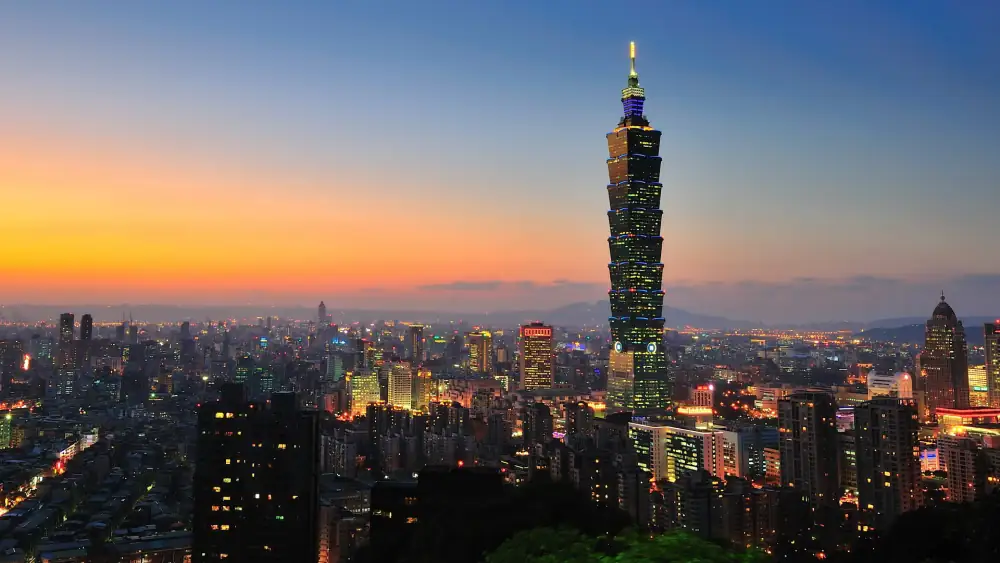
Taipei sits in a bowl ringed by green volcanic hills at the northern end of Taiwan, with the Tamsui River (淡水河) draining the basin to the sea. The geography matters. It means that the city is compact and legible, that you are never more than half an hour from a forested ridge or a hot spring, and that the humid subtropical air sits in the basin and makes summer afternoons hard work.
The character of the place is layered rather than singular. There is a nineteenth-century river port, a Japanese colonial administrative city, decades of dense post-war construction, and a recent, confident wave of design studios and coffee bars in converted warehouses. All four are still visible, often within one block. A lane of tattoo parlours and film posters runs into a temple courtyard thick with incense; a former tobacco factory hosts a design fair; a herbalist’s shop with sliding wooden drawers sits between two bubble tea counters.
What visitors tend to remember, though, is neither the skyline nor the museums but the manners. People queue on escalators, leaving one side clear. Priority seats on the metro stay empty even when carriages are full. Ask for directions and there is a real chance of being walked to your destination. It is a soft, courteous, slightly diffident public culture, and it makes Taipei one of the easiest large cities in the region to travel in.
The central districts
Ximending
The youngest, loudest part of central Taipei: a pedestrianised grid west of the old walled city, plastered with film hoardings and full of shops selling clothes to teenagers. Two lanes are worth finding — one lined with cinemas, a survivor of the era when this was the city’s film district, and a short alley of tattoo studios where the shopfront art is genuinely good. At the centre stands the Red House (西門紅樓), a century-old octagonal brick market building now given over to designers, small performances and a bar strip behind it.
Eat here rather than shop. Ximending’s snack stalls are a legitimate destination in themselves: thin thread noodles in a thickened broth with intestine and coriander, star fruit ice, braised soy-simmered snacks sold by weight, sliced duck over rice, charcoal-grilled mochi, and an old-style coffee roaster whose smell reaches the end of the street.
Bangka and Longshan Temple
South-west of Ximending lies the oldest commercial quarter in the city, known historically as Bangka (艋舺). Its anchor is Longshan Temple (龍山寺), founded in the eighteenth century and dedicated principally to Guanyin — a working temple rather than a monument, with a constant traffic of worshippers, chanting in the early morning, and an enormous flowering of lanterns at the first full moon of the lunar year. Come at dusk, when the smoke and the strip lighting and the recorded sutras combine into something genuinely absorbing.
Around it: a lane of herbalists selling bundles of medicinal greens, a restored block of nineteenth-century shophouses whose narrow rooms and back courtyards show how the port district actually lived, a snake-alley night market that is more sedate than its reputation, and neighbourhood temples where the annual processions are among the best street culture in Taipei.
Dadaocheng
When the river port shifted north in the late nineteenth century, Dadaocheng (大稻埕) became the wealthiest district in the city, built on tea, cloth and Chinese medicine. Dihua Street (迪化街) preserves that period almost intact: a long run of narrow-fronted merchant houses with elaborate parapets, still trading in dried seafood, fungi, herbs, fabric and tea. In the weeks before Lunar New Year the whole street becomes a scrum of shoppers buying sweets and dried goods, which is chaotic and enormously enjoyable.
Walk it from the metro down to the old wharf on the river, then eat at the night market a few streets inland — smaller than Shilin, better food, more locals.
Xinyi and the tower
The eastern business district is the modern city: broad avenues, department stores, and Taipei 101, a tapering, jointed tower of green glass that dominates every view in the basin. The observation deck near the top is worth the lift ride on a clear day, mostly for how clearly it explains the geography — the ring of hills, the river, the sprawl running up every valley. At night the building is lit in a colour that changes daily.
Nearby, the Songshan Cultural and Creative Park occupies a 1930s tobacco factory: baroque garden, boiler house, long brick warehouses, now exhibition halls and studios. It is the best of the city’s several industrial conversions.
Museums and the civic set pieces
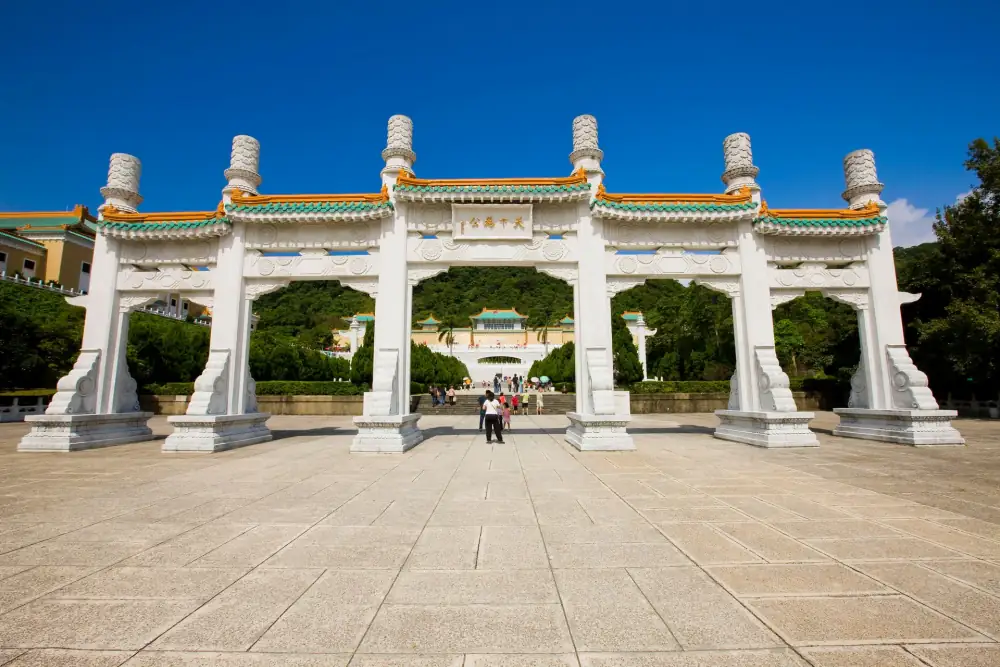
The National Palace Museum holds one of the world’s great collections of Chinese art — Shang and Zhou bronzes, jade, ceramics, calligraphy, painting, rare books — of which only a fraction is on display at any time, rotated every few months. Two things to know: it is in the northern suburbs, so allow travel time, and attempting the whole thing in one visit is a mistake. Choose two or three galleries, and pay particular attention to the bronzes and the ceramics.
Chiang Kai-shek Memorial Hall and the vast paved square in front of it is the classic Taipei postcard: white marble, a blue octagonal roof, a monumental gate, pigeons, and a concert hall and theatre flanking the space. The changing of the honour guard happens on the hour inside the hall, performed in near silence and drawing a crowd. The Sun Yat-sen Memorial Hall on the other side of the city does something similar, and the steps outside frame the best ground-level view of Taipei 101.
For a quieter and more thoughtful hour, the 228 Memorial Museum in the park of the same name documents the 1947 incident and the long period of martial law that followed. Whatever you know about the island’s twentieth-century history, it is a serious, well-made museum.
The Presidential Office Building, a red-brick Japanese-era baroque pile, opens parts of its ground floor to visitors on a registration basis, and the Shilin Residence, once Chiang Kai-shek’s home, is now mostly visited for its formal gardens and rose beds.
Night markets
Taipei’s night markets are the reason a lot of people come, and they differ enough that visiting three is not repetitive.
- Shilin is the largest and most famous, with a basement food hall and a sprawl of surrounding lanes. It is busy, touristed and still very good. Go for the range: oyster omelette, fried chicken cutlet the size of a face, pepper buns baked against the wall of a clay oven, sweet potato balls, shaved ice under mango.
- Ningxia is compact, older and better focused on food, with several stalls that have been doing one dish for decades. A good choice if crowds wear you down.
- Raohe is a single straight street between a temple gate and a bridge, easy to work end to end, and famous for those pepper buns.
- Gongguan, next to the university, is where students eat: pork belly in a steamed bun, scallion pancakes, milk tea, cheap Thai food.
House rules that make the experience better: eat standing up and keep moving, order the single thing a stall is queueing for rather than browsing its whole menu, carry small notes, and treat the queue length as the menu. For more on regional eating, see our food writing.
Beyond the markets, the city’s own specialities are worth seeking out in daylight: beef noodle soup, braised pork over rice, thick peanut and sesame soups, and the tea houses of the surrounding hills.
Hills, water and hot springs
Yangmingshan (陽明山) is the city’s back garden, a volcanic massif rising directly behind the northern suburbs, reached by bus in well under an hour. Its most striking feature is a collapsed crater vent where steam roars continuously out of fumaroles and stains the rock yellow with sulphur — bare, hissing, faintly alarming ground within sight of a metropolis of millions. Elsewhere the massif offers grassland ridges, a summit walk on the highest peak in the range, calla lily fields you can pick in, and cherry blossom from mid-February into early April. Landscape restaurants scattered across the upper slopes exist mainly for the view down over the lit basin after dark. Anyone interested in hiking should give this a full day.
Beitou (北投), on the metro at the foot of Yangmingshan, is the hot spring quarter, developed under Japanese rule and still full of that period’s architecture. The public baths range from plain and communal to elaborate and private; the thermal valley behind the town boils and steams under a footbridge; and the small museum of the springs, in a wooden bathhouse, is charming. So, unexpectedly, is the branch library — a timber building on stilts among trees that is one of the loveliest small pieces of architecture in the city.
Maokong (貓空), in the tea hills to the south, is reached by a gondola that swings up over the plantations from the zoo. The point of going is to sit in a tea house on a slope, be shown how to brew properly, and watch the city light up below. It is a slow evening rather than a sight.
Tamsui (淡水), at the river mouth at the end of the metro line, deserves more than the hour most people give it. There is a seventeenth-century fort built by the Spanish and rebuilt by the Dutch and British, a hilltop campus of extraordinary hybrid architecture, a small white colonial-era consular residence, an old street of snack shops — iron eggs, fish crisps, fish balls, a soft tofu pouch stuffed with noodles — and a fisherman’s wharf with a curved white footbridge that is the standard place to watch the sun go down. Across the water, a flat cycle path runs for kilometres along the far bank, and boats cross from the old ferry pier.
Getting there and around
Most international arrivals land at Taoyuan, well outside the city, with a dedicated rail link and frequent coaches into central Taipei; the smaller Songshan airport sits inside the city itself, minutes from a metro station. There are also sea routes to the offshore islands from mainland ports, with onward flights.
Within Taipei, the metro does almost everything. It is clean, frequent, bilingually signed, and reaches nearly every place mentioned above. Buy a stored-value card immediately — it works on the metro, city buses, some ferries and in convenience stores, and saves fumbling for change. City buses fill the gaps, particularly up into the hills, and drivers take the same card.
Taxis are abundant, metered, and yellow; a late-night surcharge applies. Bike share is widespread and the riverside paths are excellent. For trips beyond the city, conventional trains run down both coasts with dense stops, while a high-speed line reaches the south of the island in a couple of hours from Taipei’s main station. Long-distance coaches are the budget option and are often quicker than the slow trains.
Day trips worth taking
- The old mining towns in the hills east of the city — steep stone stairways, tea houses stacked above a bay, a valley of railway lanes where sky lanterns are released — make the most atmospheric day out, and are reachable by train with one branch-line change.
- The north coast, a ribbon of wind-carved sandstone, fishing harbours and beaches, is a good drive or bus route. In summer a large rock festival takes over one of the beaches for several days.
- Keelung, the working port to the north-east, has a night market built around a temple that many people rate above anything in Taipei itself.
Practical advice, including what to skip
Plan around closures. Most museums shut one day a week, usually Monday, and the island’s own public holidays fill hotels and empty exhibition halls.
Book accommodation ahead, especially for Friday and Saturday nights and around the New Year holidays. The city has everything from hostel dorms to guesthouses in converted flats, and the best-value options are in the older central districts within walking distance of a metro station.
Stay in the west if you want atmosphere, near Ximending, Dadaocheng or the main station, and in the east if you want shopping and newer hotels. Anywhere on the metro is fine.
Bring an umbrella regardless of season, plus one layer more than the forecast suggests for the hills, and swimwear if you intend to use any public hot spring pool.
What to skip: the observation deck on a hazy day, when you will pay in queueing time for a view of grey soup; the amusement park ferris wheel out in the eastern suburbs, which is pleasant but takes half a day to reach and beat by the Maokong gondola for views; and any attempt to see the National Palace Museum and two night markets and the tower in a single day. Also resist the urge to treat Tamsui as a one-hour stop on the way to a sunset — either give it the afternoon or leave it out.
Leave time to get lost. The most consistent pleasure of this city is the unplanned lane: a bookshop open past midnight, a temple festival blocking a street, an artist’s studio in a squatter settlement turned art village on the riverbank. Build a light itinerary and let the gaps fill themselves.