
At seven in the morning on Deshengsha Road, the arcades are already busy in a way that has nothing to do with tourism. Men in vests sit three to a bench under the colonnade, nursing a single glass of tea, reading a paper they have read already. Above them the shophouse façades are peeling in the salt air — baroque window heads, coloured floral tiles, a parapet with a date nobody can read. This is Hainan’s capital doing what it does best: existing.
Table of contents
Open Table of contents
The city Sanya’s visitors fly over
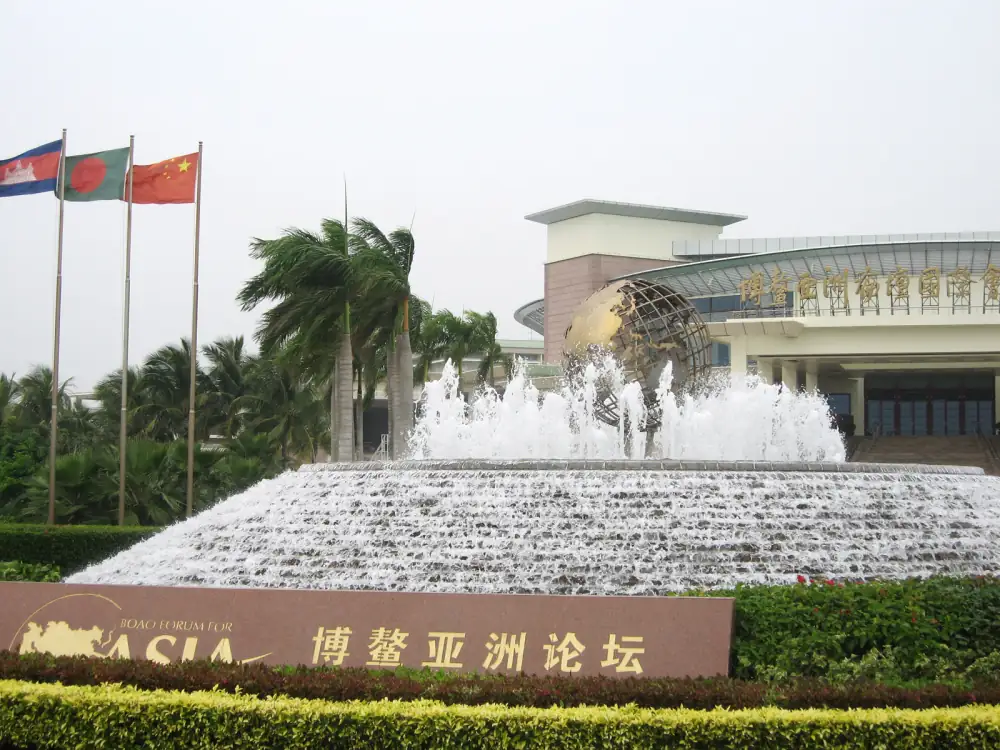
Most people who come to Hainan land at Haikou (海口) and leave within the hour, southbound. That is an understandable choice and a slightly impoverished one. Haikou has no headline beach to compete with the resort coast, no turquoise bay, no marketing campaign worth the name. What it has is a century-old commercial quarter that never got prettified, a field of dormant volcanoes on its doorstep, China’s largest mangrove reserve an hour east, and an eating culture that runs from dawn tea through to two in the morning.
It is also a genuinely relaxed place. The city sits on the island’s north coast facing the Qiongzhou Strait, close enough to the mainland that the ferries run constantly, far enough south that the average temperature barely moves out of the low twenties all year. Nobody is in a hurry. Traffic aside, the prevailing tempo is that of a tropical provincial town that happens to have a skyline.
The arcade old town
The 骑楼老街 — the qilou, or arcade streets — are the reason to come. Built by returning overseas Chinese who had made money in Southeast Asia, these are two- to four-storey shophouses with the ground floor set back behind pillars, creating a continuous covered walkway against sun and monsoon rain. The style borrows from Portuguese and Dutch colonial building, from Indian and Arab decorative habits, and from southern Chinese practicality, and the result belongs to nowhere else. Haikou’s version is more curved and more ornate than the equivalents in Guangdong or Fujian, and crucially it has not been scrubbed and rebuilt into a shopping precinct.
The quarter is still a working commercial district, which is what makes it good. Walk it street by street:
- Deshengsha Road (得胜沙路). The grandest façades, once foreign trading houses, warehouses, theatres and hotels. Now Hainan’s largest wholesale clothing market, plus a memorial hall to Lady Xian, a general venerated across the south.
- Xinhua South Road (新华南路). Tailors working at treadle machines, cheap shoes, teahouses, and an old cinema with hand-brushed lettering.
- Bo’ai Road (博爱路). Household goods, flowers, paper offerings, intersected by the East Gate and West Gate markets — the best place in the city to look at unfamiliar produce.
- Shuixiangkou Street (水巷口街). The food core, and the correct place to eat breakfast.
- Zhongshan Road (中山路). Lighting and electrical fittings, mostly traders from the mainland, neon at night.
The oldest structure in the quarter, Sipailou (四牌楼), traces back to the Southern Song. Give the area a slow half-day and return in the evening when the arcades cool down.
Volcanoes, memorials and mangroves
The volcanic geopark
Southwest of the city at Shishan sits the 雷琼海口火山群世界地质公园, a cluster of dormant Holocene craters in a volcanic rift field — one of very few such landscapes in China. You walk up through lava-rock villages where field walls, houses and pigsties are all built from the same black basalt, then climb a crater rim into forest that has colonised the caldera. It is a comfortable half-day, and the ritual is to finish it with the local braised goat, which grazes on this volcanic scrub and is the best-regarded meat on the island.
Wugong Ci
The 五公祠, the Five Officials Memorial, is Haikou’s most substantial piece of built heritage: a red-timbered complex in the old Qiongshan administrative quarter honouring officials exiled to Hainan in the Tang and Song, when the island was where the empire sent its inconvenient talent. Sometimes billed as Hainan’s first building. There is a Song imperial edict tablet, a bronze bell, a spring in the courtyard, and the city museum in the grounds. Pair it with the provincial museum nearby, whose Li ethnic and intangible-heritage galleries are the clearest window available on pre-modern island life.
Elsewhere in the city
The Ming tomb of Hai Rui (海瑞墓), the incontestably honest official whose name became shorthand for incorruptibility, is a quiet stone-lined park with a spirit way of carved figures. The Xiuying battery (秀英古炮台) preserves late-Qing coastal gun emplacements on a ridge above the port, and is rated among China’s four great gun batteries. Wanlvyuan (万绿园) is the big waterfront park where the whole city exercises at dusk. The clock tower is a photograph, not a visit.
The mangrove coast
An hour east at Yanfeng, the 东寨港红树林 reserve protects China’s largest mangrove forest — a drowned, funnel-shaped coastline with dozens of mangrove species and boat access into the channels. Birdlife is good, the light at low tide is remarkable, and just offshore lies a submerged settlement locals call the undersea village, lost when the coast dropped. This is the best half-day out of the city for anyone who likes nature over monuments.
Beaches
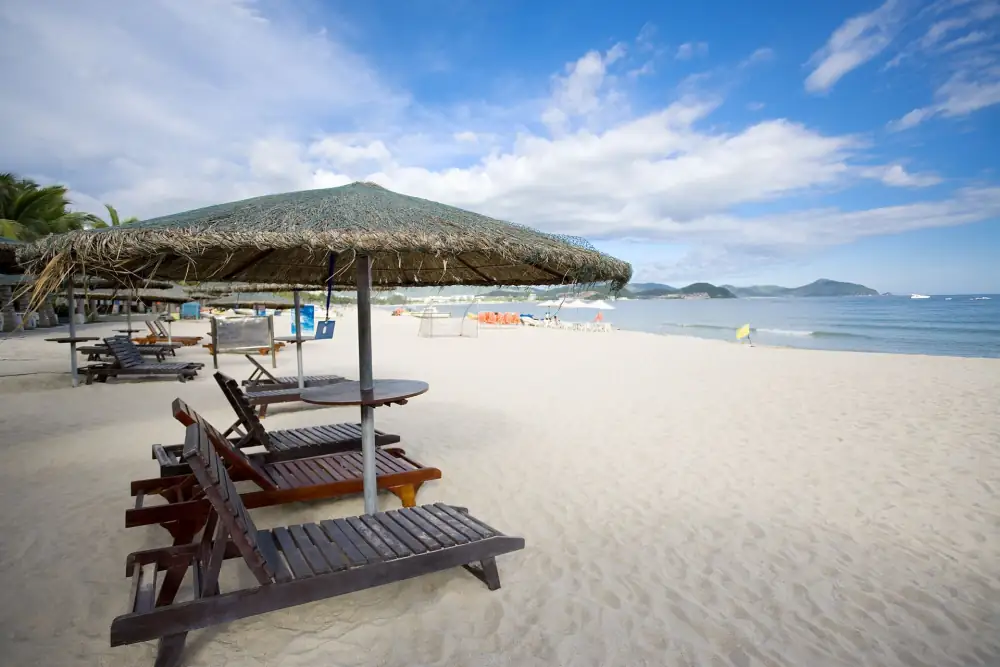
Manage expectations. Holiday Beach (假日海滩) on the western shore is a long strip of coarse sand and casuarina, and its real function is as a sunset venue and an open-air seafood barbecue plaza, plus an outdoor stage show. Xixiu Beach nearby is quieter. For actual swimming, the long natural beach at Guilinyang east of the city is better. None of this competes with the south coast, and it does not need to.
Getting there and around
Haikou is the island’s northern gateway and it is well connected. Meilan International Airport sits east of the city with broad domestic coverage plus regional flights to Hong Kong, Southeast Asia, Japan and Korea, and an airport rail link running into town and onward down the island. The high-speed ring railway makes Sanya a two-hour trip from the eastern station; the older western station handles long-distance sleepers that cross the strait by train ferry, which is a curiosity in its own right.
By sea, ferries cross the Qiongzhou Strait to the Leizhou peninsula constantly, with longer sailings to Guangzhou, Beihai and Hong Kong. Vehicle ferries mean self-driving onto the island is entirely practical.
In the city, use taxis — metered, cheap, everywhere. Tourist sightseeing buses string the main sights together and the ordinary bus network is dense. Car hire with one-way drop-off in Sanya is easy to arrange and is the best way to see the east coast at your own pace.
Seasons
Late autumn to spring is the season, and the reason northern Chinese retirees migrate here in winter. Warm days, cool evenings, calm water, dry air by tropical standards. This is peak demand.
Late spring to summer brings heat, heavy humidity and the rainy season. Afternoon downpours are routine and brief.
Summer into autumn is typhoon season, and Hainan’s east flank is nicknamed the typhoon corridor for good reason. A serious storm grounds flights, suspends ferries and closes the coast for a day or two. Travel then if you like empty streets and are relaxed about schedules; build in slack either way.
Whenever you come: strong sunscreen, an umbrella that handles both sun and rain, mosquito repellent, and one long-sleeved layer for aggressively air-conditioned interiors.
Where to stay
- The Guomao trade circle in Longhua district — the business core, with a food street, a bar street and shopping, and walking distance to the seafront park. The most convenient base.
- Binhai Avenue and Wenhua Road — closer to the water, near the convention district and the battery. Quieter, more hotel-like.
- Haidian Island — across the river, where the hostels and the everyday neighbourhoods are. Good for budget travellers and cyclists doing the island loop.
- Qiongshan — the old administrative quarter near Wugong Ci. Least touristed, most local, furthest from the nightlife.
The reassuring thing about Haikou compared with Sanya is availability. Rooms exist here in periods when the south coast is sold out entirely.
Eating in Haikou
This is the strongest argument for the city. Hainanese cooking uses Cantonese technique but leans hard on coconut, and it is lighter and less sweet than mainland southern food.
The four famous dishes are all available in the capital: Wenchang chicken (文昌鸡), poached and served with a dipping sauce, the original of what the rest of the world calls Hainanese chicken rice; Jiaji duck (加积鸭); Dongshan goat (东山羊); and Hele crab (和乐蟹).
Beyond them:
- Shishan braised goat (石山扣羊肉), from the volcanic grazing land, most often served as a hotpot.
- Hainan noodles (海南粉), the signature breakfast — soft rice noodles dressed with a dozen or more condiments and eaten cold.
- Pork trotter rice (猪脚饭), ladled from twin cauldrons at the shopfront alongside beef brisket.
- Fish claypot (鱼煲), in two schools: one clear and fresh, one fried first then stewed.
- Coconut sticky rice (椰子饭), steamed inside the nut.
- Qingbuliang (清补凉), the iced coconut-milk dessert bowl loaded with beans, peanuts, tapioca pearls, fresh fruit and grass jelly. The single best thing to eat on a hot afternoon in this city.
Lao ba cha (老爸茶), literally “old dad tea”, is the ritual that defines Haikou. Plain tea in undecorated old-town shops where strangers share benches and a single cup lasts hours. Morning tea fills these places from first light. Nothing about it is designed for visitors, which is precisely why you should go.
Night eating matters more here than dinner. From late evening the small restaurants fill for beer, barbecue, congee, milk-fed goat and hotpot, and the city is at its most sociable. Shuixiangkou Street is best for breakfast; Xinbu Island is where you buy your own catch and have a shop cook it; the market lanes off Haixiu Avenue handle noodles at any hour. Our food archive covers more of the regional picture.
Two or three days, sequenced
Day one. Wugong Ci and the provincial museum in the morning while it is cool. Walk into the arcades for a Hainanese lunch and an unstructured afternoon among the shophouses. Sunset and seafood barbecue on the west-coast beach.
Day two. Out to the volcanic geopark early, up the crater rim before the heat, lava-rock villages on the way down, braised goat for lunch nearby. Back to the city for an old-town tea shop and a long night-food dinner.
Day three. East to the mangrove reserve by boat, then the submerged village and a swim at Guilinyang. Or, with children, the tropical wildlife park southwest of the city instead.
Honest advice
Skip the replica attractions and the aquarium-style parks; they are not what this city is for. Skip Zhongshan Road unless you need a lamp. The clock tower takes four minutes.
Ignore anyone handing out tour flyers or air-ticket offers on the street — buy transport and tours through your accommodation or the operators directly. Haggle firmly on souvenirs, and treat the pearl, crystal and tortoiseshell shops along the main avenue with real scepticism unless you know precisely what you are looking at. The dried-seafood stalls at East Gate market are more honest, because they compete openly side by side.
Best things to carry home: Hainan pepper, both white and the smaller, paler wild kind; Xinglong coffee, since the island is one of China’s few coffee-growing regions; coconut sugar; and yellow lantern chilli sauce, which is fierce and travels well.
Finally, do not plan Haikou to the hour. Its pleasures are the tea shop you sit in longer than intended, the arcade you double back through because the light changed, and the third bowl of qingbuliang. Build the days loosely and let the city set the pace. For more on structuring a Hainan trip, see our itinerary collection.