
Dawn at the Bohai Sea arrives without ceremony. On a headland east of Beidaihe (北戴河), a few dozen people stand on wet granite with flasks of tea, watching a red disc lift out of grey water and set the shallows alight. Behind them a twenty-kilometre curve of soft sand runs west towards pine-covered hills, past guesthouses and seafood stalls hosing down their tanks. This is northern China’s oldest beach habit, far more likeable than the brochures suggest.
Table of contents
Open Table of contents
What Beidaihe actually is
Beidaihe is a district of Qinhuangdao (秦皇岛) in Hebei province, a strip of resort development wedged between the Bohai Sea and a wooded ridge. It became a summer retreat in the late nineteenth century, after railway engineers surveying the line east from Tianjin noticed the gentle surf and fine sand. Missionaries and merchants built villas among the pines; later the Chinese state adopted the place as its summer bolthole, and the leafy, low-rise, faintly institutional character that resulted still defines it.
Set your expectations correctly and you will enjoy it. The water is not turquoise; Bohai is shallow and semi-enclosed, running from steel-grey to milky jade with the wind and tide. Beidaihe offers instead a soft, gently shelving beach that goes on for miles, air smelling of pine resin and grilled prawns, and seafood landed that morning. It suits families with small children, couples wanting a slow weekend, and birdwatchers who come for something else entirely. Anyone after tropical glamour should look elsewhere.
The beaches, west to east
The seafront divides into three loose zones, and knowing which is which saves wasted walking.
West Beach and the river mouth
The western end, where the Dai River meets the sea, is quietest and least developed. Sand is coarser, crowds thin almost to nothing, low dunes and scrub back the shore. Come to walk at dusk rather than to swim; here the coast feels like a river delta, with mudflats and channels that matter enormously to birds.
Middle Beach and Tiger Rock
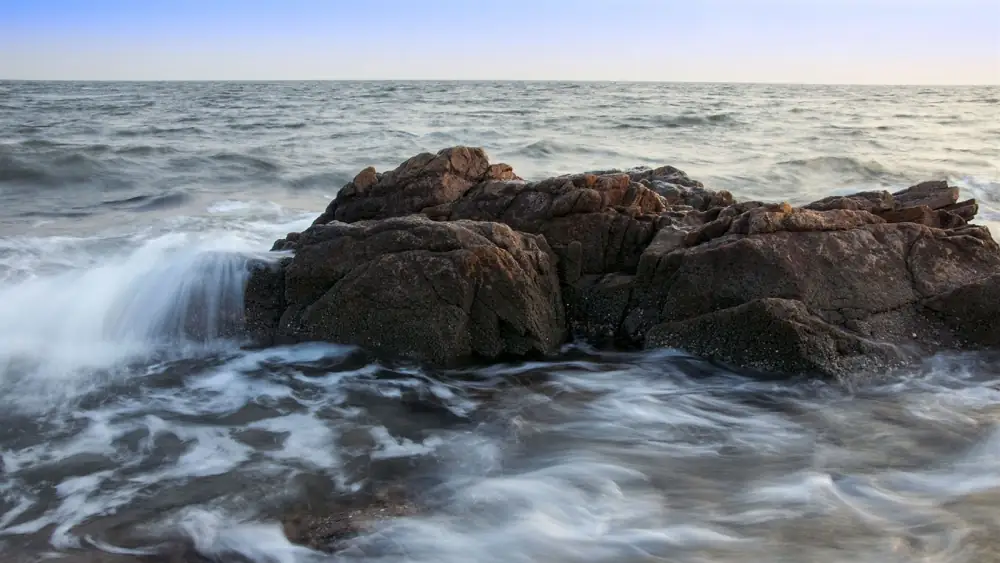
Middle Beach is the resort’s centre of gravity, and Tiger Rock Sea Park (老虎石) sits at its heart: weathered granite boulders sunk into otherwise unbroken sand, waves breaking white against them at high tide. The sand is the finest on the coast, the shelf shallow and forgiving, and the surrounding blocks hold most of the hotels and restaurants. In July, expect kites, families digging for small crabs, and enough umbrellas to blot out the beach. Free public stretches sit either side of the park section.
East Beach and the headlands
East of the centre the shoreline turns rockier and rises into low cliffs, holding the geology and the sunrise viewpoints. Fishing boats work off the point, anglers cast from ledges, and sand gives way to pools worth poking about in at low tide.
Sunrise at Pigeon Nest
Pigeon Nest (鸽子窝), also known as Eagle Angle Pavilion (鹰角亭) for the raptor-shaped crag that anchors it, is the reason to set an alarm you will resent. A geological fault left a short sea cliff here, and a small tiled pavilion perches above it looking due east over open water. Pigeons once roosted in the rock fissures, which gave the place its name; today several hundred are kept on the lawns and will land on an outstretched arm.
Sunrise is the event. In the dark a slow procession moves along the cliff path, torches bobbing. When the sky drains from black to washed blue the sea takes on a metallic sheen, and the sun comes up in stages, ringed with red haze, hesitating before it clears the horizon. On the right tide, with water lying in sheets on the flats below, it appears to rise twice, once in the air and once at your feet.
Arrive well before first light, and remember that everyone else has the same plan; the railings fill first, but flatter ground along the cliff gives a cleaner foreground. Bring a windproof layer even in midsummer, and get there by taxi rather than working out buses in the dark.
Birds: the real speciality
Beidaihe sits at the neck of the Liaoxi corridor, the narrow coastal funnel between mountains and sea that migrating birds use to move between Siberia and southern Asia. Add heavy tree cover, extensive mudflats and a river mouth, and you get one of the most productive migration watchpoints in East Asia. Birders travel from across the world for it, which is why you occasionally see a scope-laden foreigner in an otherwise domestic town.
Two windows matter: spring passage from around mid-March to late May, autumn passage from early September to mid-November. Between them, June and July still reward attention, with pond herons, yellow bitterns, hoopoes and orioles breeding locally and terns working the surface offshore. August brings the main wader pulse, when the flats, river mouth and harbour edges fill with sandpipers, plovers, godwits and stints. The autumn crane passage is the marquee event: common and hooded cranes moving down the coast in ragged lines, with raptors, storks and spoonbills alongside.
Where to look:
- The wetland and flats near the river mouth and eastern point, worked on a falling tide when birds concentrate on exposed mud
- Pigeon Nest’s own flats and scrub, best in the hour after sunrise
- Lianfeng Hill’s woodland for passerines, flycatchers and thrushes dropping in after a night’s flight
- Any quiet reedy channel behind the western beaches
Bring your own optics; local rental is not something to count on. Move slowly, keep off soft mud, and check the tide before walking out. If landscapes are your reason for travelling in China, this coast belongs alongside the country’s better-known nature destinations.
Lianfeng Hill and the green interior

Lianfeng Hill (联峰山) rises directly behind the resort, a set of linked wooded summits that from a distance resemble a lotus seed pod, which earned the hill its alternative name. Paths wind up through dense pine and locust to a sea-viewing pavilion on the highest point, from where the whole arc of beach lays itself out below, town roofs half-swallowed by trees. Allow an unhurried couple of hours; the climb is short and shaded. Scattered through the woods are a small temple complex, a bell tower, and old stone villas from the resort’s first foreign era, some restored and some quietly rotting.
Along the coast road you will also pass a bare, fenced site where a Qin dynasty imperial palace once stood, its excavated tile-ends hinting at the emperor who gave Qinhuangdao its name. Interpretation is thin, but ten minutes here beats an afternoon in any of the resort’s built attractions.
Getting there and getting about
Frequent high-speed trains run up from Beijing through the day, the fast services taking a couple of hours or so, and plenty of travellers fold the trip into a wider Beijing itinerary. Slower trains, sleepers and long-distance coaches also serve the town; Tianjin is closer still. A small regional airport near Shanhaiguan handles a few domestic routes but is rarely the sensible option.
Trains stop either at Beidaihe’s own station, several kilometres inland from the sand, or at Qinhuangdao’s main station. From either, buses and taxis run to the seafront; allow the better part of an hour by bus, considerably less by taxi.
Locally, a few bus routes link the seafront bus station with Tiger Rock, Lianfeng Hill, the eastern headlands and the markets, cheaply and slowly. Taxis are metered and plentiful, though in peak summer insist on the meter. The best way to move around, honestly, is a bicycle or e-bike: distances between beaches, hill and markets are just far enough to be annoying on foot and trivially short on two wheels. Traffic can be assertive, so ride defensively. To reach Nandaihe (南戴河) or Shanhaiguan (山海关), hire a car with a driver for the day, and avoid unlicensed drivers touting outside stations. Shanhaiguan deserves a full half-day: the First Pass Under Heaven gate tower and Old Dragon’s Head, where the Great Wall runs into the sea, give the trip a jolt of drama the beaches cannot.
The four seasons
Spring
March to May is the connoisseur’s Beidaihe. The sea is too cold for swimming, the town half-awake, the woods and flats alive with birds moving north. Winds can be sharp and the light is often beautifully clear. Bring layers; some businesses stay closed through March.
Summer
Mid-June to late August is the season the town was built for: warm shallow water, long evenings, night markets, kites. It is also when the resort strains at the seams. Rooms are scarce, central beaches carpet over with umbrellas, and you watch people rather than the sea. Early June and late August feel calmer for almost identical weather.
Autumn
September and October may be the best all-round window. Sea temperatures hold up into September, crowds evaporate after the first week apart from the national holiday spike, the light turns golden, and migration builds towards its crane-filled peak. Seafood is at its finest, crab especially.
Winter
November to February is bare, windy and almost empty. Parts of the shallows freeze and ice pushes up along the tideline in slabs. Many guesthouses and beach restaurants simply shut. A deserted shoreline has austere appeal, but plan around limited food options and confirm your accommodation is open.
Where to stay
Location matters more than category here.
- Near Tiger Rock and Middle Beach: the obvious choice, with everything in walking distance and the best sand. Dearest in summer and noisiest at night; higher floors on the sea side are worth asking for.
- The eastern district near the headlands: quieter, handy for a pre-dawn walk to the sunrise cliffs, close to the seafood markets, better value.
- Around Lianfeng Hill and inland: leafy, cool and calm, popular with families settling in for a week. You will need wheels or buses to reach the water.
- Nandaihe, just west: a separate, more modern strip with wider, emptier sand. Good for beach without the throng, less good if you want to wander to dinner.
Family-run guesthouses dominate, and many will let you steam your own seafood, a genuine advantage. Older state-era hotels near the sea offer big rooms, dated fittings and sea views.
Eating: seafood, and how to handle it
Bohai seafood is why many people come back. The catch runs to swimming crab, mantis shrimp, scallops, razor clams, cockles, sea snails, abalone, squid and a rotating cast of local fish. Northern Chinese seafood cooking is refreshingly plain: steam it, boil it, occasionally grill it, and let vinegar and garlic do the rest.
What to order:
- Swimming crab, the local star. Choose lively ones and pick autumn if you can, when the roe is thick. Press the underside; a firm, full belly means a well-fed crab.
- Mantis shrimp, steamed. Fiddly to peel, sweet enough to justify it.
- Grilled prawns brushed with a light sauce, a regional signature.
- Scallops steamed with garlic and glass noodles, ubiquitous and excellent.
- Razor clams and cockles, quick-boiled, eaten with vinegar.
- Mung bean cake afterwards, a crumbly local sweet that is not cloying.
The classic move is to buy your own. Head to a seafood market, the large one near the central walking street or the smaller, more local one to the south, choose live shellfish, then hand it to a nearby processing stall to cook by weight. Markets wind down in the evening, so go early. Three habits save grief: watch your purchase being bagged and weighed, check it on the market’s public scale, and ignore the strangers at market entrances offering to pick your seafood or lead you to a kitchen, since they earn commission from both ends.
Restaurants in the tourist blocks charge handsomely for convenience; walk ten minutes into a residential street and the same dishes arrive better. Anyone tracking regional cooking will find this coast a useful corrective to inland food traditions.
Honest practical advice
What to skip. Beidaihe accumulated a layer of built attractions over the decades and most can be ignored: the maze-like folly house with its sound-and-light gimmicks, the mythology theme park, the wildlife park, the tower-with-a-bar complex on the eastern point, the showpiece agricultural garden with its record-breaking pumpkins. Each charges separately for the amusements inside and none justifies half a day. The shallow bay along the coast road often recommended for swimming is pleasant to stroll, but the water does not invite a dip.
Peak weeks. From late June until mid-August, and during national holidays, the central beach becomes a study in crowd dynamics. If those dates are fixed, book early, choose the eastern or inland districts, and use the beach early or late in the day.
Other things worth knowing:
- Sun and mosquitoes both bite hard in summer, so pack high-factor sunscreen, a hat and repellent.
- Enter the water gradually, and skip diving in crowded shallows where you cannot see the bottom.
- Skip sightseeing boats in poor weather.
- Tides matter more than you would expect on such a shallow sea, so check them before planning a rock-pool or mudflat walk.
- Little English is spoken. A translation app and a screenshot of your accommodation’s address in Chinese cover almost every situation.
Beidaihe will not stun you. It hands you a cold sunrise, a bag of crabs, a hill with a view and a long empty beach at dusk, which for a two-day break out of the capital is a fair trade. Build it into a broader north China route with Shanhaiguan’s wall and the ruins of an emperor’s palace, and it stops feeling like a beach stop and starts feeling like a proper corner of the country.