
Jiuhuashan — literally “Nine Glorious Mountains” — is one of China’s four sacred Buddhist mountains, the others being Wutai, Emei, and Putuo. Each mountain is associated with a Bodhisattva: Jiuhuashan is dedicated to Dizang (地藏菩萨, Ksitigarbha in Sanskrit), the Bodhisattva of the underworld who vowed to remain in the realms of suffering until all beings are liberated.
The mountain sits in the southern part of Anhui province, about 60km from Huangshan. It draws around 1.5 million visitors a year — far fewer than Huangshan — and has a genuinely active Buddhist community of around 3,000 monks and nuns living and practising across 99 registered monasteries. Coming here feels different from a standard scenic area visit.
Table of contents
Open Table of contents
The Mountain and Its Scale
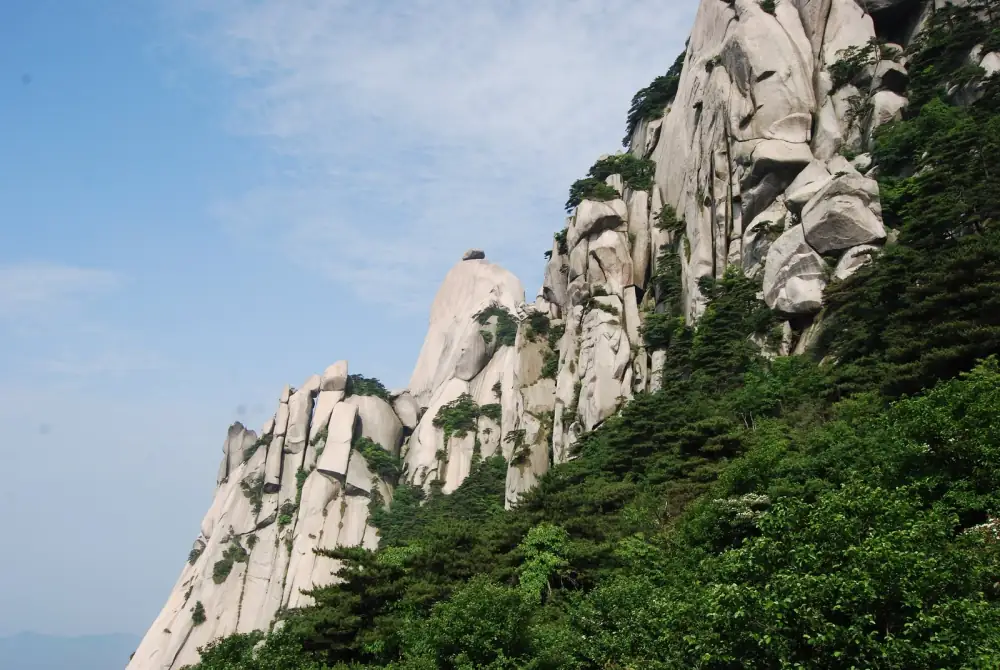
Jiuhuashan rises to 1,342 metres at its highest point (Tiantai Peak, 天台峰). The mountain is dramatic — steep forested ridges with temples clinging to cliff faces and mist frequently rolling through the valleys below.
The main scenic area is accessed from Jiuhuashan Town (九华山镇), a small settlement at about 600 metres elevation that serves as the base. From here, trails and roads lead higher, with cable cars making the upper sections accessible without the full hike.
Entrance fee to the scenic area: ¥190 per person (covers access to most temple areas)
Opening hours: Open year-round; some temples have specific visiting hours (6:00am–6:00pm typical)
Key Temples and Sites
Huacheng Temple (化城寺)
The oldest and most historically important temple on the mountain, dating to the Tang Dynasty (8th century AD). This is where the Korean monk Kim Gyo-gak (金乔觉), believed to be a reincarnation of the Dizang Bodhisattva, meditated for 75 years before his death in 794 AD. The temple complex is large and atmospheric, with a particular intensity during morning prayers (usually 5–6am).
Tiantai Temple (天台寺)
At the summit of Tiantai Peak (1,342 metres), this is the highest temple on the mountain and the goal of many pilgrims. The climb from the cable car station takes about 45 minutes on stone steps — manageable but steep. The cloud sea views from here on clear mornings are extraordinary.
Roushen Temple (肉身宝殿)
Perhaps the most striking site on the mountain. The temple enshrines the preserved body of the Korean monk Kim Gyo-gak, seated in a lotus position inside a gilded stupa. It’s a pilgrimage site of enormous importance — large numbers of monks and lay practitioners come specifically to pray here.
Opening hours: 7:00am–5:30pm
Entry: Included in scenic area ticket
Zhiyuan Temple (祗园寺)
The largest active monastery on the mountain, with around 200 monks in residence. The morning chanting sessions here (starting around 5:30am) are open to visitors who observe quietly — standing at the back of the main hall listening to several hundred monks chanting together is genuinely moving.
The Cable Cars
Two cable car systems serve the upper mountain:
Huacheng Cable Car: Runs from Jiuhuashan Town to mid-mountain, ¥65 up, ¥50 down
Tiantai Cable Car: Runs from mid-mountain up to near the Tiantai peak area, ¥80 up, ¥65 down
Both are standard gondola-style cable cars with good views. On busy days (weekends, public holidays), queues of 30–60 minutes are normal. Arrive early.
Hiking Jiuhuashan
The traditional pilgrimage route follows stone steps up the mountain, passing through multiple temple complexes. The Central Trail from the base to Tiantai Peak is about 8–10km and takes 4–6 hours ascending. This is physically demanding but gives you a much deeper feel for the mountain than the cable cars.
Key hiking sections:
- Base town to Huacheng Temple: 1 hour, moderate
- Huacheng to Mingyue Pool (明月池): 1.5 hours, moderate-steep
- Mingyue Pool to Tiantai Peak: 2–3 hours, steep with stone steps
Bring water (limited shops above mid-mountain), sun protection in summer, and a rain jacket year-round — the mountain generates its own weather.
Staying Overnight on the Mountain
This is the thing most visitors who just do a day trip miss. The overnight experience at Jiuhuashan is markedly different from the daytime tourist flow.
By 5pm, most day-trippers have left. The mountain becomes quieter. In the evening, monks return to their temples for evening prayers. In the morning (4:30–5:30am), you can witness morning chanting at Zhiyuan or other large monasteries. The dawn light on the cloud sea from Tiantai Peak is the image most photographers are here to capture.
Accommodation options:
- Temple guesthouses (香客楼): Some monasteries offer basic accommodation for ¥80–150 per person. Facilities are simple. This is the most atmospheric option.
- Hotels in Jiuhuashan Town: More comfortable, ¥200–600/night depending on season
- Higher-end options: A few resort hotels near the cable car base, ¥500–1,200/night
Booking in advance is essential during Chinese public holidays and summer (July–August).
Combining with Huangshan (Yellow Mountain)
Jiuhuashan and Huangshan are about 60km apart and are the natural pairing for an Anhui trip.
Suggested itinerary:
- Day 1: Arrive Jiuhuashan, afternoon temple visit
- Day 2: Full day on the mountain, overnight stay
- Day 3: Morning prayers and dawn views, then train/bus to Huangshan area
- Day 4–5: Huangshan hiking
Transport connection: Buses run between Jiuhuashan and Tangkou (Huangshan entry town), about 1.5–2 hours. Or go via Chizhou city (the nearest large town to Jiuhuashan) and then train.
Getting to Jiuhuashan
The nearest railway station is Chizhou Station (池州站) on the Hefei-Hangzhou high-speed line.
From Chizhou: Bus to Jiuhuashan scenic area, about 1 hour, ¥25–35. Buses run frequently 7am–6pm.
From Nanjing: High-speed train to Chizhou (about 1 hour, ¥70–100), then bus
From Hangzhou: High-speed train to Chizhou (about 1.5 hours, ¥80–120), then bus
From Shanghai: High-speed to Chizhou via Nanjing (about 2.5–3 hours total), then bus
When to Visit
Spring (April–May): Azaleas bloom across the mountain slopes. Excellent weather, manageable crowds.
Summer (June–September): Busiest season and hot in the valleys, though the summit stays cooler. Peak crowds in July–August.
Autumn (October–November): Best conditions — clear skies, foliage colours, cooler temperatures. Fewer crowds than summer.
Winter (December–February): Snow on the mountain is beautiful; significantly reduced crowds. Some facilities close. Bring warm clothing — the summit is cold.
Practical Notes
- Dress respectfully inside temples (covered shoulders and knees)
- Photography is permitted in most areas but not inside the main shrine halls during prayer times
- The incense smoke in the temple courtyards can be heavy — this is not a place for people with respiratory issues
- The mountain involves a lot of steps — comfortable shoes with good grip are essential
- Bring small denomination cash for donations, incense, and smaller food stalls