
Table of contents
Open Table of contents
- Understanding Jinggangshan: History and Landscape Combined
- Key Historical Sites
- Best Hiking Trails
- When to Visit Jinggangshan
- Getting to Jinggangshan
- Admission Prices and Passes
- Where to Stay
- Food and Dining in Jinggangshan
- Red Tourism: A Note for International Visitors
- Practical Tips
- Combining Jinggangshan with Other Destinations
Understanding Jinggangshan: History and Landscape Combined
There are places in China where history and landscape are so thoroughly intertwined that separating them feels wrong. Jinggangshan — or Jinggang Mountain — is one of those places. Situated on the border of Jiangxi and Hunan provinces, this mountain range became the cradle of the Chinese Communist revolution’s rural strategy when Mao Zedong and Zhu De established the first rural revolutionary base here in 1927.
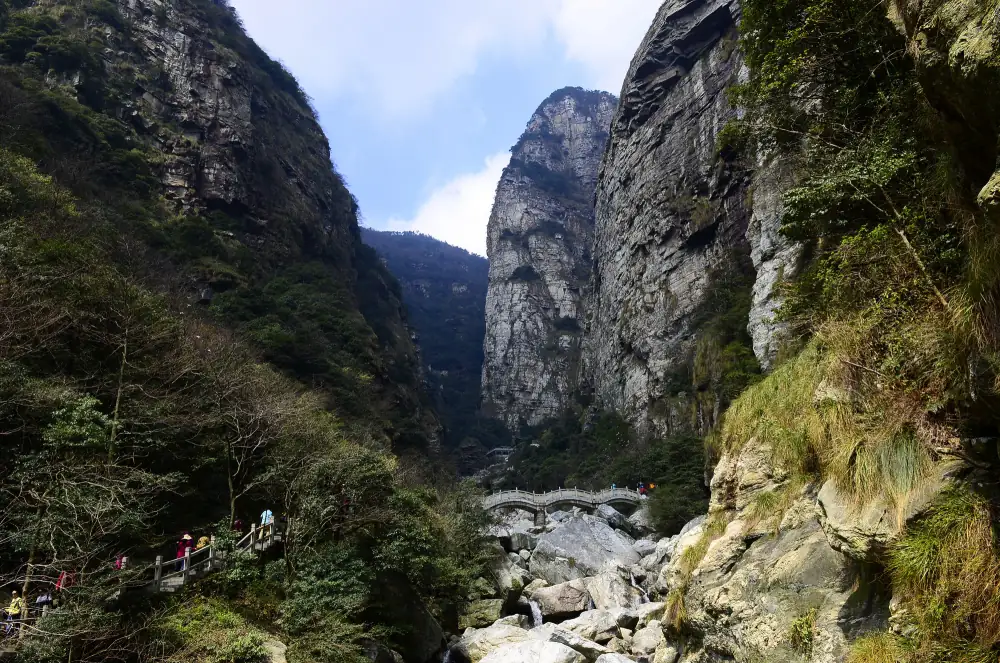
What many visitors don’t expect is how genuinely beautiful the mountains are. Forested ridges draped in cloud, waterfalls tumbling through bamboo groves, narrow paths worn smooth by decades of foot traffic — Jinggangshan is not simply a political pilgrimage destination. It’s a mountain retreat of real quality, and its relative distance from the major tourist circuits means it retains a certain authenticity that more famous Chinese mountains have lost.
In 2026, the site receives approximately 10 million visitors annually, primarily from domestic tourists on organised “red tourism” (红色旅游) trips. Foreign independent travellers remain relatively rare, which gives the destination a slightly different energy than, say, Zhangjiajie or Huangshan.
Key Historical Sites
Ciping Town: The Revolutionary Headquarters
The main settlement, Ciping (茨坪), serves as the base for most visitors. The town retains its function as a living community rather than a purely tourist construct, though the commercial strip around the central square is increasingly geared toward visitors.
Revolutionary Museum of Jinggangshan (井冈山革命博物馆) The anchor of the historical experience, this modern museum traces the establishment of the Jinggangshan base area from 1927 to 1930. Well-curated with English labels on the main exhibits, the collection includes original documents, weapons, and personal effects. The exhibition doesn’t flinch from discussing the hardships and failures of the period alongside the successes. Allow 2–3 hours. Entry: ¥60, or free with the Jinggangshan Scenic Area combined ticket.
Former Revolutionary Headquarters Site (红四军司令部旧址) A modest collection of traditional Jiangxi wood-frame buildings where the Fourth Army was headquartered. The preserved interiors give a genuine sense of the spartan conditions of the period. Entry included with scenic area ticket.
Mao Zedong Former Residence (毛泽东旧居) Several residences scattered around the mountain area are marked as places where Mao lived and worked during the base period. The Ciping residence is the most visited. Entry included with scenic area ticket.
The Eight Major Sites (八大景区)
The scenic area is formally organised into eight sub-areas covering both historical and natural attractions:
- Huangyangjie (黄洋界) — A famous mountain pass and battle site, now with a memorial pavilion and cannon. The views over the forested ridges are exceptional.
- Ciping Revolutionary Memorial Area — The main historical cluster including the museum and several former residences
- Wuzhifeng (五指峰) — The “Five Finger Peak” ridge, one of the most photographed natural features
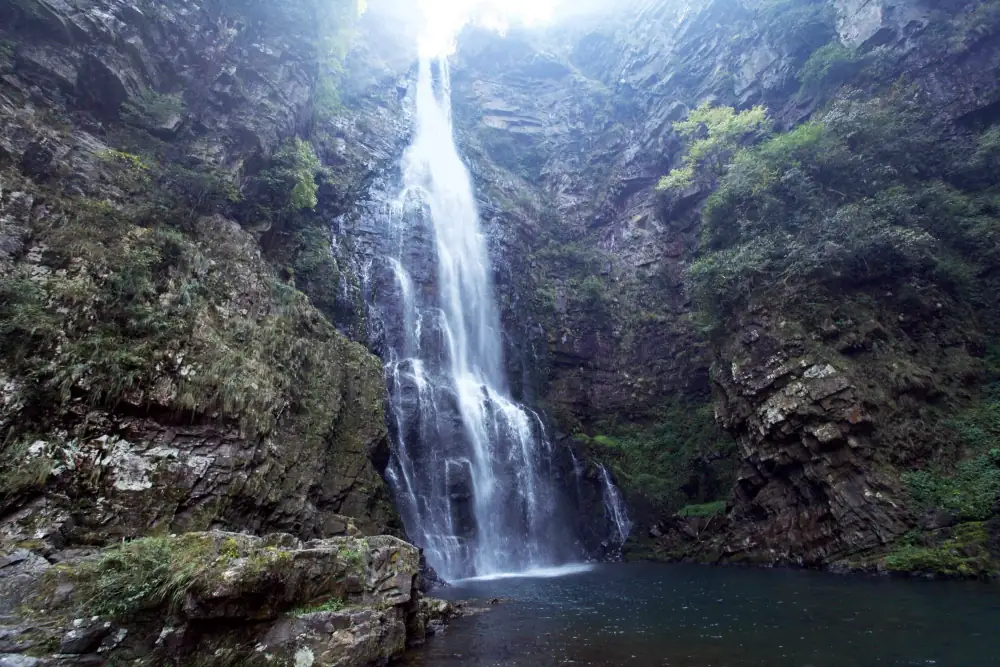
- Longtan (龙潭) — A series of waterfalls and pools, the most dramatic natural scenery on the mountain
- Xiankou (仙口) — A quieter forested area with several scenic trails
- Shapingling (沙坪岭) — Accessible rhododendron forest, spectacular in April
- Bijia Mountain (笔架山) — Ridgeline hiking with panoramic views
- Xiaojishan (小井山) — Includes the site of the Red Army hospital and war graves
Best Hiking Trails
Longtan Waterfall Trail (龙潭瀑布径) — Easy to Moderate
The most popular natural trail, following a stream through forest past five named waterfalls. The main waterfall at the end drops about 60 metres. The path is well-maintained and takes about 2 hours return. Best visited in spring and early summer when water levels are high after rainfall.
Huangyangjie Ridge Walk — Moderate
The trail from Ciping up to Huangyangjie covers about 8km with an elevation gain of 600m. The upper sections offer extraordinary views in clear weather, though clouds frequently obscure the ridges (locals say this adds to the mystique rather than detracting from it). Allow 4–5 hours return.
Wuzhifeng Circuit — Moderate to Difficult
A longer loop around the Five Finger Peak ridge. Total distance around 15km with significant elevation change. This trail is less crowded than the main sites and rewards those willing to work for it. Go early and bring sufficient water. Allow a full day.
Forest Trails around Ciping — Easy
Several well-marked short nature walks exist within 3km of Ciping town, suitable for those who want fresh air and forest views without serious hiking. Good for morning walks before the main sites get crowded.
When to Visit Jinggangshan
Spring (March–May): Best Season
Rhododendrons bloom across the mountainsides from mid-March, peaking in April. The famous Shapingling area turns vivid red and pink. Temperatures are mild (12–20°C), trails are accessible, and mist in the valleys creates the classic Chinese mountain landscape aesthetic.
Summer (June–August): Busy and Hot
Summer school holidays bring peak domestic tourist crowds, particularly July and August. The mountain is cooler than the surrounding plains (average 22–28°C at elevation) making it a popular summer retreat. Book accommodation 2–4 weeks ahead for July weekends.
Autumn (September–November): Excellent
Foliage colours arrive from late October, with the bamboo-and-broadleaf forests turning gold and amber. Crowds thin after the October Golden Week. October and early November offer perhaps the best combination of good weather, manageable crowds, and beautiful scenery.
Winter (December–February): Quiet and Cold
Occasional snowfall transforms the mountain and creates beautiful scenes, but trails can be slippery and some facilities reduce hours. The few visitors who come in winter have a peaceful, contemplative experience. Temperatures can drop below 0°C at night.
Getting to Jinggangshan
By High-Speed Train
The most convenient option. Jinggangshan Station (井冈山站) is served by high-speed trains from several major cities:
- From Nanchang: About 1 hour 20 minutes, ¥115–160
- From Changsha: About 1.5 hours, ¥120–165
- From Guangzhou: Approximately 4 hours (via Ganzhou), ¥300+
- From Beijing West: Around 7 hours by G-train, ¥500+
The station is located in Jian City (吉安市), about 50km from Ciping. Shuttle buses and taxis connect the station to the scenic area.
By Bus
Buses from Jian City (吉安) to Ciping run regularly throughout the day, taking about 1.5 hours. Ticket price approximately ¥30–40.
Getting Around the Mountain
Within the scenic area, tourist buses run circuits connecting the eight sub-areas. A day pass for these buses costs ¥45. Taxis are also available. Private vehicles are restricted in much of the scenic area.
Admission Prices and Passes
Jinggangshan Scenic Area Comprehensive Ticket: ¥160 Covers entry to all eight scenic sub-areas and includes transport within the area. Valid for two consecutive days.
Revolutionary Museum (additional): ¥60 (or included in some package deals)
Ropeway/Cable Car: ¥80–100 one-way at various locations
Note on free access: The Chinese government has a policy of free entry to patriotic education bases for certain groups. Chinese citizens (students, veterans, etc.) often receive free or discounted entry. Foreign visitors pay standard prices.
Where to Stay
In Ciping Town
Most accommodation is concentrated in Ciping, within walking distance of the main historical sites.
Budget: Guesthouses (农家乐) scattered throughout and around Ciping offer basic but clean rooms from ¥80–150 per night. Breakfast is often included.
Mid-range: Chain hotels including Jinjiang Inn and several local hotels in the ¥200–400 range. The Jinggangshan Hotel (井冈山大厦) is a reliable mid-range choice with good central positioning.
Comfortable: Several 4-star options have opened in recent years, particularly targeted at the organised tour market. Prices ¥400–700 per night.
Food and Dining in Jinggangshan
The local cuisine reflects Jiangxi’s love of preserved foods, dried vegetables, and chilli. The mountain conditions historically demanded food that could be stored and transported.
Red Rice (红米饭): A local staple associated with the revolutionary period, made from a reddish variety of rice. Often served alongside preserved vegetables and bean curd in set meals.
Bamboo Shoot Dishes (笋菜): Fresh bamboo shoots in season, dried bamboo shoots year-round. Stir-fried, braised, and in soups.
Smoked Meat (腊肉): Jiangxi-style smoked pork, cured over pine and bamboo smoke. Rich and aromatic.
Wild Mushroom Hotpot: Mountain mushrooms foraged from the forests, served in a light broth. Available in autumn particularly.
Many restaurants in Ciping serve “revolutionary meals” (红军餐), themed around the simple food of the base period. The food is genuine country cooking rather than tourist-trap theatre, and usually good value: a full meal per person ¥50–80.
Red Tourism: A Note for International Visitors
Jinggangshan sits at the centre of China’s “red tourism” network — a government-supported industry connecting sites associated with the Communist Party’s history. For international visitors unfamiliar with this context, a few things are worth understanding.
The experience is deeply meaningful for the millions of Chinese visitors, particularly older generations and Communist Party members on official educational visits. The mountain is not simply a museum — it has genuine emotional resonance for much of the population.
As a foreign visitor, approach with curiosity rather than judgment. The historical events of 1927–1930 were genuinely significant in shaping modern China, and understanding them — even if your interpretation differs from the official narrative — adds depth to any trip to China.
The museum is professionally run and the information, while presented from a specific perspective, is historically substantive. Ask questions, observe how Chinese visitors engage with the sites, and you’ll come away with insights that no amount of book-reading can provide.
Practical Tips
- Photography: Generally unrestricted at natural sites. Some indoor sites request no photography or limit it.
- Crowds on national holidays: Absolutely packed on National Day (October 1–7) and other major holidays. Avoid these dates unless you enjoy extreme crowds.
- Guided tours: Numerous English-speaking guides are available in Ciping, and a half-day guided historical tour significantly enriches the experience. Budget ¥300–500 for a private guide.
- Weather preparation: Mountain weather changes rapidly. Bring a light rain jacket regardless of season.
- Altitude: The highest peaks reach around 1800m. Not high enough to cause altitude issues, but dress accordingly for cooler temperatures at the summit areas.
Combining Jinggangshan with Other Destinations
Jinggangshan works well as part of a broader Jiangxi itinerary:
- Nanchang (2.5 hours by train): Jiangxi’s capital has several revolutionary sites and the Tengwang Pavilion
- Jingdezhen (3–4 hours): The porcelain capital makes for a wonderful contrast — from communist history to ceramic artistry
- Lushan (3 hours): The classical Chinese mountain resort, beloved by Mao and a stunning natural landscape in its own right
- Wuyuan (2.5 hours): The “most beautiful village in China,” famous for rapeseed fields and Huizhou architecture
A week exploring Jiangxi combining these destinations gives a remarkably rounded picture of one of China’s most culturally and historically rich provinces.